
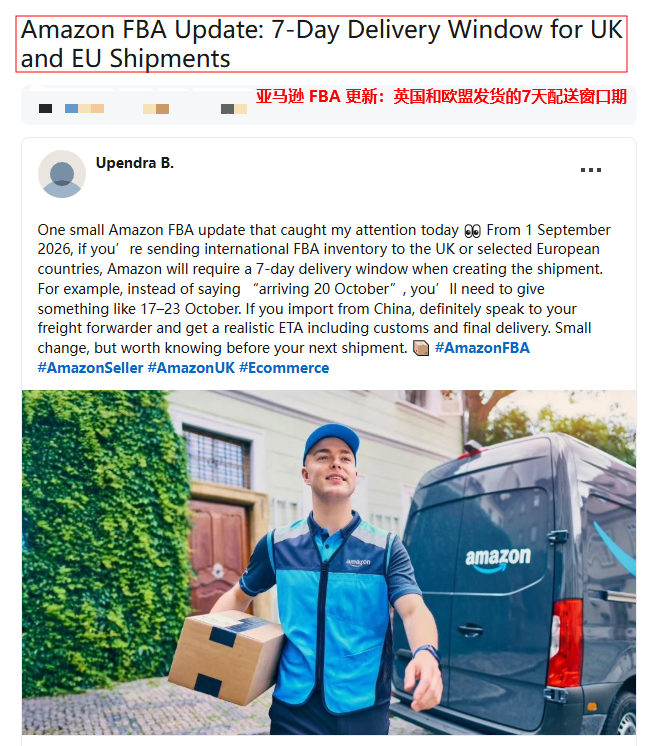
From September 1, 2026, a "big test" of timeliness will officially kick off at Amazon's five major European sites — the UK, Germany, France, Italy, and Spain.
Amazon officially announced that it will enforce a 7-day delivery window policy for international FBA shipments using non-Amazon-partnered carriers. This marks the end of the 14-day loose buffer period previously enjoyed by cross-border shipments, and the logistics rules for European sites have been abruptly aligned with the same standard as domestic shipments.
For many sellers relying on third-party self-fulfillment or first-mile logistics service providers, this is not just a simple change in the date filled in the backend, but a refined survival challenge involving the entire supply chain.

Image source: linkedin
Window Tightening: From Rough Estimates to Precise Hits
The core change of this new policy is to forcibly compress the expected delivery range of cross-border shipments to within 7 days of one calendar week.
Under the old system, cross-border transportation enjoyed a relatively generous 14-day flexibility window because it involved customs clearance, long-distance shipping, and multi-country transit. This, to some extent, treated the uncontrollability of cross-border logistics as a norm.
However, the introduction of the new rules has completely broken this inertial thinking: with domestic and cross-border rules now aligned, Amazon no longer pays for or provides extra tolerance for delays or early arrivals in cross-border transportation.

Image source: Google
When sellers create shipments in "Send to Amazon", they must manually finalize this crucial 7-day window. This seemingly simple action actually forcibly binds three originally separate uncertain links — shipping date, customs clearance date, and warehouse arrival date — into an extremely narrow tolerance range.
The previous rough shipping logic based on experience estimation has become invalid, replaced by an almost stringent precision calculation capability. If a shipment arrives earlier than the window period, the warehouse is likely to reject it directly because there is no reserved appointment slot, causing vehicle queues and soaring warehousing costs.
If it arrives later than the window period, the priority for warehouse entry is directly downgraded, and the shipment must wait for the warehouse to reschedule. In the fast-paced rhythm of peak season, this is no different from giving away the chance of an order surge to others.
Seller Ecosystem Shock: Who Is Swimming Naked, and Who Is Upgrading Equipment?
The first to bear the brunt of this policy are a large number of small and medium-sized sellers and wide-assortment sellers who use non-Amazon-partnered carriers.
In the past, they might have tolerated occasional delays in customs clearance or minor changes in shipping schedules by relying on a loose grasp of the 14-day window. Today, the hard 7-day requirement makes the accuracy of delivery estimates no longer empty talk. The freight forwarder's historical on-time rate, the stability of specific shipping routes, and even the work efficiency of the customs broker at the destination port will all become key variables determining whether shipments can be completed on time.

Image source: Google
This forces sellers to re-examine and upgrade their supply chain management systems. On one hand, the cooperation relationship with freight forwarders needs to shift from pure price orientation to delivery-commitment orientation. Logistics providers that cannot provide on-time rate data support or lack contingency plans for delays will be gradually eliminated.
On the other hand, sellers' inventory planning strategies must become more aggressive. Dispersed shipping, backup logistics channels, and pre-stocking goods at overseas warehouses for transit buffering may become standard measures for risk avoidance.
For the operations side, this means a longer capital lock-up cycle and a sharp increase in inventory turnover pressure. Refined operations are no longer just a slogan, but real financial gains and losses on the books.
Conclusion
The effectiveness of Amazon's new 7-day delivery window rule marks the official end of the extensive-growth dividend period in European cross-border e-commerce.
It tests not only the stickiness of relationships with logistics providers, but also the overall supply chain collaboration capability, data-driven forecasting level, and capital chain resilience of enterprises.
In the future, sellers who can turn the 7-day window period into their own competitive advantage will be the first to break through in this efficiency revolution, and the entire industry will evolve toward a more professional, efficient, and transparent direction driven by such external rules.
What this signal means for growth teams
This market signal should be treated as an operating prompt, not a standalone trend. The brand question is whether the team can connect TikTok content, creators, paid media, commerce readiness, and reporting into one measurable growth cycle.
Commercial read
- Market signal: TikTok Marketing Information and Solutions
- Published: September 1, 2026
- Commercial lens: TikTok Ads, creators, TikTok Shop, live commerce, and reporting.
- Source transparency: the original source linked in this article
What brands should do next
- Identify the market, audience, product group, and KPI this signal could affect.
- Turn the insight into a small TikTok creative, creator, Shop, or paid media test before scaling spend.
- Add FAQ, offer clarity, product proof, and contact paths so traffic can convert instead of only reading.
- Review weekly performance across reach, click quality, Shop actions, creator output, and revenue impact.
Tuke Marketing helps brands connect TikTok Ads, creator partnerships, TikTok Shop operations, live commerce, and reporting into one accountable operating system.
What should brands do with this TikTok signal?
Brands should translate the signal into a focused operating test across creative, creators, TikTok Shop readiness, paid media, and reporting before increasing budget.
How does Tuke Marketing evaluate this kind of news?
Tuke Marketing reviews platform news through market timing, category demand, creator supply, commerce readiness, and measurable growth actions.
When should a team contact Tuke about this topic?
A team should contact Tuke when it needs to turn a TikTok market signal into a practical launch, creator, advertising, live commerce, or reporting plan.
Source transparency: Tuke cites the original source linked in this article and adds its own operating analysis for brands evaluating TikTok growth decisions.