
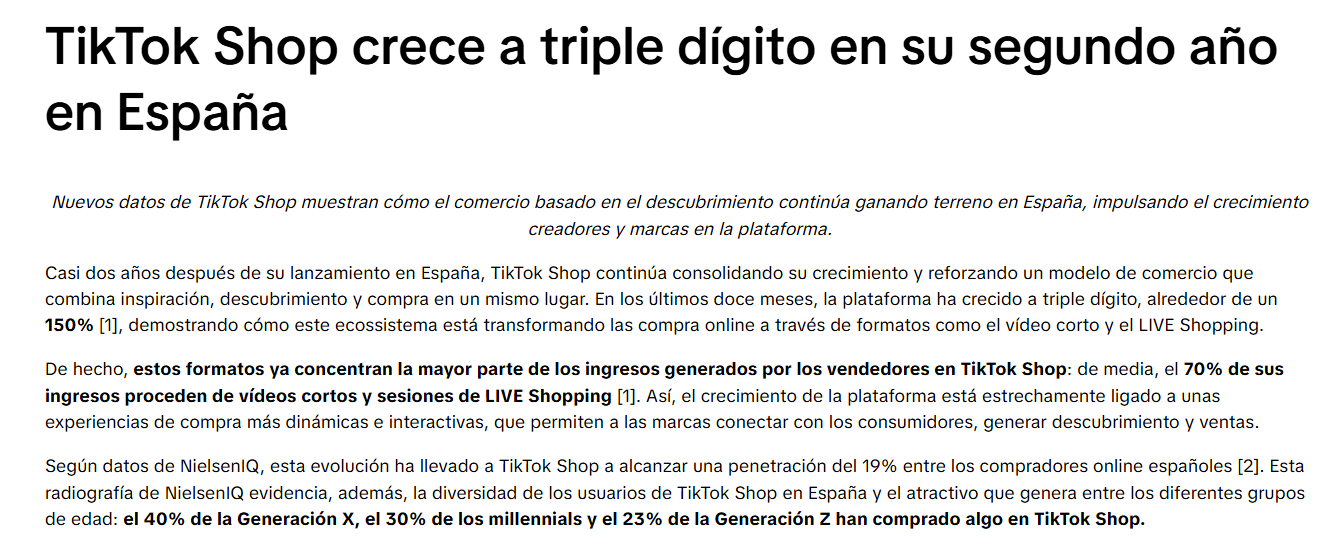
Less than two years after TikTok Shop launched in Spain, the report card it has delivered is a bit beyond expectations. Over the past 12 months, the platform’s business scale in Spain grew by about 150%, with a penetration rate of 19%. In other words, nearly one out of every five Spanish online shoppers has already completed an order on TikTok Shop.
This pace is not slow when viewed in the European market. Spain’s overall social commerce market has been growing all along, with a scale of about 8.2 billion euros in 2025 and expected to surge to 11.5 billion euros in 2026, a growth rate of nearly 40%. TikTok Shop is riding this rhythm, going with the flow, but its growth rate is indeed running somewhat faster.

Image source: TikTok
Buyers aren't just young people.
Many people’s default impression of TikTok Shop is “Gen Z’s shopping cart.” In Spain, that impression is only half right.
According to data from IAB Spain, the Interactive Advertising Bureau, TikTok Shop’s penetration among Gen Z (18–30) is indeed very high, reaching 61%, and 56% of Gen Z admit that social networks influence their purchasing decisions. But the truly interesting data comes from NielsenIQ: 40% of Gen X consumers (45–60) have already bought things on TikTok Shop, a proportion even higher than Millennials’ 30% and Gen Z’s 23%.
The fact that middle-aged people are spending money on short-video platforms itself illustrates a shift: TikTok Shop in Spain has already moved beyond its “young people only” label. The barrier to content consumption is low enough that a Spaniard in their 40s can come across a real-life video of a small kitchen appliance, find it useful, and place an order on the spot, with no extra learning cost.

Image source: IAB Spain
The key is not having to leave the App.
Between user attention and actual sales lies a conversion rate problem. What TikTok Shop got right in Spain is that it removed this step.
Early social media selling followed a model of content exposure plus external redirects. When users saw something they were interested in, they clicked a link, jumped to a browser, and then entered their address to pay—every step caused drop-off. TikTok Shop integrates product showcases, creator selling, livestream pitches, and checkout and payment entirely within the app. When users scroll to a product they are interested in, they can complete the purchase without leaving the current page.
The effect of this closed loop is directly reflected in sellers' revenue structure. Currently, about 70% of the average revenue of TikTok Shop Spain sellers comes from short videos and livestream content. Over the past year, the number of livestream sessions has increased by 120%, and livestreaming has become the fastest-growing sales channel.
Why does livestreaming work? Because clothes need to be seen on the body, color cosmetics need shade swatches, and small home appliances need to be seen in real-world use—this information is hard to explain clearly through image-and-text detail pages. Short videos and livestreaming fill exactly the gap left by traditional product pages. Beauty and personal care, fashion apparel, and home and daily goods naturally became the top categories by transaction volume on the Spain site, together accounting for about 68% of the platform’s GMV.

Image source: Internet
Influencer distribution has become the starting block for small and medium-sized sellers.
The seller structure on the platform is also worth a look. As of April 2026, TikTok Shop had more than 21,000 local sellers in Spain. According to data disclosed by TikTok Shop, the statistics cover the platform’s operations from November 2025 to April 2026, showing that more and more merchants are entering this market.
According to Lengow data, among top sellers on the Spanish site, as much as 87% of sales come from influencer content and affiliate distribution—the highest proportion among all European sites.
What does this mean? For small and medium-sized merchants without brand awareness, it is very difficult to start livestreaming themselves from a cold start, but partnering with local influencers is a more realistic path. Influencers use their own fan base and content style to showcase products, and merchants pay commission based on completed transactions, so the risks for both sides are relatively controllable. Spanish local brands such as Moulinex and Tefal have already joined the platform, but affiliate creators contribute up to 80% of some sellers' sales. Big brands build their own content teams to do regular livestreaming, while small and medium-sized merchants start by leveraging influencer distribution; both paths are being pursued.

Image source: Google
High growth does not mean opportunities everywhere. Spanish consumers have a very low tolerance for hard-sell advertising, a preference difference similar to that in the German and French markets, but Spanish users are more sensitive to price fluctuations and more directly averse to being “pitched to.”
For sellers who want to enter the Spanish market, the product itself needs room for visual display, and the content needs to have a sense of “authenticity”; these two things matter more than a low-price strategy. TikTok Shop Spain is moving from traffic aggregation toward commercial implementation. In this process, products suited to content expression and operating methods that respect local content habits will do more to determine whether a seller can gain a firm foothold than ad spend alone.
What this signal means for growth teams
This market signal should be treated as an operating prompt, not a standalone trend. The brand question is whether the team can connect TikTok content, creators, paid media, commerce readiness, and reporting into one measurable growth cycle.
Commercial read
- Market signal: TikTok Marketing Information and Solutions
- Published: October 12, 2026
- Commercial lens: TikTok Ads, creators, TikTok Shop, live commerce, and reporting.
- Source transparency: the original source linked in this article
What brands should do next
- Identify the market, audience, product group, and KPI this signal could affect.
- Turn the insight into a small TikTok creative, creator, Shop, or paid media test before scaling spend.
- Add FAQ, offer clarity, product proof, and contact paths so traffic can convert instead of only reading.
- Review weekly performance across reach, click quality, Shop actions, creator output, and revenue impact.
Tuke Marketing helps brands connect TikTok Ads, creator partnerships, TikTok Shop operations, live commerce, and reporting into one accountable operating system.
What should brands do with this TikTok signal?
Brands should translate the signal into a focused operating test across creative, creators, TikTok Shop readiness, paid media, and reporting before increasing budget.
How does Tuke Marketing evaluate this kind of news?
Tuke Marketing reviews platform news through market timing, category demand, creator supply, commerce readiness, and measurable growth actions.
When should a team contact Tuke about this topic?
A team should contact Tuke when it needs to turn a TikTok market signal into a practical launch, creator, advertising, live commerce, or reporting plan.
Source transparency: Tuke cites the original source linked in this article and adds its own operating analysis for brands evaluating TikTok growth decisions.