
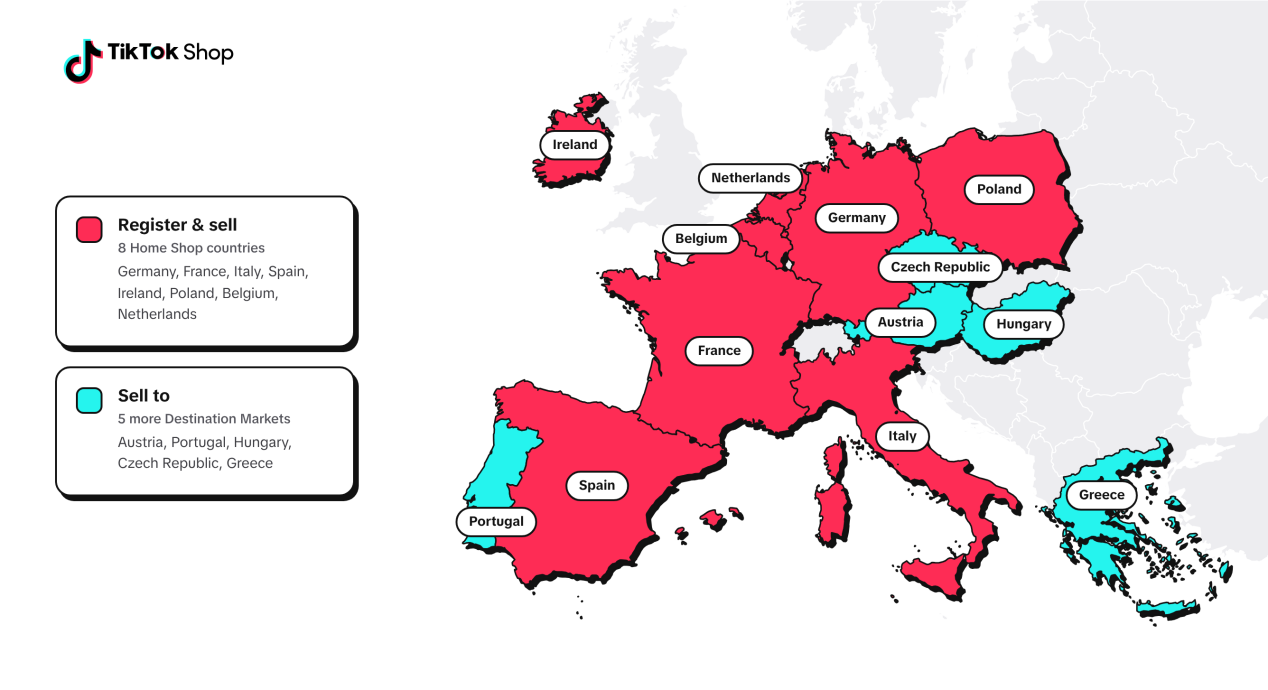
It is reported that TikTok Shop plans to launch a new feature called Sell Across EU on October 19, opening up a cross-border sales channel between the UK and the EU market for the first time.
At that time, UK merchants will be able to ship to 12 EU countries: Germany, France, Italy, Spain, Poland, Netherlands, Belgium, Czech Republic, Austria, Greece, Portugal, and Hungary; sellers in these EU markets can also sell to UK consumers in reverse.

Image source: seller-ie.tiktok
Currently, this feature launched a targeted pilot in late September. The system will automatically assess seller eligibility based on four conditions: store activity, account health status, sales records in the past 30 days, and account balance, with no separate application required.
UK-EU mutual selling opens up, seller market boundaries suddenly broaden
For UK and EU sellers long constrained to a single market, the most direct value of this adjustment lies in the leap in market space. In the past, if UK sellers wanted to reach EU consumers, they often needed to separately set up overseas warehouses, register local tax numbers, or rely on third-party logistics, which was a fairly high barrier.
After Sell Across EU launches, eligible UK sellers can simply rely on their existing stores to display products simultaneously to users in 12 EU countries. Conversely, EU sellers can also enter the UK market more smoothly. This two-way interconnection essentially pieces the previously fragmented UK-EU e-commerce landscape into a larger chessboard.

Image source: seller-ie.tiktok
From a traffic logic perspective, TikTok Shop's recommendation mechanism is naturally suited to cross-border product distribution. As long as the content is localized enough and the products match the needs of the target country, sellers have the opportunity to gain exposure in multiple countries at the same time.
This means that small and medium-sized sellers no longer need to first succeed in one country before considering expansion; instead, they can select products and create content with a multi-country perspective from the very beginning.
Eligibility is automatically assessed, shifting operational focus to health and activity
It is worth noting that this feature is not application-based, but automatically assessed by the system. The assessment dimensions include store activity, account health status, sales records in the past 30 days, and account balance. In other words, sellers do not need to submit additional materials, but the quality of daily operations directly determines whether they can get this cross-border admission ticket.
This sends sellers a clear signal:The platform places more emphasis on sustained, stable, and compliant business performance.
Those sellers who usually focus on store maintenance, maintain good fulfillment records, and healthy cash flow will be more easily identified by the system as qualified candidates. Conversely, if an account has violation records, overly large sales fluctuations, or insufficient balance, even if market opportunities are right in front of them, they may temporarily be unable to participate.
Therefore, sellers need to treat account health as a long-term asset to manage, rather than scrambling only when the feature launches.

Image source: Google
EU-to-UK sales require self-shipping, compliance capability becomes a hidden threshold
In the two-way interconnection, the direction from the EU to the UK has a special requirement.
Sellers must ship by themselves and meet the destination country's VAT and compliance requirements. Therefore, EU sellers cannot completely rely on platform logistics solutions and need to solve cross-border delivery and tax issues themselves.
Conversely, when UK sellers sell to the EU, they also need to pay attention to compliance differences among member states and cannot ignore localization requirements just because the feature is opened up.
How sellers can catch this wave of benefits
Facing the upcoming mutual selling feature, sellers can prepare in advance from several aspects.
First is to check account health, ensure that sales records in the past 30 days are stable and the balance is sufficient, and avoid being blocked by the system due to minor issues.
Next is to sort out the compliance requirements of the target market, especially VAT and product standards; for the EU-to-UK direction, the shipping solution must be determined in advance.
Then comes content localization. Consumers in different countries have different preferences for short-video style, language, and promotional timing, so direct translation may not be effective; differentiated content should be created for key countries.
Finally, there is logistics and after-sales. The timeliness of cross-border orders and the return/exchange experience directly affect store ratings, so sellers should test the shipping chain as early as possible to avoid being caught off guard after launch.

Image source: Google
Conclusion
The launch of Sell Across EU marks the transition of UK-EU e-commerce from operating separately to two-way interconnection. For sellers, this is an opportunity to expand the market and also a test of operational capability.
After October 19, whoever can adapt to cross-border rules faster and complete localization preparations earlier will have the chance to seize the initiative on this larger chessboard.
Cross-border business has never been simply about selling to a few more countries; it is about using compliance, logistics, and content capabilities to truly turn opportunities into orders.
What this signal means for growth teams
This market signal should be treated as an operating prompt, not a standalone trend. The brand question is whether the team can connect TikTok content, creators, paid media, commerce readiness, and reporting into one measurable growth cycle.
Commercial read
- Market signal: TikTok Marketing Information and Solutions
- Published: October 13, 2026
- Commercial lens: TikTok Ads, creators, TikTok Shop, live commerce, and reporting.
- Source transparency: the original source linked in this article
What brands should do next
- Identify the market, audience, product group, and KPI this signal could affect.
- Turn the insight into a small TikTok creative, creator, Shop, or paid media test before scaling spend.
- Add FAQ, offer clarity, product proof, and contact paths so traffic can convert instead of only reading.
- Review weekly performance across reach, click quality, Shop actions, creator output, and revenue impact.
Tuke Marketing helps brands connect TikTok Ads, creator partnerships, TikTok Shop operations, live commerce, and reporting into one accountable operating system.
What should brands do with this TikTok signal?
Brands should translate the signal into a focused operating test across creative, creators, TikTok Shop readiness, paid media, and reporting before increasing budget.
How does Tuke Marketing evaluate this kind of news?
Tuke Marketing reviews platform news through market timing, category demand, creator supply, commerce readiness, and measurable growth actions.
When should a team contact Tuke about this topic?
A team should contact Tuke when it needs to turn a TikTok market signal into a practical launch, creator, advertising, live commerce, or reporting plan.
Source transparency: Tuke cites the original source linked in this article and adds its own operating analysis for brands evaluating TikTok growth decisions.