
Recently, a major event occurred in the Dutch e-commerce market—Omoda Brands has acquired Wehkamp.
This is no small deal. The Netherlands Authority for Consumers and Markets (ACM) has just approved the transaction, and the merger is officially complete. After the merger, Omoda Brands now holds four brands: Omoda, Assem, Wehkamp, and Kleertjes.com, with a combined annual revenue of approximately €600 million.

Source: retaildetail
Some may not be familiar with these names, so a brief introduction follows.
Omoda is a family business that traces its roots back to 1875. It currently operates 42 physical stores in the Netherlands and Belgium. It specializes in premium retail and has built a strong reputation in the fashion sector. Over the past seven years, the company has completed 11 acquisitions, maintaining a steady pace of expansion.
Wehkamp took a different path. Founded in 1952, it started as a mail-order business and later transformed into a comprehensive e-commerce platform. Its categories span clothing, mother and baby, home, gardening, sports, electronics, and more, cultivating a loyal base of long-time users in the Netherlands. Notably, Wehkamp had been under the ownership of British private equity firm Apax Partners for nearly a decade (since 2015). After this transaction, it has finally returned to being a Dutch local brand.
One excels in offline premium retail, the other in online comprehensive platforms—their businesses are indeed highly complementary.

Source: Internet
So why merge precisely now?
Ultimately, it was driven by external pressure.
The Dutch e-commerce market has been growing steadily. Data shows that the market size is approximately $40.23 billion in 2026 and is expected to reach $58.22 billion by 2031. While the pie is indeed growing, so is the number of people vying for a slice.
The first to charge in was Amazon. In 2014, Amazon entered the Netherlands through books, launched Prime membership in 2017, and officially opened its marketplace to global sellers in March 2020. Recently, Amazon announced it would invest over €1.4 billion in the Netherlands over the next three years, covering both e-commerce and cloud businesses. British retailer Marks & Spencer also joined Amazon Netherlands, offering next-day delivery for Prime members. The investment speaks for itself—it's clear Amazon is serious about the Dutch market.

Source: Mordor Intelligence
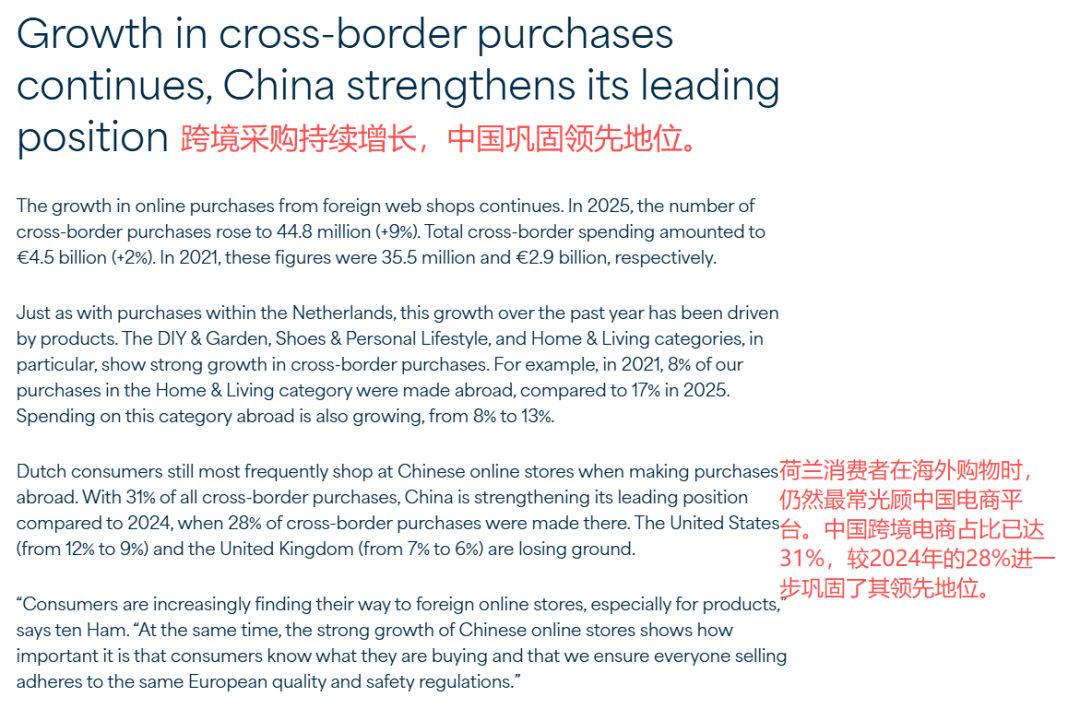
On the other side, the momentum of Chinese cross-border e-commerce platforms in the Netherlands cannot be ignored. By 2024, China surpassed other countries and regions for the first time to become the most preferred cross-border online shopping destination for Dutch consumers, accounting for 28% of orders and totaling €434 million in spending. By 2025, this proportion further increased to 31%. Apparel, DIY tools, gardening supplies—Chinese e-commerce's flexible strategies in categories and pricing have indeed opened up significant opportunities in the Dutch market.
On one hand, Amazon overwhelms with capital and technology; on the other, Chinese e-commerce penetrates with pricing and categories. If Dutch local players don't take action, their market share will only shrink further.

Source: betaalvereniging
The co-CEO of Omoda Brands put it bluntly—this deal is about 'building a Dutch answer to international platforms.' The essence of this transaction is to integrate Omoda's years of premium retail expertise with Wehkamp's scale advantages in logistics fulfillment and technology infrastructure, seeking an optimal balance between consumer experience and operational efficiency. The ultimate goal is to use localized brand recognition and omnichannel consumer scenarios to build a competitive barrier strong enough to withstand the impact of international platforms.
For cross-border sellers, the signal from this event is quite clear.
The Dutch e-commerce market is shifting from a phase where 'anyone can come and get a piece of the pie' to a phase where 'local players are banding together to build walls.' Past strategies relying solely on traffic acquisition and price advantages are likely to become increasingly difficult in the Netherlands. After the integration of local giants, traffic gateways, consumer mindshare, and fulfillment efficiency are all changing. If sellers want to gain a foothold in this market, they may need to seriously consider how to deploy multi-channel strategies, how to localize, and how to improve fulfillment capabilities.
The Dutch e-commerce game is entering a new phase.
What this signal means for growth teams
This market signal should be treated as an operating prompt, not a standalone trend. The brand question is whether the team can connect TikTok content, creators, paid media, commerce readiness, and reporting into one measurable growth cycle.
Commercial read
- Market signal: TikTok Marketing Information and Solutions
- Published: July 23, 2026
- Commercial lens: TikTok Ads, creators, TikTok Shop, live commerce, and reporting.
- Source transparency: the original source linked in this article
What brands should do next
- Identify the market, audience, product group, and KPI this signal could affect.
- Turn the insight into a small TikTok creative, creator, Shop, or paid media test before scaling spend.
- Add FAQ, offer clarity, product proof, and contact paths so traffic can convert instead of only reading.
- Review weekly performance across reach, click quality, Shop actions, creator output, and revenue impact.
Tuke Marketing helps brands connect TikTok Ads, creator partnerships, TikTok Shop operations, live commerce, and reporting into one accountable operating system.
What should brands do with this TikTok signal?
Brands should translate the signal into a focused operating test across creative, creators, TikTok Shop readiness, paid media, and reporting before increasing budget.
How does Tuke Marketing evaluate this kind of news?
Tuke Marketing reviews platform news through market timing, category demand, creator supply, commerce readiness, and measurable growth actions.
When should a team contact Tuke about this topic?
A team should contact Tuke when it needs to turn a TikTok market signal into a practical launch, creator, advertising, live commerce, or reporting plan.
Source transparency: Tuke cites the original source linked in this article and adds its own operating analysis for brands evaluating TikTok growth decisions.