
Latin America is really about to change!
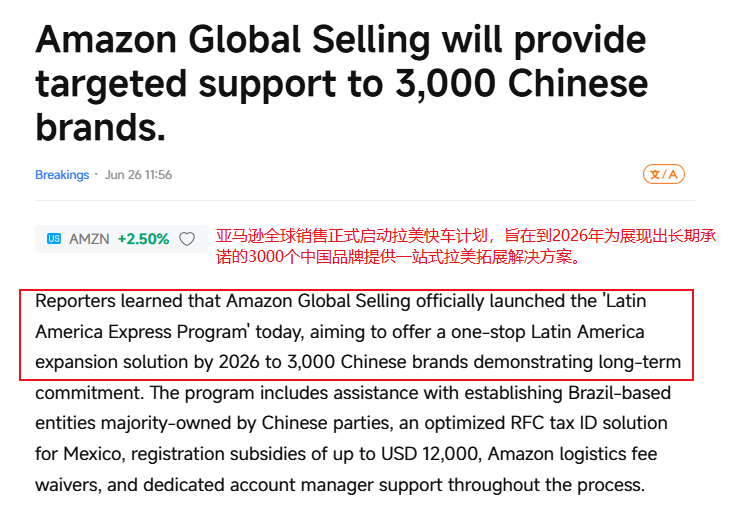
On June 26, 2026, Amazon Global Selling dropped a bombshell by officially launching the Latin America Speedway Program. This is not a simple recruitment pitch, but a highly sincere navigation map to a new continent for Chinese brands.
The initial limit of 3,000 slots, along with subsidies of tens of thousands of dollars, indicates that Amazon is dragging Latin America from a backup option for Chinese sellers to a primary battleground.

Image source: FUTUBULL
From testing the waters to putting down roots
In the past few years, Chinese sellers have had a rather ambivalent attitude toward the Latin American market: on one hand, the irresistible allure of demographic dividends and rapid e-commerce growth; on the other, the "three mountains" of compliance, taxation, and logistics.
The core impact of this Latin American Speed Pass program lies in its precise role as a "wall breaker." In the past, registering a local company in Brazil was a time-consuming and labor-intensive gamble for small and medium-sized sellers. However, the program's maximum $12,000 registration subsidy, combined with assistance in registering a Chinese-controlled local company, has virtually leveled the barrier to compliance.
Similarly, the subsidy of up to 6,000 US dollars accompanying the Mexican RFC tax ID application also greatly reduces the cost of trial and error for sellers in tax compliance.
This sends an extremely strong signal: Amazon is no longer satisfied with sellers merely testing the waters through remote logistics small parcels. By reducing sunk costs with real money, the platform aims to drive sellers to achieve a qualitative change from cross-border delivery to localized compliant operations.
As the impressive data in the materials shows, in Q1 2026, sales from new Chinese sellers on Amazon's Latin American sites doubled year-over-year, while during Mexico's Hot Sale, sales reached four times the amount from the same period last year. When policy benefits meet market boom periods, those pioneers who have taken root have already reaped tangible rewards.

Image source: Google
Covert logistics competition and price comparison advantages redefine Latin American speed.
In the e-commerce world, logistics timeliness directly determines the conversion rate.
Mexico FBA per-unit delivery fee reduced by approximately $1, which may seem small, but for sellers of low-priced, high-volume products, it is a direct booster to profit margins. More importantly, the NARF (North America Remote Fulfillment) delivery time has been optimized to 1-7 days, meaning sellers can leverage their mature US FBA inventory to test the Mexican market with minimal risk.
In Brazil, the NARF delivery time of about 10 days, combined with the cancellation of import tariffs on items under $50 in May this year, has built a highly lethal and cost-effective direct mail channel.
This is an ingenious dual-track design where sellers can first use US warehouses for product testing, leveraging tariff exemptions for a price advantage. Once sales data validates the market, they can seamlessly transition to local company operations, enjoying a deeper moat and higher profit margins, significantly reducing the decision-making risk for brands making heavy investments in Latin America.

Image source: Google
Not only an opportunity, but also a qualifying competition.
The first batch of 3,000 quotas implies scarcity, which requires sellers to have extremely strong compliance awareness and localized operation capabilities.
Although subsidies can cover a considerable portion of initial costs, the real test lies in whether the product truly fits the cultural habits of Latin American consumers, whether the localized listings in Spanish and Portuguese are authentic, and whether after-sales service can keep up with the pace of full-cycle support.
It is recommended that forward-thinking sellers should promptly utilize NARF for low-cost product testing, while simultaneously preparing localized teams or service provider resources, and precisely invest subsidy funds into product certification and brand infrastructure, rather than merely using them to pay off old debts.

Image source: Google
Conclusion
The launch of the Latin America Express Plan coincides with a time when global cross-border trade faces growth anxiety. It has torn open a gap, allowing us to see a vast world that still holds incremental dividends.
For Chinese brands, Latin America is no longer a distant conceptual market, but a new growth space that can be steadily entered and continuously operated.
In today’s cross-border e-commerce, which is increasingly driven by efficiency and depth, only brands that make early arrangements, implement solid localization, and continue to innovate can sail steadily in the new blue ocean and win their own sea area.
What this signal means for growth teams
This market signal should be treated as an operating prompt, not a standalone trend. The brand question is whether the team can connect TikTok content, creators, paid media, commerce readiness, and reporting into one measurable growth cycle.
Commercial read
- Market signal: TikTok Marketing Information and Solutions
- Published: July 4, 2026
- Commercial lens: TikTok Ads, creators, TikTok Shop, live commerce, and reporting.
- Source transparency: the original source linked in this article
What brands should do next
- Identify the market, audience, product group, and KPI this signal could affect.
- Turn the insight into a small TikTok creative, creator, Shop, or paid media test before scaling spend.
- Add FAQ, offer clarity, product proof, and contact paths so traffic can convert instead of only reading.
- Review weekly performance across reach, click quality, Shop actions, creator output, and revenue impact.
Tuke Marketing helps brands connect TikTok Ads, creator partnerships, TikTok Shop operations, live commerce, and reporting into one accountable operating system.
What should brands do with this TikTok signal?
Brands should translate the signal into a focused operating test across creative, creators, TikTok Shop readiness, paid media, and reporting before increasing budget.
How does Tuke Marketing evaluate this kind of news?
Tuke Marketing reviews platform news through market timing, category demand, creator supply, commerce readiness, and measurable growth actions.
When should a team contact Tuke about this topic?
A team should contact Tuke when it needs to turn a TikTok market signal into a practical launch, creator, advertising, live commerce, or reporting plan.
Source transparency: Tuke cites the original source linked in this article and adds its own operating analysis for brands evaluating TikTok growth decisions.