
If you usually use AI-generated model images and digital human explainer videos for Amazon product displays, you may need to spend some time organizing your media library in the next few days.
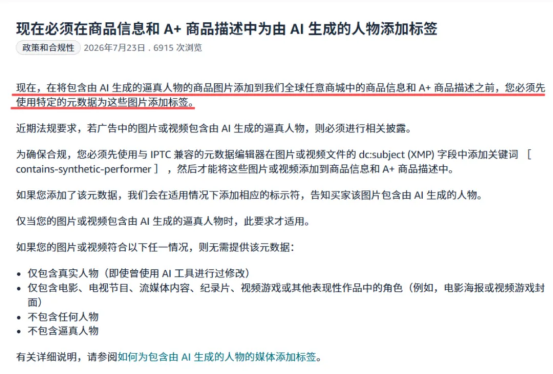
Starting August 15, 2026, Amazon will enforce a new AI content disclosure rule. For any product image or video that contains AI-generated realistic human images — whether it is an AI model showcasing a product, an AI portrait advertisement, or an explainer video featuring a digital human — sellers must first write a specific keyword into the file metadata before uploading.
The background of this new rule begins with several overseas legislative acts this year.

Image source: Amazon
Why was this rule introduced?
2026 is regarded by many as the 'first year of AI compliance' for cross-border e-commerce. On June 9 this year, New York State's Synthetic Performer Disclosure Act officially took effect, requiring that if AI-generated people are used in advertisements, consumers must be clearly informed. Shortly after, the EU's Artificial Intelligence Act also entered its implementation stage on August 2, starting to enforce transparency-related rules.
The core logic behind these laws and regulations is actually straightforward: consumers have the right to know whether the 'person' they see is a real human or AI-generated. If an advertisement features an AI-generated model and consumers mistake it for a real celebrity endorsement, this is considered a lack of transparency at the regulatory level.
As the world's largest e-commerce platform, Amazon naturally has to follow these compliance requirements.

Image source: Google
How exactly will the new rule be enforced?
In fact, as early as this June, after the Synthetic Performer Disclosure Act took effect, Amazon had already added an AI attribute checkbox in its A+ content upload interface, allowing sellers to voluntarily declare whether images contain AI-generated people. At that time, it was voluntary and more of a reminder.
But this time it's different.

Image source: Amazon
Starting from August 15, the compliance requirement has escalated from 'voluntary checkbox' to 'mandatory metadata labeling'. Metadata, simply put, is hidden information carried inside the image file — it cannot be solved by adding a line of 'AI generated' watermark text in the corner of the image. The platform will use automated detection to check whether the specified keyword has been written into the IPTC metadata of the image file.
Specifically, the content that needs to be labeled includes: AI-generated model display images, AI-generated portrait advertisements, AI-generated realistic human explainer videos, video material featuring digital humans, and more. It is worth noting that even if only a part of an AI-generated human body is shown — such as a hand wearing a ring or an arm showing skincare products — it also needs to be labeled.

Image source: Amazon
What situations do not require labeling? Amazon has also made it clear: if the image contains real people (even if retouched with AI tools), characters from movies or games, or images that do not contain any people, there is no need to add this tag.
For A+ content, sellers have two compliance paths to choose from: one is to manually write the keyword with a metadata editor before uploading; the other is to directly check the 'AI-generated people' option when uploading in A+ Content Manager, and Amazon will automatically add the metadata for you. But if it is for non-A+ content such as main images and secondary images, sellers can only manually write the metadata before uploading.

Image source: Internet
It's not just Amazon tightening the rules.
In fact, Amazon is not the only platform tightening the management of AI-generated content. Meta, TikTok, Pinterest, and YouTube have all successively introduced rules related to AI content labeling. TikTok requires AI-generated product promotion videos to be clearly labeled; Meta will automatically add disclosure labels to AI-generated ads; Pinterest will automatically identify and mark images that have been AI-modified.
AI content regulation is moving from 'industry self-discipline' to 'hard compliance', and this trend has become very clear. For sellers, rather than waiting until assets are blocked or links fail to hastily remedy the situation, it is better to review existing assets now, label what needs to be labeled, and replace what needs to be replaced. Continuing to effectively use AI tools to improve efficiency within a compliance framework is a more prudent approach.
What this signal means for growth teams
This market signal should be treated as an operating prompt, not a standalone trend. The brand question is whether the team can connect TikTok content, creators, paid media, commerce readiness, and reporting into one measurable growth cycle.
Commercial read
- Market signal: TikTok Marketing Information and Solutions
- Published: August 18, 2026
- Commercial lens: TikTok Ads, creators, TikTok Shop, live commerce, and reporting.
- Source transparency: the original source linked in this article
What brands should do next
- Identify the market, audience, product group, and KPI this signal could affect.
- Turn the insight into a small TikTok creative, creator, Shop, or paid media test before scaling spend.
- Add FAQ, offer clarity, product proof, and contact paths so traffic can convert instead of only reading.
- Review weekly performance across reach, click quality, Shop actions, creator output, and revenue impact.
Tuke Marketing helps brands connect TikTok Ads, creator partnerships, TikTok Shop operations, live commerce, and reporting into one accountable operating system.
What should brands do with this TikTok signal?
Brands should translate the signal into a focused operating test across creative, creators, TikTok Shop readiness, paid media, and reporting before increasing budget.
How does Tuke Marketing evaluate this kind of news?
Tuke Marketing reviews platform news through market timing, category demand, creator supply, commerce readiness, and measurable growth actions.
When should a team contact Tuke about this topic?
A team should contact Tuke when it needs to turn a TikTok market signal into a practical launch, creator, advertising, live commerce, or reporting plan.
Source transparency: Tuke cites the original source linked in this article and adds its own operating analysis for brands evaluating TikTok growth decisions.