
Just at the beginning of August 2026, the Indonesian e-commerce circle staged a "plot twist."
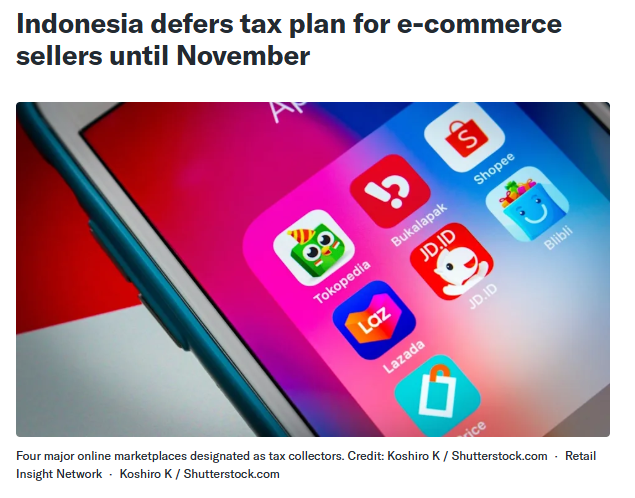
On August 1, the four major Indonesian e-commerce platforms Tokopedia, Shopee, Lazada, and Blibli had just launched the income tax withholding mechanism for sellers. Just four days later, the Indonesian Directorate General of Taxes issued an announcement postponing the policy to November 1, 2026. The taxes that had already been withheld had to be refunded to sellers by the platforms.
What was even more unexpected was that the DGT directly revoked the designation qualifications for these four platforms as collection agencies, saying that it would re-select them later. A tax reform that had been prepared for more than half a year was thus urgently put on hold.

Image source: finance.yahoo
So what tax does this policy actually collect?
Let me make this clear. This policy is based on PMK Regulation No. 37/2025 issued by the Indonesian Ministry of Finance in 2025. The core content is: e-commerce platforms, as withholding parties for PPh Pasal 22 income tax, will withhold income tax at 0.5% of the total transaction amount from sellers with annual transaction value exceeding 500 million Indonesian rupiah.
One point needs to be emphasized: this is not a new tax, but a change in the collection method from "sellers self-declaring" to "platforms directly withholding at the point of transaction." In the words of DGT Director Bimo, this money is part of the prepaid income tax owed by sellers, not an additional tax.
For example: if a seller sells goods worth 2 million rupiah on the platform, the platform withholds 10,000 rupiah in income tax. Individual sellers with annual turnover below 500 million rupiah are not within the scope of collection.

Image source: Business Times
Why the repeated delays?
This is actually not the first postponement.
In June 2025, the Indonesian Ministry of Finance issued PMK Regulation No. 37/2025, which was originally planned to take effect soon. But in September of the same year, due to pressure on macroeconomic growth, the government announced a postponement for the first time.
In early July 2026, the DGT formally issued designation letters to the four major platforms for withholding and paying taxes, giving them one month to make system changes. The policy took effect on August 1, and everyone thought it was finally going to be implemented. But just four days later, it was suspended again.
Indonesian Finance Minister Purbaya gave a clear explanation at a press conference on August 5. He said bluntly: the postponement is not due to a problem with the policy itself, but because the current economic situation is not suitable.
Data shows that Indonesia's GDP grew 5.29% year-on-year in the second quarter of 2026. That number sounds decent, but there are hidden problems—the growth rate was lower than the 5.61% in the first quarter, and indicators such as consumer confidence and offline retail were weak. The government is worried that adding a withholding tax on e-commerce sellers at this time would compress the profits of small and micro sellers and weaken the already fragile purchasing power of the public.
Purbaya's original words were: "We will postpone first, and only push forward after the economic situation and purchasing power improve."

Image source: DJP
Will there be another change on November 1?
Based on current information, the probability of another postponement is already very low. The Indonesian Ministry of Finance is determined—once consumption recovers and purchasing power picks up, it will be implemented according to the new schedule. Although the Indonesian E-commerce Association has proposed further postponing the policy to January 2027, this is only the appeal of the industry association, and officials have not yet relented.
There are less than three months until November 1. Rather than betting on whether the policy will once again fail to deliver, it is better to use this time to do solid homework on fiscal and tax compliance. After all, what is bound to come will come, and being prepared early is always right.
What this signal means for growth teams
This market signal should be treated as an operating prompt, not a standalone trend. The brand question is whether the team can connect TikTok content, creators, paid media, commerce readiness, and reporting into one measurable growth cycle.
Commercial read
- Market signal: TikTok Marketing Information and Solutions
- Published: August 14, 2026
- Commercial lens: TikTok Ads, creators, TikTok Shop, live commerce, and reporting.
- Source transparency: the original source linked in this article
What brands should do next
- Identify the market, audience, product group, and KPI this signal could affect.
- Turn the insight into a small TikTok creative, creator, Shop, or paid media test before scaling spend.
- Add FAQ, offer clarity, product proof, and contact paths so traffic can convert instead of only reading.
- Review weekly performance across reach, click quality, Shop actions, creator output, and revenue impact.
Tuke Marketing helps brands connect TikTok Ads, creator partnerships, TikTok Shop operations, live commerce, and reporting into one accountable operating system.
What should brands do with this TikTok signal?
Brands should translate the signal into a focused operating test across creative, creators, TikTok Shop readiness, paid media, and reporting before increasing budget.
How does Tuke Marketing evaluate this kind of news?
Tuke Marketing reviews platform news through market timing, category demand, creator supply, commerce readiness, and measurable growth actions.
When should a team contact Tuke about this topic?
A team should contact Tuke when it needs to turn a TikTok market signal into a practical launch, creator, advertising, live commerce, or reporting plan.
Source transparency: Tuke cites the original source linked in this article and adds its own operating analysis for brands evaluating TikTok growth decisions.