
European beauty e-commerce is changing: Amazon holds first place, but TikTok has surged to second
If your impression of European beauty e-commerce is still stuck in 'the era of Sephora and Douglas,' you may need to update your understanding.
Recently, market research firm NielsenIQ released a report titled '2026 Beauty E-commerce: New Rules for Growth.' Based on tracking data from over 5 million real online consumers in Europe, the report outlines the latest landscape of the online beauty market in Europe. The conclusion is straightforward: Amazon remains strong, but TikTok Shop is rising much faster than many expected.

Source: NielsenIQ Digital Purchases
Amazon: Not just a place to grab a facial cleanser on a whim
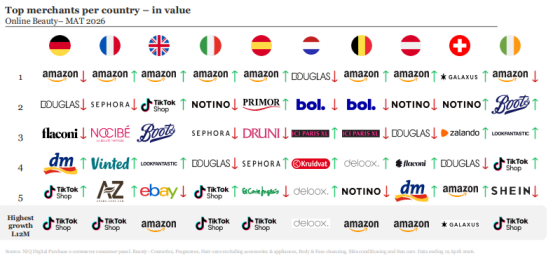
Let's start with Amazon. The report shows that Amazon ranks first in 8 of the 10 major beauty markets in Europe. A few years ago, many might not have expected this result—after all, beauty has long been a category heavily reliant on offline experience, beauty advisor recommendations, and trial services.
So how did Amazon achieve this? The report highlights two key changes.
First, the buyers have changed. Traditionally, the consumer base for beauty e-commerce was predominantly female, but on Amazon, men account for about half of beauty sales. This proportion is quite high, indicating that Amazon has successfully converted a large number of male users into beauty consumers through its entry points in daily necessities and personal care categories.
Second, the way they buy has changed. In the UK and Italy, 37% of professional beauty consumers consider Amazon their only channel for purchasing beauty products. 'Professional beauty consumers' refer to those with higher requirements for ingredients and efficacy, who previously were accustomed to shopping at specialized channels like Sephora and Douglas. The fact that this group is willing to concentrate their spending on Amazon shows that the platform has achieved a level of product selection variety, authenticity assurance, and delivery experience capable of meeting professional needs.
The category structure is also changing. The share of dermocosmetics and premium skincare on Amazon is continuously growing. In other words, Amazon is gradually breaking out of its 'low-price, high-volume' stereotype and establishing a foothold in the high-end beauty segment.

Source: NielsenIQ Digital Purchases
TikTok Shop: Not just for browsing, but actually making purchases
If Amazon is the defending champion, then TikTok Shop is the most formidable challenger.
The report shows that TikTok Shop has become the second-largest beauty retail platform in the UK, and has also entered the top five in Germany, Italy, and Ireland. Considering that TikTok Shop officially launched in the UK at the end of 2022, this speed is indeed impressive.
What’s even more noteworthy is the incremental growth it brings. The report points out that in markets such as Germany, Italy, and France, about 30% of TikTok Shop beauty consumers had not purchased any beauty products online in the past year. In other words, TikTok Shop is not just taking users from other platforms; it is genuinely bringing 'people who previously did not buy beauty products online' into this market. Moreover, the spending power of these new users is not low—after switching to TikTok Shop, their average annual beauty consumption increased by about 40 euros.

Source: Yahoo Finance
Feedback from the brand side is also direct. UAE fragrance brand Lattafa, by strategically positioning itself on TikTok Shop early, saw its market share in Europe grow by nearly 250%, directly topping the platform’s beauty sales chart. This case shows that for brands with solid product strength, social commerce is no longer just a supplementary channel for 'trying out content' but a real battleground for driving growth.
It's worth noting that TikTok Shop's influence is not limited to the mass beauty market. The report mentions that in the UK, 27% of premium beauty consumers have made purchases on TikTok Shop in the past 12 months. This indicates that content e-commerce is penetrating from the bottom up, and high-end brands are beginning to take this channel seriously.

Source: NielsenIQ Digital Purchases
What does this mean for sellers?
Different platforms require different strategies. Amazon competes on search optimization, brand trust, and fulfillment efficiency; TikTok Shop competes on content creativity, influencer partnerships, and user reach; DTC brands compete on differentiation and user engagement. How to allocate resources and which platform to invest in depends on the brand's own stage and capabilities.
But no matter which path you choose, the ones that will ultimately survive are the brands that have truly put effort into their products and content. Platforms are just gateways; what truly stays with consumers is always the experience delivered by the brand itself.
What this signal means for growth teams
This market signal should be treated as an operating prompt, not a standalone trend. The brand question is whether the team can connect TikTok content, creators, paid media, commerce readiness, and reporting into one measurable growth cycle.
Commercial read
- Market signal: TikTok Marketing Information and Solutions
- Published: June 30, 2026
- Commercial lens: TikTok Ads, creators, TikTok Shop, live commerce, and reporting.
- Source transparency: the original source linked in this article
What brands should do next
- Identify the market, audience, product group, and KPI this signal could affect.
- Turn the insight into a small TikTok creative, creator, Shop, or paid media test before scaling spend.
- Add FAQ, offer clarity, product proof, and contact paths so traffic can convert instead of only reading.
- Review weekly performance across reach, click quality, Shop actions, creator output, and revenue impact.
Tuke Marketing helps brands connect TikTok Ads, creator partnerships, TikTok Shop operations, live commerce, and reporting into one accountable operating system.
What should brands do with this TikTok signal?
Brands should translate the signal into a focused operating test across creative, creators, TikTok Shop readiness, paid media, and reporting before increasing budget.
How does Tuke Marketing evaluate this kind of news?
Tuke Marketing reviews platform news through market timing, category demand, creator supply, commerce readiness, and measurable growth actions.
When should a team contact Tuke about this topic?
A team should contact Tuke when it needs to turn a TikTok market signal into a practical launch, creator, advertising, live commerce, or reporting plan.
Source transparency: Tuke cites the original source linked in this article and adds its own operating analysis for brands evaluating TikTok growth decisions.