
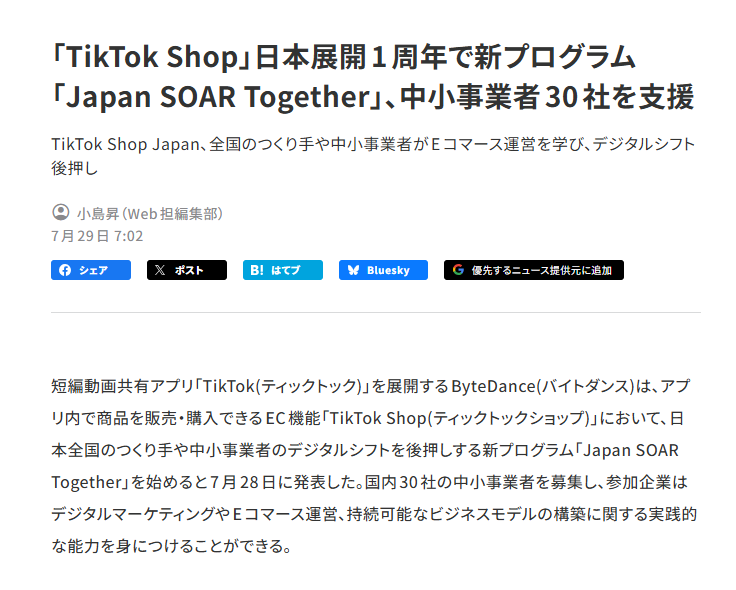
On June 30, 2025, TikTok Shop officially launched in Japan. One year later to this day, TikTok Shop Japan announced the launch of a digital support program specifically for Japanese small and medium-sized enterprises - "Japan SOAR Together".
This is worth paying attention to, not because TikTok Shop has made another big move, but because it hits exactly a rather subtle state of the Japanese market: e-commerce is growing, but the penetration rate is still far from enough.

Image source: webtan
Japan's e-commerce: considerable in scale, but offline is still the "boss".
First, look at a set of figures. According to the "FY2024 E-Commerce Market Survey" released by Japan's Ministry of Economy, Trade and Industry, Japan's B2C e-commerce market reached 26.1 trillion yen in 2024, a year-on-year increase of 5.1%. This scale is not small on a global level.
But another figure is more interesting: Japan's overall e-commerce penetration rate is only 9.8%. In other words, about 90% of transactions in Japan's retail industry are still completed offline.
A comparison shows the gap. China's e-commerce penetration rate has long exceeded 25%, and the United States is also above 15%. Japan's 9.8% e-commerce rate means there is still a vast market space waiting to be developed.
So why hasn't Japan's e-commerce penetration rate been able to rise? The reasons are quite complex. Japanese consumers are accustomed to offline shopping, have high requirements for service quality, and although the logistics and delivery system is developed, the costs are not low. Coupled with the high degree of aging in Japanese society, many middle-aged and elderly consumers are not particularly interested in online shopping.
However, changes are taking place. With a market size of 26.1 trillion yen, it is still growing at a rate of more than 5% every year. For those who want to do online business, this is indeed a window of opportunity worth taking seriously.

Image source: meti.go
TikTok Shop in Japan: from zero to 50,000 in one year
TikTok Shop has not been in the Japanese market for long. It officially launched on June 30, 2025, and has been just over a year so far.
What happened in this year? Within half a year of launch, the number of shoppers on the platform grew 20 times, the number of registered merchants exceeded 50,000, and the scale of creators also expanded to about 200,000 people. In terms of GMV composition, more than 70% of transactions were driven by content - of which livestreaming contributed about 60% and short videos contributed about 40%.
These figures show one thing: Japanese consumers are gradually accepting the shopping method of "ordering while watching content". Although the scale is incomparable to China's livestream e-commerce, this trend is indeed moving forward.

Image source: webtan
"Japan SOAR Together": What exactly will it do?
Let's get back to the support program announced this time.
The full name of "SOAR Together" is "Supporting Our Artisans and Retailers Together" - supporting our artisans and retailers. This program was first launched as a small and medium-sized enterprise support project by TikTok Shop at the global level, and has so far supported more than 1,500 entrepreneurs in more than 10 markets around the world each year.
Japan's "Japan SOAR Together" is a local implementation of this global program. Specifically, this program will recruit 30 small and medium-sized enterprises in Japan. The targets of recruitment are mainly small-scale operators who have good products but encounter difficulties in digital operations and sales channel expansion, including "makers" in fields such as traditional handicrafts, local specialties, and agricultural products.

Image source: webtan
A bit of observation
From a market perspective, Japan's 9.8% e-commerce penetration rate means huge growth space. From a platform perspective, TikTok Shop has proven in one year in Japan that the "content e-commerce" model has a market there. From a business perspective, those small and medium-sized enterprises that have good products but lack online capabilities really need an external force to push them.
"Japan SOAR Together" is that external force. The quota of 30 companies is not many, but the significance of this project lies not in quantity, but in the fact that it is a signal: TikTok Shop has begun to seriously do localized in-depth cultivation of the Japanese market.
For those Japanese small and medium-sized enterprises that are still hesitating about whether to do online business, this may be an opportunity worth paying attention to. After all, in a market where 90% of transactions are still completed offline, whoever runs through the online path first is likely to seize the first opportunity.
What this signal means for growth teams
This market signal should be treated as an operating prompt, not a standalone trend. The brand question is whether the team can connect TikTok content, creators, paid media, commerce readiness, and reporting into one measurable growth cycle.
Commercial read
- Market signal: TikTok Marketing Information and Solutions
- Published: August 11, 2026
- Commercial lens: TikTok Ads, creators, TikTok Shop, live commerce, and reporting.
- Source transparency: the original source linked in this article
What brands should do next
- Identify the market, audience, product group, and KPI this signal could affect.
- Turn the insight into a small TikTok creative, creator, Shop, or paid media test before scaling spend.
- Add FAQ, offer clarity, product proof, and contact paths so traffic can convert instead of only reading.
- Review weekly performance across reach, click quality, Shop actions, creator output, and revenue impact.
Tuke Marketing helps brands connect TikTok Ads, creator partnerships, TikTok Shop operations, live commerce, and reporting into one accountable operating system.
What should brands do with this TikTok signal?
Brands should translate the signal into a focused operating test across creative, creators, TikTok Shop readiness, paid media, and reporting before increasing budget.
How does Tuke Marketing evaluate this kind of news?
Tuke Marketing reviews platform news through market timing, category demand, creator supply, commerce readiness, and measurable growth actions.
When should a team contact Tuke about this topic?
A team should contact Tuke when it needs to turn a TikTok market signal into a practical launch, creator, advertising, live commerce, or reporting plan.
Source transparency: Tuke cites the original source linked in this article and adds its own operating analysis for brands evaluating TikTok growth decisions.