
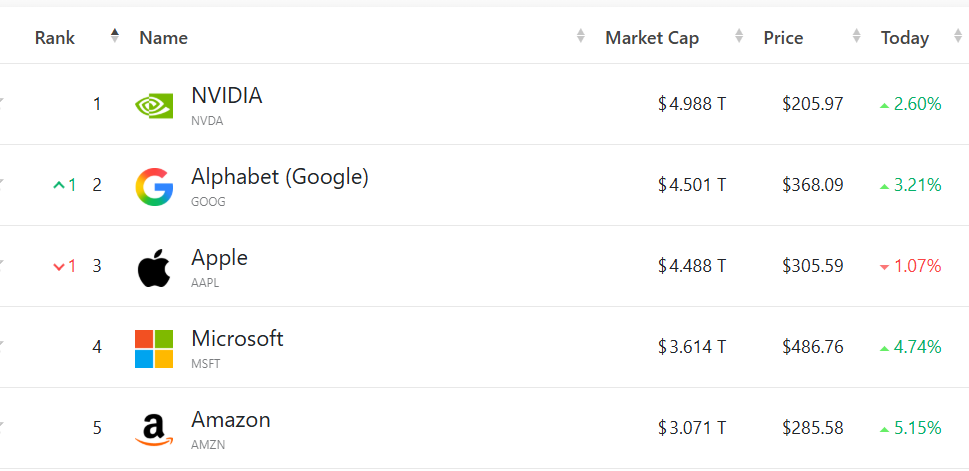
On August 3, Eastern Time, Amazon's stock surged more than 5% at one point during trading, closing at $284.02, up 4.6%, setting an all-time high closing record, and the company's total market value exceeded $3 trillion for the first time.
At this point, Amazon became the world's fifth listed company to reach a market value of $3 trillion, after Nvidia, Alphabet, Microsoft, and Apple. It took Amazon just over two years to go from first exceeding $2 trillion in June 2024 to hitting $3 trillion; while it took more than six years from first exceeding $1 trillion at the end of 2018 to reaching $2 trillion. So far this year, Amazon's stock has risen more than 23%.

Source: Cailianshe
Q2 Earnings Report: AWS Does the Heavy Lifting
The direct driver of this surge was Amazon's second-quarter earnings report released a few days earlier.
Amazon delivered a second-quarter report card that beat expectations: revenue reached $200.6 billion, up 20% year over year, well above the $197 billion analysts had forecast; operating profit was $27.5 billion, up 43% year over year.
However, the net profit was as high as $62.6 billion, up nearly two and a half times from a year earlier (up 245%), mainly because the quarter included a $53.4 billion pre-tax non-recurring gain from the revaluation of Amazon's investment in AI company Anthropic. In other words, excluding this one-time factor, the net profit growth would not be so prominent.
What really excited investors was AWS's performance. In the second quarter, AWS revenue reached $42.2 billion, up 37% year over year, the fastest growth in 18 quarters (i.e., nearly five years). AWS's operating profit increased from $10.2 billion in the same period last year to $16.6 billion. In other words, AWS contributed only about 21% of Amazon's revenue, but about 60% of its operating profit.

Source: Sina Finance
Bezos “Cashing Out at a High”: Premeditated, Not Impulsive
On the same day the stock hit a new high and the market value exceeded $3 trillion, a filing with the U.S. Securities and Exchange Commission showed that Amazon founder Jeff Bezos planned to sell 15 million Amazon shares, worth an estimated $4.07 billion (about 27.5 billion yuan) at the current stock price.
The timing is indeed a bit delicate — just as the stock hit a record high, the founder is about to sell shares. But a closer look at the filing reveals that this reduction was carried out under a 10b5-1 trading plan set up on November 14, 2025. A 10b5-1 plan allows company insiders to preset the timing and quantity of stock sales, in order to avoid suspicion of insider trading. In other words, this cash-out plan was set more than half a year before Amazon's earnings release and the stock surge.

Source: Securities China
This is not the first time Bezos has sold shares. Since 2002, he has sold a cumulative total of approximately $50 billion in Amazon stock. In 2025, he just completed a round of cashing out, selling nearly $5.7 billion in total. Part of this money has gone to other projects under Bezos, especially the space company Blue Origin. Last month, reports said Blue Origin was seeking to raise $10 billion at a $130 billion valuation, the company's first external financing in years.
After the announcement, Amazon's shares fell more than 1% in after-hours trading. However, based on the approximately 869 million Amazon shares Bezos still holds, his remaining stake is still worth about $244 billion. Selling these $4 billion is just “pocket money” for him.

Source: Securities China
Burning Cash for the Future: A $220 Billion Bet
But transformation comes at a cost. Amazon has raised its full-year 2026 capital expenditure forecast from $200 billion to $220 billion. Jassy said on the earnings call that due to rising prices for storage chips related to AI infrastructure construction, the company had to increase its investment budget. He also added a remark worth pondering: “Even at this level of investment, we still won't be able to meet all demand in 2026. I believe 2027 will face the same situation. In fact, we have already seen demand for 2028, and it is very striking.”
The direct consequence of the massive investment is pressure on cash flow. As of the second quarter, Amazon's free cash flow over the past 12 months swung from a net inflow of $18.2 billion a year ago to a net outflow of $7.6 billion.
However, the capital market currently chooses to believe Jassy. CNBC host Jim Cramer commented that Jassy's explanation on the earnings call of the path to returns on AI capital expenditures “changed the way Wall Street views massive AI investments by large tech companies.”
In short: invest heavily upfront to build infrastructure, then sit back and reap the rewards later. The market has bought this logic.

Source: fortune
A $3 trillion market value is the market's affirmation of Amazon's AI story.
But whether AWS can maintain its 37% growth rate, and when the $220 billion massive investment can once again translate into stable positive free cash flow, are the key questions that determine how long this trust will last.
What this signal means for growth teams
This market signal should be treated as an operating prompt, not a standalone trend. The brand question is whether the team can connect TikTok content, creators, paid media, commerce readiness, and reporting into one measurable growth cycle.
Commercial read
- Market signal: TikTok Marketing Information and Solutions
- Published: August 12, 2026
- Commercial lens: TikTok Ads, creators, TikTok Shop, live commerce, and reporting.
- Source transparency: the original source linked in this article
What brands should do next
- Identify the market, audience, product group, and KPI this signal could affect.
- Turn the insight into a small TikTok creative, creator, Shop, or paid media test before scaling spend.
- Add FAQ, offer clarity, product proof, and contact paths so traffic can convert instead of only reading.
- Review weekly performance across reach, click quality, Shop actions, creator output, and revenue impact.
Tuke Marketing helps brands connect TikTok Ads, creator partnerships, TikTok Shop operations, live commerce, and reporting into one accountable operating system.
What should brands do with this TikTok signal?
Brands should translate the signal into a focused operating test across creative, creators, TikTok Shop readiness, paid media, and reporting before increasing budget.
How does Tuke Marketing evaluate this kind of news?
Tuke Marketing reviews platform news through market timing, category demand, creator supply, commerce readiness, and measurable growth actions.
When should a team contact Tuke about this topic?
A team should contact Tuke when it needs to turn a TikTok market signal into a practical launch, creator, advertising, live commerce, or reporting plan.
Source transparency: Tuke cites the original source linked in this article and adds its own operating analysis for brands evaluating TikTok growth decisions.