
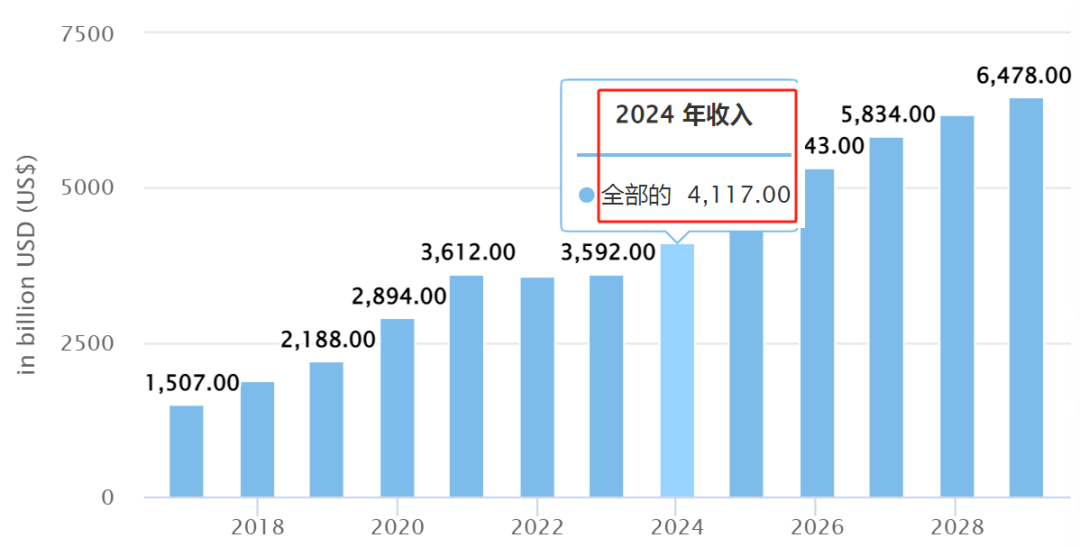
With the rapid development of the digital economy, the global e-commerce industry is undergoing swift transformation. It is estimated that by 2024, its market value will reach an astonishing $4.11 trillion, representing a 90% increase compared to 2019 ($2.18 trillion) and a 15% increase over last year. This data has been confirmed by Statista.

Image source: Statista
There are many factors influencing such changes in the global e-commerce market, such as the widespread adoption of mobile internet, which allows consumers to shop anytime and anywhere, greatly enhancing shopping convenience. With the gradual rollout of 5G networks, the user experience of mobile e-commerce has further improved, driving more consumers to shift to online shopping. According to the "2023 Mobile Internet Report" released by GSMA, by the end of 2022, 54% of the global population (4.3 billion people) owned smartphones; in 2023, the global mobile internet penetration rate continued to grow, with 57% of the world's population (4.6 billion people) using mobile internet.

Image source: GSMA
Technological advancements, especially the application of artificial intelligence, big data analytics, and blockchain technology, have also accelerated the transformation of the global e-commerce market, enabling e-commerce platforms to provide more personalized and efficient services. Previously, ByteDance, the parent company of TikTok, announced plans to invest $2.13 billion (10 billion ringgit) to build an artificial intelligence center in Malaysia. This news was confirmed by Malaysia's Minister of Trade on June 7, and Malaysia's Minister of Investment, Trade, and Industry, Tengku Zafrul Aziz, stated that ByteDance will also invest an additional 1.5 billion ringgit to expand its data center facilities in Johor, Malaysia.

Image source: Reuters
The rise of cross-border e-commerce is another important reason for the rapid changes in the global e-commerce market. With the acceleration of globalization and the continuous improvement of international logistics systems, cross-border e-commerce has become a very popular shopping method. For example, TikTok Shop is a shopping platform highly favored by young overseas consumers, where people can easily purchase goods from all over the world.
TikTok Shop values traditional e-commerce functions while also enhancing the shopping experience through content formats such as videos and live streaming. By leveraging these platform features, it has successfully integrated entertainment and shopping seamlessly, creating a brand-new "entertainment shopping" model, which unsurprisingly attracts a large number of consumers seeking fresh and interesting shopping experiences.
According to data from Marketplace Pulse, TikTok Shop has already successfully surpassed Walmart to become the fourth largest e-commerce platform in the United States.

Image source: Marketplace Pulse
Overall, the future development of the global e-commerce market is promising. If platforms like TikTok Shop are given a bit more time, it is believed that they will achieve even more significant results and influence in the future. Let’s look forward to it together!
What this signal means for growth teams
This market signal should be treated as an operating prompt, not a standalone trend. The brand question is whether the team can connect TikTok content, creators, paid media, commerce readiness, and reporting into one measurable growth cycle.
Commercial read
- Market signal: TikTok Marketing Information and Solutions
- Published: July 16, 2024
- Commercial lens: TikTok Ads, creators, TikTok Shop, live commerce, and reporting.
- Source transparency: the original source linked in this article
What brands should do next
- Identify the market, audience, product group, and KPI this signal could affect.
- Turn the insight into a small TikTok creative, creator, Shop, or paid media test before scaling spend.
- Add FAQ, offer clarity, product proof, and contact paths so traffic can convert instead of only reading.
- Review weekly performance across reach, click quality, Shop actions, creator output, and revenue impact.
Tuke Marketing helps brands connect TikTok Ads, creator partnerships, TikTok Shop operations, live commerce, and reporting into one accountable operating system.
What should brands do with this TikTok signal?
Brands should translate the signal into a focused operating test across creative, creators, TikTok Shop readiness, paid media, and reporting before increasing budget.
How does Tuke Marketing evaluate this kind of news?
Tuke Marketing reviews platform news through market timing, category demand, creator supply, commerce readiness, and measurable growth actions.
When should a team contact Tuke about this topic?
A team should contact Tuke when it needs to turn a TikTok market signal into a practical launch, creator, advertising, live commerce, or reporting plan.
Source transparency: Tuke cites the original source linked in this article and adds its own operating analysis for brands evaluating TikTok growth decisions.