
Overseas version of 'Li Jiaqi' assembled! ChatGPT, Gemini, Claude debut on the same stage, AI full-chain empowerment!
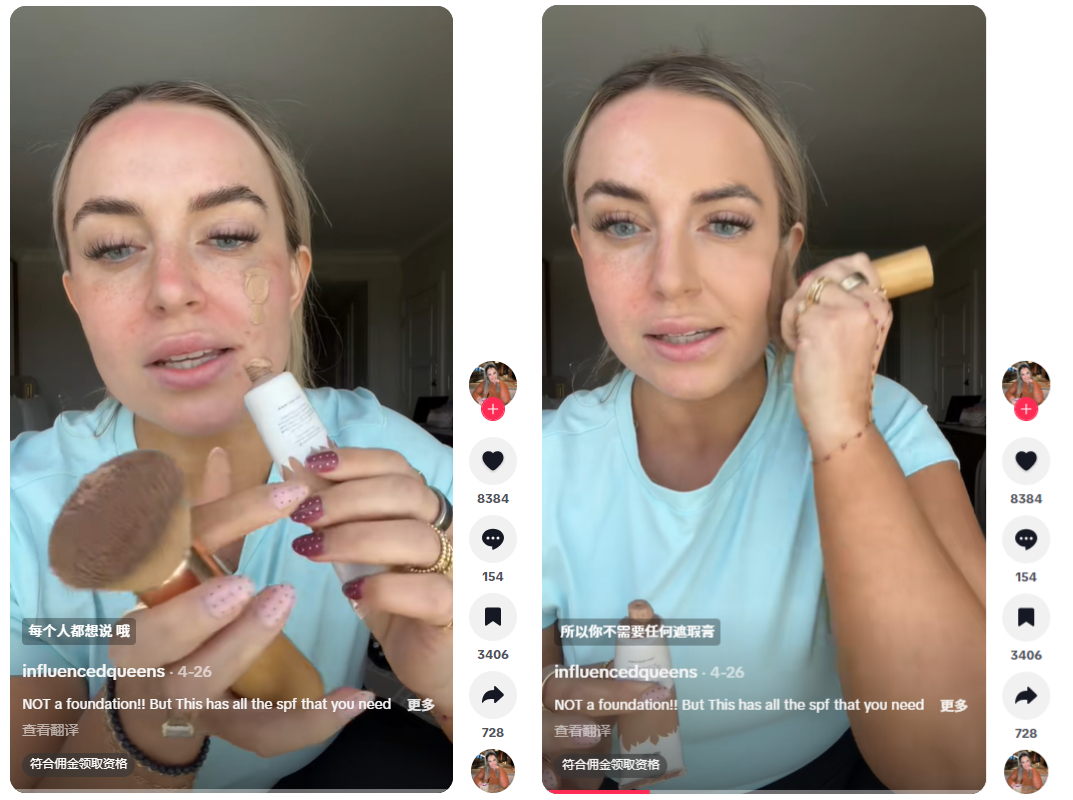
In April this year, TikTok Shop US influencer @influencedqueens posted a BB cream product promotion video with 3.2 million views, ultimately converting $98,700 in sales. And she achieved this with just about 1 minute of content.
This is not an isolated case.
Kalodata data shows that over the past six months, this influencer generated nearly $3,015,240 through short video promotions, collaborating with 381 stores. Her video GPM reached $29.43, with only 530,000 followers—a modest follower count but astonishing conversion efficiency.

Image source: TikTok
Behind this is an ongoing trend shift: overseas consumers increasingly trust 'people' when buying products.
In recent years, for Chinese brands going overseas, product quality has long ceased to be an issue. What truly holds back most brands is the awareness and trust of overseas consumers.
So what to do? Over the past two years, more and more brands have found a solution—overseas influencers.

Image source: Google
One chair, sold $5.5 million in a year
The story of Zhejiang brand Sweet Furniture is quite typical. In September 2023, when TikTok Shop US just launched, founder Jason, who was on a business trip in the US, caught this signal immediately and, upon returning home, immediately put all product lines on TikTok.
They had a cross-legged chair that could only sell 200 units per month on other platforms. After going on TikTok, it sold 2,000 units a day, nearly a 10-fold increase.
How did they do it? The core is just two words: influencers.
They found a large number of TikTok influencers to shoot videos. A burly influencer jumped directly into the chair, instantly showing viewers that the space was large enough; a beauty influencer assembled the chair in a few simple steps, making everyone immediately understand 'easy assembly'. The effect of these short videos is something that traditional image-text detail pages and instruction manuals can never achieve.

Image source: Kalodata
What was the result? Just that cross-legged chair alone exceeded $5.5 million in sales. In less than a year, Sweet Furniture's overall sales directly surpassed $100 million.
What's even better is that after the explosion of orders on TikTok, sales on other platforms also rose. It can be said that one channel activated the entire inventory.

Image source: Kalodata
It's not just big brands that can play this game
Some might say that Sweet Furniture was just lucky to hit a hot product. Let's look at a few more examples.
A brand called NovaSight, made by a post-00s team in Shenzhen, sells AI glasses. Instead of seeking top influencers, they partnered with a group of 'ordinary people'—construction workers, moms, skiing enthusiasts, and cyclists.
These people shared real use scenarios on TikTok. A video of a construction worker wearing AI glasses while working on a roof gained millions of views. Last Black Friday, a single product link achieved nearly $1 million in revenue.
There's also swimwear brand Blooming Jelly, which invited fashion bloggers of different skin tones and body types to shoot outfit videos, attracting over 800,000 views in a single day; and dashcam brand 盯盯拍, which exceeded $7 million in sales on AliExpress in 2025, a 700% year-over-year increase.

Image source: TikTok
AI is continuously lowering the barriers to cross-border business
After discussing influencers, let's talk about AI.
Fu Jiangyan, the owner of a sock shop in Yiwu, has become quite well-known in recent years. She says '12345' to the camera, and AI tools can automatically generate marketing videos in dozens of languages, matching voice and lip movements. Her shop exports over 20 million pairs of socks annually, and by using AI digital humans, she has turned short videos into a stable source of customers, with overseas followers exceeding 40,000.

Image source: CCTV News
What AI does now is more than content generation. It is also used in product selection—scraping reviews, capturing trends, analyzing competitor data. Things that used to rely on experience and intuition now have more systematic methods.
The same goes for ad placement—automatically adjusting keywords and bids, reducing time spent manually monitoring the backend. Customer service is even more common; multilingual auto-replies have become standard for many shops.
Simply put, influencers help brands solve the 'who says it' problem, while AI solves the 'how to implement faster' problem. The two are not a substitution relationship but a complementary one.

Image source: Internet
Why have overseas influencers and AI become must-haves?
At the end of the day, the logic of cross-border e-commerce is changing. In the past, it was all about 'variety' and 'savings'—as long as you had plenty of goods at low prices. Now these tricks don't work anymore. Overseas consumers don't lack cheap products; they lack trustworthy brands.
The role of influencers is precisely translation. They present the advantages of Chinese products in a way that local consumers can understand and trust. AI's role is to amplify the efficiency of this translation by ten or a hundred times. The combination of the two is reshaping the cost structure of the entire overseas business.
Data also confirms this. The global AI e-commerce market has exceeded $10 billion and is expanding at a compound annual growth rate of over 15%. According to Tencent Cloud, the volume of AI product calls by cross-border e-commerce companies it serves increased by 70% in 2025.

Image source: market research
How to find reliable overseas influencers? How to keep up with the pace of AI?
This is the biggest headache for many brands. Finding influencers isn't just about sending a few emails; you need to assess their sales ability, negotiate cooperation models, and adapt to cultural differences across markets. Looking for them one by one is too inefficient, but batch cooperation makes it hard to know how to filter.
The same goes for AI tools. There are a bunch of products on the market, and no one clearly tells you which ones are really useful and which are just gimmicks.
From August 4th to 5th, there is a KACE 2026 exhibition at the Shenzhen Fuyuan International Convention and Exhibition Center, which might help.

Image source: kalodata
Looking at the list, a few names carry significant weight:
@influencedqueens — the one mentioned at the beginning, the top influencer historically in TikTok Shop US region in terms of sales GMV, with cumulative sales transaction volume exceeding $22 million.

Image source: kalodata
@kohcun — the number one on Indonesia's 2025 annual sales list. His story is quite interesting. He first ran a mobile phone store in his hometown, went bankrupt, and then went to Jakarta alone to make a living. In the toughest times, he lived in a basement, livestreaming 9 to 12 hours a day, sleeping 4 hours, then getting up to work again. He persisted like this for several years, and now has over 2.1 million followers. In 2025, he achieved about 250 million RMB in GMV on the TikTok platform, firmly ranking as the top sales influencer in Indonesia.

Image source: kalodata
@louissesscarlettfamily — known in the industry as 'the Indonesian Li Jiaqi'. Her real name is Lina Amelia, a mother of five children. She has been livestreaming for nearly 5 years, livestreaming 8 to 10 hours a day, and can achieve 24-hour non-stop broadcasting when traveling. In 2023, she achieved a single-day sales volume of 21 million RMB. Currently, she has 16 million fans across all platforms, with cumulative sales GMV reaching 400 billion Indonesian Rupiah.

Image source: kalodata
@papalarisofficia — a traffic entrepreneur with tens of millions of followers in Malaysia. In the past 30 days, his sales through livestreaming exceeded $800,000, and live views surpassed 26 million. His content simply shows products in daily life, without complex editing; the sense of authenticity has become the strongest driving force for sales.
For example, one of his mango product promotion videos garnered over 17.29 million views, directly generating $78,200 in sales from a single video.

Image source: kalodata
Of course, this is just part of it. At the venue, there will be more top influencers from markets such as Japan, Vietnam, and Thailand, covering categories like beauty, home, 3C electronics, hardware, mother and baby, etc. You can browse and chat at your leisure.

Image source: kalodata
And it's not just influencers. It is said that the three overseas AI models—Gemini, ChatGPT, and Claude—will share the stage together for the first time in China. On the domestic side, Doubao, Qianwen, and Yuanbao will also be present.
Brands like DJI, UGREEN, and MINISO will also attend. Amazon, TikTok, Shopee, Temu, and a dozen other major platforms will have booths.

Image source: kalodata
Conclusion
Brands that have grown quickly over the past two years have basically bet on two things: first, letting real users speak for the products; second, using AI to improve overall operational efficiency.
This is also why a much-discussed topic in the industry this year is: in the second half of going global, the competition is no longer about who has cheaper production lines, but about who knows how to better engage with overseas consumers.
If you are also thinking about going global, or looking for reliable influencers and tools, the KACE 2026 exhibition is worth a visit. After all, some things are far more useful when discussed in person than just on paper.
What this signal means for growth teams
This market signal should be treated as an operating prompt, not a standalone trend. The brand question is whether the team can connect TikTok content, creators, paid media, commerce readiness, and reporting into one measurable growth cycle.
Commercial read
- Market signal: TikTok Marketing Information and Solutions
- Published: July 14, 2026
- Commercial lens: TikTok Ads, creators, TikTok Shop, live commerce, and reporting.
- Source transparency: the original source linked in this article
What brands should do next
- Identify the market, audience, product group, and KPI this signal could affect.
- Turn the insight into a small TikTok creative, creator, Shop, or paid media test before scaling spend.
- Add FAQ, offer clarity, product proof, and contact paths so traffic can convert instead of only reading.
- Review weekly performance across reach, click quality, Shop actions, creator output, and revenue impact.
Tuke Marketing helps brands connect TikTok Ads, creator partnerships, TikTok Shop operations, live commerce, and reporting into one accountable operating system.
What should brands do with this TikTok signal?
Brands should translate the signal into a focused operating test across creative, creators, TikTok Shop readiness, paid media, and reporting before increasing budget.
How does Tuke Marketing evaluate this kind of news?
Tuke Marketing reviews platform news through market timing, category demand, creator supply, commerce readiness, and measurable growth actions.
When should a team contact Tuke about this topic?
A team should contact Tuke when it needs to turn a TikTok market signal into a practical launch, creator, advertising, live commerce, or reporting plan.
Source transparency: Tuke cites the original source linked in this article and adds its own operating analysis for brands evaluating TikTok growth decisions.