
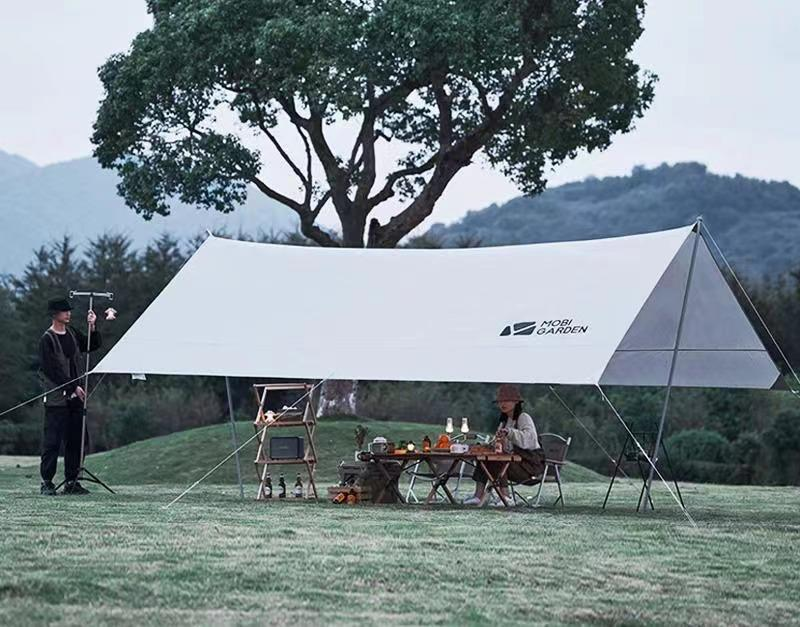
In an ordinary small town in Ningbo, Zhejiang, there is a pair of brothers whose names may not be widely known, but the business legend they created has shaken the entire industry. These brothers are Lu Tunhua and Lu Tunfeng, who make a living by selling tents and founded theMobiGarden brand, sparking a unique revolution in the outdoor goods sector.

Since 2016, the outdoor industry has gradually fallen into a bottleneck of low growth, with many brands experiencing declining performance. In 2023, the camping industry giantSnow Peak even suffered a rare sales decline, ending 22 consecutive years of growth and sounding the alarm for the entire camping industry. The market suddenly shifted from prosperity to downturn, and brands are facing unprecedented challenges.
However, in this cold winter, as the former "first stock of Chinese camping," MobiGarden's revenue has continued to grow since 2017, with annual sales quickly surpassing 1 billion yuan.
By 2022, it had reached 1.436 billion yuan, a year-on-year increase of more than 55%. Especially in the first three quarters of 2023, MobiGarden's own brand business achieved strong growth, with operating income reaching 671 million yuan, a year-on-year increase of 29.31%.
Why was MobiGarden able to break through the industry's winter blockade?

01 Unwilling to be just an OEM, shifting to own brand
In 2003, MobiGarden started as an OEM business, producing tents and sleeping bags for international outdoor brands such as Decathlon, with products exported all over the world. At the same time, founder Lu Tunhua realized the potential of the domestic outdoor sports market and was unwilling to just be an OEM, so he created his own brand, MobiGarden.
But after more than ten years, the road to building its own brand was not smooth.
It wasn't until 2020, catalyzed by the pandemic, that the camping industry ushered in its first year, with a large influx of new users, and MobiGarden achieved tremendous growth by riding the trend.
However, unlike traditional users, these new users pay more attention to the experience and atmosphere brought by camping products, which has driven the rise of refined camping.
But as a brand that started as an OEM, MobiGarden has always followed a functional and practical route, which does not fit with the current demand for a refined style.
So what to do?Transformation!
MobiGarden quickly shifted from traditional product thinking to user thinking, thus achieving growth in adversity.

In terms of brand positioning, MobiGarden repositioned itself as "bringing the magic of nature into life, bringing the comfort of life into nature," and targeted the petty bourgeoisie such as the middle class, white-collar workers, and literary youth.
In terms of product matrix, MobiGarden began to diversify, launching not only its core product tents, but also sleeping bags, outdoor furniture, cookware, and other related products, building a product ecosystem covering all scenarios.
As for the core product tents, MobiGarden continuously iterated and upgraded, putting user experience first. For example, they designed a full black coating based on user needs, but later found it affected daytime comfort, so they upgraded and modified it to better meet user needs.
In addition to product upgrades, MobiGarden also launched a series of co-branded products through collaborations with well-known IPs or designers, such as the Brown Bear model co-branded with LINE FRIENDS, enhancing the brand's sense of fashion and trendiness, and attracting a wider consumer group, especially young consumers. These initiatives enabled MobiGarden to achieve explosive growth in 2021 and 2022.

02 MobiGarden's Overseas Marketing Journey
Despite its outstanding performance in the domestic market, MobiGarden's performance in overseas markets has not been satisfactory. In contrast, emerging brand Naturehike, which adopts the DTC model, is booming in the European and American markets.
To change this situation, MobiGarden began to increase its publicity efforts in overseas markets. After all, no matter how good the product is, it still needs advertising.
Therefore, MobiGarden has established a presence on social platforms such as TikTok, Instagram, Facebook, and YouTube, enhancing brand awareness through overseas social media.
For example, on TikTok, since MobiGarden entered late and had fewer followers, it chose to cooperate with mid- and tail-end influencers, who demonstrated the product's usage scenarios in real life, leveraging the influence of KOCs to enhance brand awareness.

In addition, MobiGarden is actively developing independent overseas sites, with product displays and page interaction designs that are very simple and stylish, giving a sense of ease and freedom. Its co-branded brands and overall design can also be perfectly integrated, greatly increasing the chances of attracting users.

In addition, paid search and direct access are also important channels for acquiring traffic. This shows that MobiGarden has put a lot of effort into search engine optimization (SEO) and website optimization, thereby increasing the conversion rate of users through search engines and direct website visits.

However, in the competition in overseas markets, MobiGarden still faces challenges. Although multi-platform deployment is conducive to covering a wider range of consumer groups, it also leads to resource dispersion, affecting the brand's focused communication and market impact. In this fiercely competitive market, MobiGarden needs to think about how to better allocate and prioritize resources.
This is also a problem that many cross-border companies Tuke have to face.
In summary, through transformation, MobiGarden has moved from professional camping to refined camping, successfully achieving growth against the trend. However, when facing new challenges and opportunities, MobiGarden still needs to continue to innovate and adjust in order to maintain its competitive advantage and achieve greater success in the global market.
What this signal means for growth teams
This market signal should be treated as an operating prompt, not a standalone trend. The brand question is whether the team can connect TikTok content, creators, paid media, commerce readiness, and reporting into one measurable growth cycle.
Commercial read
- Market signal: TikTok marketing tips - short video marketing methods
- Published: April 29, 2024
- Commercial lens: TikTok Ads, creators, TikTok Shop, live commerce, and reporting.
- Source transparency: the original source linked in this article
What brands should do next
- Identify the market, audience, product group, and KPI this signal could affect.
- Turn the insight into a small TikTok creative, creator, Shop, or paid media test before scaling spend.
- Add FAQ, offer clarity, product proof, and contact paths so traffic can convert instead of only reading.
- Review weekly performance across reach, click quality, Shop actions, creator output, and revenue impact.
Tuke Marketing helps brands connect TikTok Ads, creator partnerships, TikTok Shop operations, live commerce, and reporting into one accountable operating system.
What should brands do with this TikTok signal?
Brands should translate the signal into a focused operating test across creative, creators, TikTok Shop readiness, paid media, and reporting before increasing budget.
How does Tuke Marketing evaluate this kind of news?
Tuke Marketing reviews platform news through market timing, category demand, creator supply, commerce readiness, and measurable growth actions.
When should a team contact Tuke about this topic?
A team should contact Tuke when it needs to turn a TikTok market signal into a practical launch, creator, advertising, live commerce, or reporting plan.
Source transparency: Tuke cites the original source linked in this article and adds its own operating analysis for brands evaluating TikTok growth decisions.