
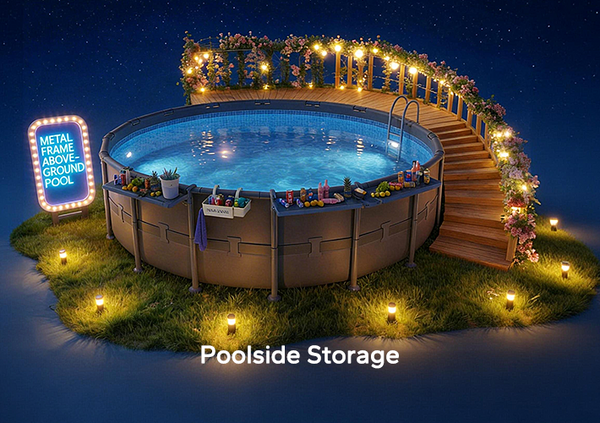
In backyards of European and American households, above-ground pools have long been a summer staple. For years, this track has been dominated by two giants, Intex and Bestway, which have captured the lion's share of the finished pool market with mature supply chains and high cost-effectiveness.
However, an interesting phenomenon is that in the niche segment of pool accessories, the market has long been in a state of fragmentation, chaos, and poor quality, with mostly white-label players fighting independently, inconsistent quality, and poor user experience in design.
In such a niche track where 'big players eat meat, small players can't even drink soup,' Poolhacker has managed to stand out.

Source: Poolhacker
As of now, this brand, founded only a few years ago, has accumulated over 8.56 million pool enthusiasts and loyal users globally, with its products and services reaching more than 20 countries and regions.
On the sales side, taking TikTok Shop US as an example, a Poolhacker dual-head fountain bracket priced at $37 sold 3,933 units in the last 28 days, generating $144,500 in GMV, with a historical total of over 31,800 units sold and GMV exceeding $930,000.
An accessory brand in a niche track achieving such volume in a few years is worth dissecting how it got there step by step.

Source: TikTok Shop
A 'reverse-engineered product' entrepreneurial logic
The operational entity behind Poolhacker is an innovative technology company based in Shenzhen, with an R&D center in Shenzhen. Over 70% of the team are R&D and design personnel, and core members include smart hardware engineers, software algorithm engineers, and mechanical structure engineers.
The team led by the brand founder took a different path from most Shenzhen cross-border brands: instead of developing a product first and then finding a market, they spent an entire year researching and interviewing customers to understand real needs and pain points, then reverse-engineered the product design.
The official About page includes a straightforward description: 'Summer is short, ideas are plenty, but most people lack the right tools or enough time to make their pool more fun. Poolhacker is a brand built specifically for these 'real pool owners' pain points.'

Source: Poolhacker
The product line now covers several directions: ambiance includes dual-head fountains, built-in LED fountains, solar fountain lights; functional includes cordless handheld pool vacuum cleaners, pool liners, upgrade round pool covers; peripherals include poolside baskets, solid wood folding poolside bars.
Notably, Poolhacker repeatedly emphasizes a label in its products: 'The First'.
The dual-head fountain is the first, the LED fountain is the first, the solar model is the first, the poolside basket with support strips is the first, and the solid wood folding poolside bar is also the first.
These products not only fill market gaps but also redefine the quality standard of 'pool living'.

Source: Poolhacker
The big market is growing, accessories are waiting
Poolhacker's rapid growth, besides its own product strength, is inseparable from the macro dividends of the global pool market. According to a report by a market research firm, the global above-ground pool market is valued at approximately $2.8 billion to $3.12 billion in 2025, and is expected to grow to $4.01 billion by 2030, with a compound annual growth rate of about 5.1%.
The core driver of this growth is precisely the post-pandemic surge in 'staycation' patterns and the continuous upgrade of outdoor living spaces in private homes in North America and Europe.

Source: research and markets
Notably, the pool accessories and maintenance market is even larger.
According to third-party data, the global pool equipment market reached $19.78 billion in 2023 and is expected to grow to approximately $31.14 billion by 2030.
As the number of pools increases, the frequency of users replacing accessories and their demand for upgraded experiences also rise simultaneously. Especially after Millennials and Gen Z became the main homebuyers, they are no longer satisfied with pools being merely a place for swimming, but rather view them as spaces for social gatherings, family entertainment, and showcasing personal lifestyles.
This shift in consumer mindset provides excellent market soil for brands like Poolhacker that focus on 'atmosphere' and 'creative upgrades'.

Source: marknteladvisors
TikTok: Not just a sales channel, but also a brand amplifier
For an emerging overseas brand, traditional cross-border e-commerce shelves may provide basic sales, but often fall into the passive logic of 'search product terms - compare prices - place orders', making it difficult to accumulate brand premium.
And the full explosion of TikTok Shop has become a super accelerator for Poolhacker to achieve explosive growth and accumulate brand assets.

Source: TikTok
Poolhacker's official account @poolhacker_official is regarded as the brand's main base. Its bio directly uses 'Best Pool Accessories' to capture users' minds, allowing users who encounter the account for the first time to immediately know its main direction.
As of now, the account has accumulated over 130,000 followers and received over 3 million likes. Behind this is continuous high-quality content output. Since pool accessories are 'visual' products, they tend to emphasize contextualization and emotional value in video production.

Source: TikTok
Take one of the solar fountain light videos as an example. This video received 814,900 views and generated $26,100 in sales.
The video opens with a visual hook comparing a dark pool at night with a brightly lit pool, instantly grabbing attention. Then the camera creates a genuine and friendly atmosphere, followed by close-ups of the product and demonstrations of compatibility with different pools. The entire video revolves around the need to 'enhance pool atmosphere at low cost', emphasizing solar charging, automatic activation, zero-maintenance ease of use, while showing compatibility with both above-ground and in-ground pools.
In the comment section, users' questions about prices and compatible models are concentrated, and the conversion effect is directly reflected in sales.

Source: TikTok
In terms of influencer collaboration strategy, Poolhacker adopted a combination model of 'vertical category reviews + lifestyle integration'.
On one hand, they collaborate with KOLs like @tino_reviews and @show_and_tell who focus on home or pool reviews, publishing 'Ordered vs Gotten' (expectation vs actual unboxing) test videos to build trust through real user experience. On the other hand, they encourage influencers to naturally integrate the product into lifestyle content such as 'yard renovation' and 'summer party', allowing users to be influenced while enjoying beautiful scenes.

Source: kalodata
Looking at the overall performance of the store, Poolhacker's TikTok Shop has formed a stable sales loop. As of now, the store has achieved total sales of 95,000 orders, with total revenue exceeding $4.45 million, and the per-product output efficiency is quite impressive.
In addition, the influencer-driven sales ecosystem is well-established – with nearly 4,000 commissioned influencers, over 10,000 sales videos, and more than 4,400 live streams, forming a growth model driven by official content, influencer matrix, and live streaming.

Source: fastmoss
Conclusion
When domestic companies enter overseas markets, many times it's not that the product is not good, but that they don't know who to sell to, where to sell, and how to get seen.
In the above-ground pool category, the pool itself is the business of giants. But the experience outside the pool – how the fountain sprays, how the lights shine, where to place drinks – these details hide countless small opportunities.
Similar opportunities exist in categories like outdoor furniture, yard decor, camping gear, and pet supplies. The value of platforms like TikTok is that they allow a product that could only be discovered through search keywords to have the chance to directly reach target users through a 15-second video.
Going overseas can be difficult or simple, depending on how you look at it. The hard part is that no one knows you at the beginning; the easy part is that as long as you identify a genuine need and apply the right communication logic, even a small brand can find its own pace.
What this signal means for growth teams
This market signal should be treated as an operating prompt, not a standalone trend. The brand question is whether the team can connect TikTok content, creators, paid media, commerce readiness, and reporting into one measurable growth cycle.
Commercial read
- Market signal: TikTok marketing tips - short video marketing methods
- Published: July 13, 2026
- Commercial lens: TikTok Ads, creators, TikTok Shop, live commerce, and reporting.
- Source transparency: the original source linked in this article
What brands should do next
- Identify the market, audience, product group, and KPI this signal could affect.
- Turn the insight into a small TikTok creative, creator, Shop, or paid media test before scaling spend.
- Add FAQ, offer clarity, product proof, and contact paths so traffic can convert instead of only reading.
- Review weekly performance across reach, click quality, Shop actions, creator output, and revenue impact.
Tuke Marketing helps brands connect TikTok Ads, creator partnerships, TikTok Shop operations, live commerce, and reporting into one accountable operating system.
What should brands do with this TikTok signal?
Brands should translate the signal into a focused operating test across creative, creators, TikTok Shop readiness, paid media, and reporting before increasing budget.
How does Tuke Marketing evaluate this kind of news?
Tuke Marketing reviews platform news through market timing, category demand, creator supply, commerce readiness, and measurable growth actions.
When should a team contact Tuke about this topic?
A team should contact Tuke when it needs to turn a TikTok market signal into a practical launch, creator, advertising, live commerce, or reporting plan.
Source transparency: Tuke cites the original source linked in this article and adds its own operating analysis for brands evaluating TikTok growth decisions.