

In the global market, a chair made in China is quietly stirring up a "revolution".
1
Seeing the World Through a Chair
Against the backdrop of the global economy, many industries are facing unprecedented challenges, and the furniture industry is no exception. However, in such an environment, there are always some companies that can go against the tide and find their own blue ocean.
Sihoo Furniture (SIHOO) is one of them.
Since its establishment in Guangdong in 2011, Sihoo has been committed to providing consumers with high-quality ergonomic office chairs, children's desks and chairs, and related peripheral products.
At first, its focus was mainly on the domestic market, until 2018, when a chance opportunity allowed Sihoo to see a broader world—the global office supplies market.

Expansion of the global office supplies market. Image source: toner buzz
Data shows that the global office supplies market is expected to reach $270 billion by 2025, almost double that of 2020. Sihoo keenly captured this trend and chose ergonomic chairs as its breakthrough point for Tuke.
And facts have proven that Sihoo succeeded.
In 2021, Sihoo's sales on Amazon reached 360 million yuan, 45 times that of 2018 when it first Tuke, making it a popular brand on e-commerce platforms such as Amazon.

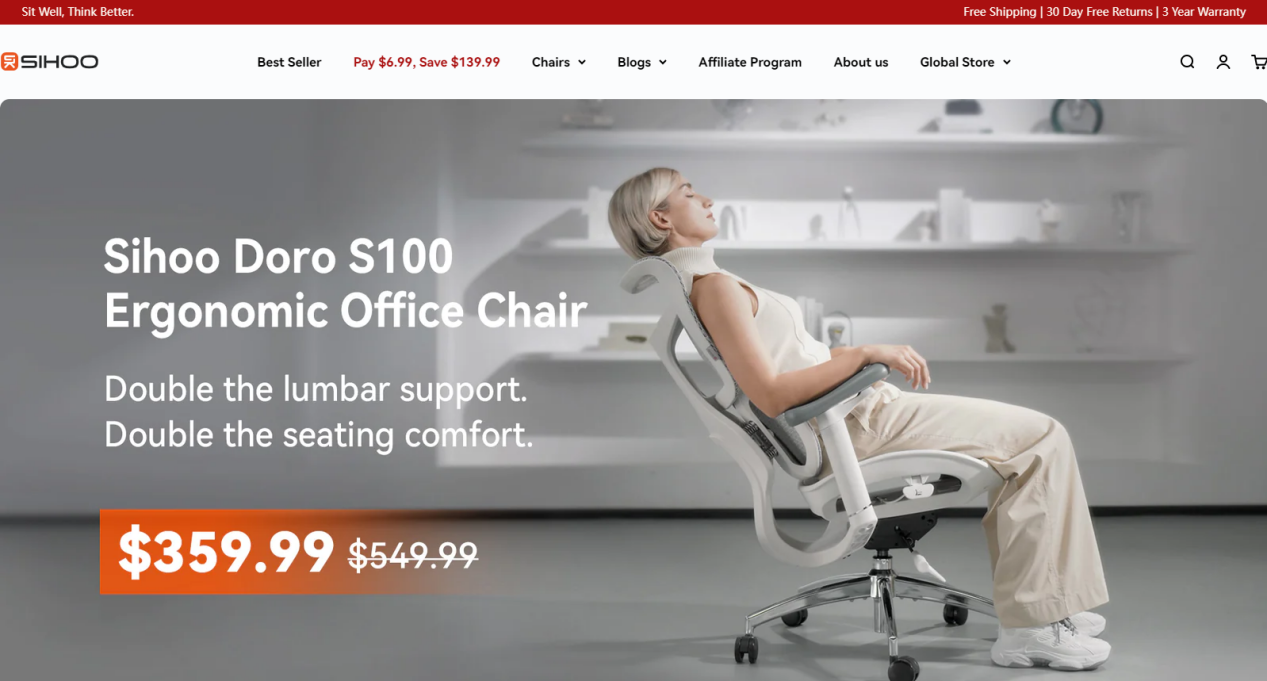
Sihoo overseas independent site
However, Sihoo did not stop there. In order to maintain product competitiveness, it established a dedicated Ergonomics Research Institute, focusing on product design, improvement, and optimization. Every year, Sihoo invests a considerable portion of its sales revenue into R&D to ensure that every chair becomes a market leader.
Today, Sihoo's products are sold in more than 100 countries and regions worldwide, becoming a force to be reckoned with in the international market.
2
The Art of Marketing
If the positive after-sales reviews of Sihoo's ergonomic chairs stem from their superior product design,
then its initial overseas brand awareness came from its unique insights in brand building and marketing.
At a time when social media was already booming, Sihoo knew well that relying solely on traditional marketing channels was not enough to quickly open up overseas markets. So it leveraged the power of social media early on, connecting with consumers through platforms such as YouTube and Facebook, and after TikTok fully entered the North American market, quickly established a presence on TikTok, sharing daily product content and driving traffic to its independent site.

Sihoo's account on Tiktok Image source: TikTok
In addition, Sihoo also collaborated with KOLs for product reviews, accurately targeting its consumer groups and further expanding its brand influence.

Sihoo's collaboration videos with influencers on Tiktok Image source: TikTok
Growing from an inconspicuous small factory to a globally renowned furniture brand, Sihoo did not take many years. What it leveraged was simply keeping up with the trend of the times, utilizing the momentum of this era, combined with the right direction and persistent effort.
A very simple case, but it is enough to prove that domestic brands are fully capable of shining in the international market.
Especially in this era where social media such as TikTok is prevalent and as AI technology penetrates various industries, competition within industries is becoming increasingly fierce. Tuke may not be the only option, but it is the choice most brands currently prefer.
Especially for B2B-type enterprises, when the domestic living space is compressed, Tuke may offer another way to survive.

With the continuous changes in the global economic landscape, the journey of domestic brands Tuke will also face more challenges and opportunities.
But with pioneers like Sihoo, it is believed that more Chinese brands will bravely go abroad and showcase the unique charm of "Made in China".
What this signal means for growth teams
This market signal should be treated as an operating prompt, not a standalone trend. The brand question is whether the team can connect TikTok content, creators, paid media, commerce readiness, and reporting into one measurable growth cycle.
Commercial read
- Market signal: TikTok marketing tips - short video marketing methods
- Published: February 21, 2024
- Commercial lens: TikTok Ads, creators, TikTok Shop, live commerce, and reporting.
- Source transparency: the original source linked in this article
What brands should do next
- Identify the market, audience, product group, and KPI this signal could affect.
- Turn the insight into a small TikTok creative, creator, Shop, or paid media test before scaling spend.
- Add FAQ, offer clarity, product proof, and contact paths so traffic can convert instead of only reading.
- Review weekly performance across reach, click quality, Shop actions, creator output, and revenue impact.
Tuke Marketing helps brands connect TikTok Ads, creator partnerships, TikTok Shop operations, live commerce, and reporting into one accountable operating system.
What should brands do with this TikTok signal?
Brands should translate the signal into a focused operating test across creative, creators, TikTok Shop readiness, paid media, and reporting before increasing budget.
How does Tuke Marketing evaluate this kind of news?
Tuke Marketing reviews platform news through market timing, category demand, creator supply, commerce readiness, and measurable growth actions.
When should a team contact Tuke about this topic?
A team should contact Tuke when it needs to turn a TikTok market signal into a practical launch, creator, advertising, live commerce, or reporting plan.
Source transparency: Tuke cites the original source linked in this article and adds its own operating analysis for brands evaluating TikTok growth decisions.