
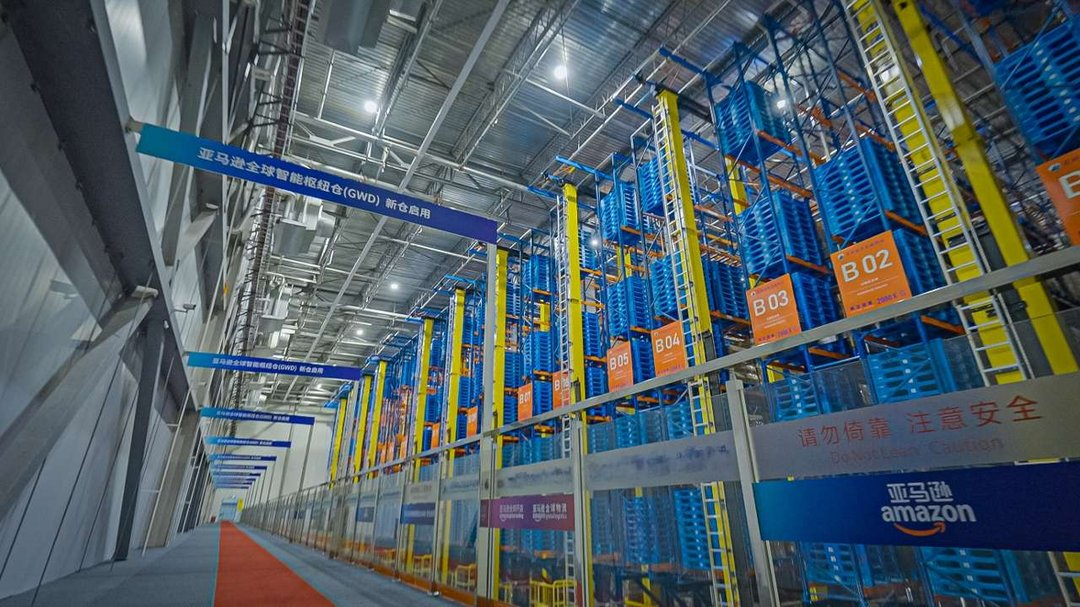
Recently, Amazon's Global Smart Hub (GWD) officially launched the Ningbo distribution center, marking the upgrade of its domestic warehousing layout from a dual-core drive in Shanghai and Shenzhen to a triangular synergy among Shanghai, Shenzhen, and Ningbo.
What is particularly noteworthy is that the Ningbo warehouse charges a storage fee of $7.91/CBM/month, a direct 10% reduction from the $8.79 charged by the Shanghai and Shenzhen warehouses, making it the lowest-rate warehouse among the three.
This move appears to be a simple price adjustment, but in reality, it reflects Amazon's deep ambitions in cross-border supply chain integration, and it has also brought chain reactions to sellers of different scales, the platform ecosystem, and even traditional freight forwarding links.

Image source: Google
The regional strategic intention behind the rate difference
The pricing strategy of the Ningbo warehouse is by no means accidental. From a geographical perspective, the Shanghai warehouse radiates to the northern part of the Yangtze River Delta, the Shenzhen warehouse covers the Pearl River Delta and South China, and the addition of the Ningbo warehouse precisely fills the logistics gap in Zhejiang and surrounding manufacturing hubs.
In the past, sellers in East China who wanted to use GWD services often had to haul goods across cities to Shanghai or send them south to South China, which not only increased short-distance transportation costs but also faced time pressure in warehousing resource allocation.

Image source: Google
Now, the Ningbo warehouse is directly embedded in the hinterland of East China at a lower rate, which is equivalent to saving local sellers a considerable amount of intra-provincial turnover expenses. Especially for lightweight, small-sized, and high-turnover goods, the price difference of nearly $1 per cubic meter can translate into a significant profit buffer when stocking up in large quantities during the peak season.
What is even more intriguing is that Amazon did not reduce prices for the Shanghai and Shenzhen warehouses, but instead created a price gradient by setting up a new warehouse in Ningbo. This differentiated pricing not only avoids revenue fluctuations of existing resources but also cleverly leverages regional cost differences to attract new customers, while testing the market's reaction to price sensitivity. It can be described as killing multiple birds with one stone.
From three-stage outsourcing to a one-stop closed loop
The core of this adjustment is not just a price cut, but the leap in service logic carried by the GWD three-warehouse network.
In the past, sellers handling US-bound replenishment had to deal separately with freight forwarders, customs brokers, and first-leg logistics providers, with fragmented processes and unclear responsibility boundaries. Under GWD's managed model, customs declaration, cross-border transportation, and automatic FBA replenishment are all integrated into Amazon's system. Sellers only need to send goods to the domestic distribution center, and the system will then allocate inventory to US fulfillment centers based on sales data as needed.
Under this model, sellers actually cede part of the control over inventory management to the platform's algorithm, but in return they gain certainty and efficiency: no limits on shipment quantities, no peak-season surcharges, no long-term commitments, plus a 30-day free storage window until December 31, which is equivalent to providing a zero-cost stocking buffer for the Q4 peak season.

Image source: Google
For small and medium-sized sellers lacking a professional supply chain team, this means they no longer need to worry about first-leg shipping schedule fluctuations or customs clearance delays, but can focus more on product selection and operations.
However, it also means sellers need to predict sales trends more accurately, because the system's automatic replenishment rhythm completely depends on the stability of historical data. If there is a cliff-like fluctuation, they may face inventory overstocking or delayed replenishment risks.
Short-term dividends and long-term games
In the short term, the low price of the Ningbo warehouse and the free period policy directly reduce the trial-and-error costs for East China sellers. Especially for seasonal products or new product tests, sellers can place safety stock in domestic distribution centers in advance rather than pressuring it into overseas warehouses at high prices, which not only avoids unsold surplus but also maintains sellable status when the front end is out of stock.
But in the long run, sellers need to re-examine the positioning of their own supply chains. When the platform standardizes the entire chain of first-leg shipping, customs clearance, and replenishment, the space for sellers to differentiate in logistics is compressed, and the convergence of price and service will force competition to migrate upstream toward product strength.

Image source: Google
In addition, relying on a single platform's managed services means that data assets and operational rhythm are more deeply embedded in the Amazon ecosystem. Once the platform adjusts policies or rates, sellers' room for maneuver may be limited.
Therefore, experienced sellers may adopt a hybrid strategy: using GWD to guarantee basic supply for core bestsellers, while retaining some independent logistics channels for long-tail or high-margin products to diversify risks.
Conclusion
The rate reduction at Amazon's GWD Ningbo warehouse and the three-warehouse layout appear on the surface to optimize regional warehousing resources, but in essence represent a forceful push by the platform toward standardization and consolidation of cross-border logistics.
It is foreseeable that with the Q4 peak season approaching, the free window at the Ningbo warehouse will attract a wave of trial traffic, while the long-term effect will depend on whether Amazon can retain sufficient flexibility in its standardized services to accommodate the real needs of sellers across different categories and sizes.
What this signal means for growth teams
This market signal should be treated as an operating prompt, not a standalone trend. The brand question is whether the team can connect TikTok content, creators, paid media, commerce readiness, and reporting into one measurable growth cycle.
Commercial read
- Market signal: TikTok Marketing Information and Solutions
- Published: September 7, 2026
- Commercial lens: TikTok Ads, creators, TikTok Shop, live commerce, and reporting.
- Source transparency: the original source linked in this article
What brands should do next
- Identify the market, audience, product group, and KPI this signal could affect.
- Turn the insight into a small TikTok creative, creator, Shop, or paid media test before scaling spend.
- Add FAQ, offer clarity, product proof, and contact paths so traffic can convert instead of only reading.
- Review weekly performance across reach, click quality, Shop actions, creator output, and revenue impact.
Tuke Marketing helps brands connect TikTok Ads, creator partnerships, TikTok Shop operations, live commerce, and reporting into one accountable operating system.
What should brands do with this TikTok signal?
Brands should translate the signal into a focused operating test across creative, creators, TikTok Shop readiness, paid media, and reporting before increasing budget.
How does Tuke Marketing evaluate this kind of news?
Tuke Marketing reviews platform news through market timing, category demand, creator supply, commerce readiness, and measurable growth actions.
When should a team contact Tuke about this topic?
A team should contact Tuke when it needs to turn a TikTok market signal into a practical launch, creator, advertising, live commerce, or reporting plan.
Source transparency: Tuke cites the original source linked in this article and adds its own operating analysis for brands evaluating TikTok growth decisions.