
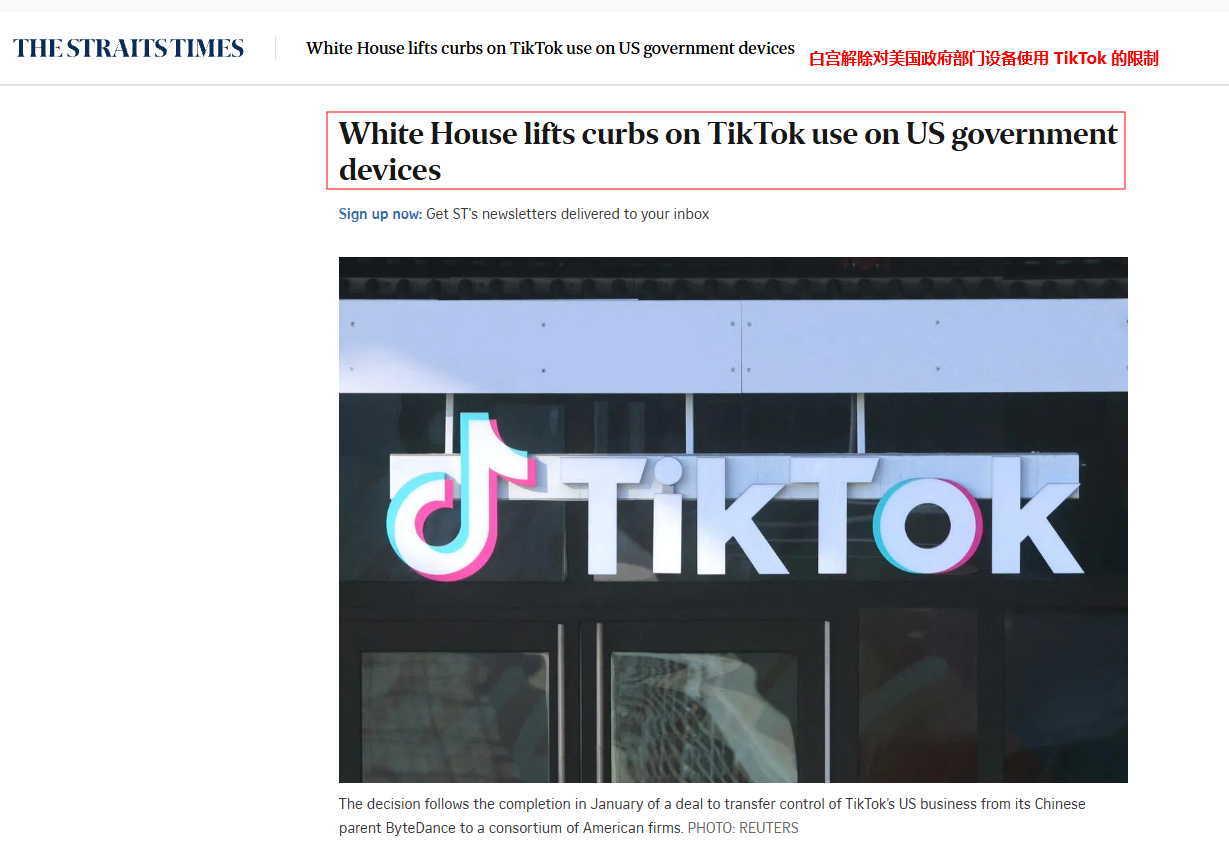
Recently, a federal-level restriction targeting TikTok was formally revoked.
The White House Office of Management and Budget (OMB) issued a directive abolishing the 2023 regulation that banned TikTok on U.S. federal government devices. The direct basis for this administrative adjustment came from a written opinion issued by the U.S. Department of Justice last month.

Source: straitstimes
The opinion determined that TikTok's U.S. operations now have a shareholding structure in which American investors hold a majority stake, its operating system is independent from ByteDance, and its content recommendation algorithm and cybersecurity system have been adjusted to no longer meet the definition of a 'regulated application' under the relevant 2022 legislation.
Accordingly, the White House confirmed that the platform 'no longer poses a national security threat.'

Source: straitstimes
The revocation of this administrative directive signifies a key turning point in the U.S. government's risk assessment of TikTok. The evaluation criteria have shifted from the previous focus on the parent company's place of registration to a focus on equity control and actual operations.
Although the direct scope of the ban was limited to federal government devices, its lifting carries strong symbolic significance, indicating that the policy environment surrounding TikTok's U.S. business ecosystem is entering a new phase backed by judicial opinions.
The platform's development foundation has stabilized, and its long-term strategy has become clear.
The lifting of the ban first removes a significant policy obstacle to the development of TikTok's U.S. platform itself.
Over the past two years, the federal-level ban, while having limited impact on ordinary users, remained a substantive disruptive factor hanging over the platform's commercialization process. It directly affected brand partners' decision-making cycles and, to some extent, constrained the platform's expectations for long-term investment in localized services, data center construction, and other areas.
Now, with the compliance framework re-established, TikTok's operating entity in the U.S. has obtained a clear legal identity. This will directly drive changes in three aspects:
First, the platform's cooperation with key infrastructure partners such as payment institutions and logistics service providers will become smoother, reducing transaction friction costs caused by policy fluctuations.

Source: Google
Second, the platform's internal resource planning and traffic allocation plans for major promotional periods (such as the year-end shopping season) will have stronger certainty and execution capability.
Third, the weight of policy risk factors in attracting senior management talent and expanding local team size will be significantly reduced.
It can be said that this lifting of the ban provides the necessary stability cornerstone for TikTok's U.S. strategic layout over the next three to five years.
Cross-border sellers' confidence in ad spending is recovering, and operational focus is returning to business fundamentals.
For cross-border sellers who rely on TikTok traffic, the most direct change brought by this lifting of the ban is in market confidence.
The previous policy uncertainty led some brand owners to tend to treat TikTok as an incremental or testing channel when formulating annual marketing budgets, rather than a core conversion platform. This mentality caused sellers to be conservative in ad bidding strategies or to hold back on inventory depth.
As the policy risk discount fades, more brand owners who were on the sidelines—especially those in categories with high regulatory compliance requirements (such as consumer electronics and personal care products)—are expected to accelerate their return to TikTok's advertising lineup.

Source: TikTok shop
Although this trend may push up the cost of traffic competition in the short term, it also means that the coverage and user quality of the entire traffic ecosystem will become more solid.
Sellers should seize this window period and fully shift their operational focus from monitoring policy changes to refined improvements in product selection, creative content, and store conversion rates. Meanwhile, top influencers and content creators will see a significant reduction in concerns about long-term in-depth cooperation with the platform, providing a better external environment for sellers to build stable and efficient influencer matrices.

Image source: Google
Conclusion
The U.S. federal government's removal of restrictions on the use of TikTok on government devices is a landmark policy correction. It pulls TikTok's U.S. business back from the margin of prolonged legal disputes onto the track of normal commercial competition.
For companies going global, this marks both the end of a period of uncertainty and the beginning of a new phase of competition. With the compliance framework now clear, the market's judging power will once again be fully returned to consumers and commercial efficiency itself.
Next, how to build a sustainable brand growth path in this more stable ecosystem will be the core issue for all participants.
What this signal means for growth teams
This market signal should be treated as an operating prompt, not a standalone trend. The brand question is whether the team can connect TikTok content, creators, paid media, commerce readiness, and reporting into one measurable growth cycle.
Commercial read
- Market signal: TikTok Marketing Information and Solutions
- Published: August 20, 2026
- Commercial lens: TikTok Ads, creators, TikTok Shop, live commerce, and reporting.
- Source transparency: the original source linked in this article
What brands should do next
- Identify the market, audience, product group, and KPI this signal could affect.
- Turn the insight into a small TikTok creative, creator, Shop, or paid media test before scaling spend.
- Add FAQ, offer clarity, product proof, and contact paths so traffic can convert instead of only reading.
- Review weekly performance across reach, click quality, Shop actions, creator output, and revenue impact.
Tuke Marketing helps brands connect TikTok Ads, creator partnerships, TikTok Shop operations, live commerce, and reporting into one accountable operating system.
What should brands do with this TikTok signal?
Brands should translate the signal into a focused operating test across creative, creators, TikTok Shop readiness, paid media, and reporting before increasing budget.
How does Tuke Marketing evaluate this kind of news?
Tuke Marketing reviews platform news through market timing, category demand, creator supply, commerce readiness, and measurable growth actions.
When should a team contact Tuke about this topic?
A team should contact Tuke when it needs to turn a TikTok market signal into a practical launch, creator, advertising, live commerce, or reporting plan.
Source transparency: Tuke cites the original source linked in this article and adds its own operating analysis for brands evaluating TikTok growth decisions.