
Sellers who have just finished Prime Day haven't had time to catch their breath before a new wave of shipping rate increases hits them.
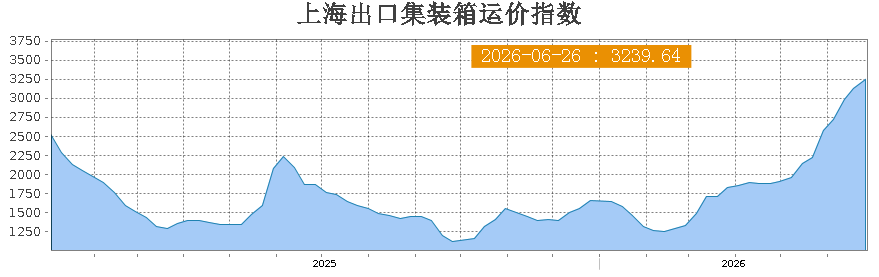
According to data from the Shanghai Shipping Exchange, the Shanghai Containerized Freight Index (SCFI) climbed from 1875.26 points on April 24 to 3239.64 points on June 26. In just over a month, the increase exceeded 72%. What makes sellers even more frustrated is that this marks the ninth consecutive week hitting a new high for the year.

Source: Shanghai Shipping Exchange
Looking at specific routes, the freight rate on the Shanghai to U.S. West Coast route closed at 6067 USD/FEU, up 7% week-on-week; the U.S. East Coast route was 7384 USD/FEU, also up 7% week-on-week. The European direction is equally grim — the Shanghai to North Europe route was 6683 USD/FEU, up 6% week-on-week; the Mediterranean route was approaching five figures, reaching 9332 USD/FEU. Some freight forwarders reported that direct sailings from major ports in East and South China for the period from late June to mid-July on U.S. routes were basically sold out, with container overbooking and rollovers becoming common.
This is not the end.
Entering July, multiple shipping lines continued to increase charges. CMA CGM announced that from July 10, they will impose new peak season surcharges on cargo from Asia to the U.S. and Canada: USD 3,600 for a 20-foot container, USD 4,000 for a 40-foot container, and USD 5,050 for a 45-foot container. These figures are nearly double the standards from April this year — when the corresponding surcharges were USD 1,800, USD 2,000, and USD 2,530 respectively. For a single 40-foot container, this means an extra cost of about USD 2,000 compared to before.

Source: CMA CGM
The scope of price increases is also expanding. Besides North American routes, CMA CGM started imposing peak season surcharges on exports from China to East Africa as of July 1; Maersk also added surcharges on Far East to India and Pakistan routes. The U.S./Canada, Europe/Mediterranean, East Africa, Australia/New Zealand... almost all major routes that sellers commonly use are covered.
Why is this round of price increases so fierce?
In previous years, peak season price increases usually started in late July, but this year they began in late April and have been rising consecutively. Several factors are converging behind this.
First is the change in U.S. tariff policy. In July, two Section 301 tariffs are about to take effect: one related to forced labor issues and the other addressing manufacturing overcapacity. U.S. buyers are rushing to ship goods before the tariffs take effect, leading to concentrated shipments and directly driving up logistics costs across the entire chain. Simply put, everyone is scrambling to ship, so container space naturally becomes tight.
Second is the impact of the Red Sea shipping crisis. Vessels rerouting via the Cape of Good Hope have significantly longer voyages, slower turnaround times, and effective capacity continues to tighten. Although new capacity is being added to the market on the surface, under the combined effects of diversions, delays, and port congestion, the actual container space available for popular routes is not as abundant as imagined.
Then there is the compounding effect of peak season restocking. Prime Day has just ended, and sellers have consumed a lot of inventory, leading to a concentrated surge in replenishment demand. Coupled with the opening of stocking windows for back-to-school, Halloween, Black Friday and other year-end promotions, shipment demand is piling up together.

Source: Amazon
There is also an easily overlooked factor: the structural issue of container space allocation.
According to industry insiders, about 70% of the space on a vessel is usually locked in by large shippers through long-term contracts, and the freight rates for this portion are relatively fixed.
Recently, large shippers have been shipping in a concentrated manner according to their contracts, taking up most of the space, resulting in a sharp reduction in available container space for the spot market. For small and medium-sized sellers without long-term agreements, they have to scramble for the remaining space in the spot market, naturally driving up prices.
What to do next?
In the face of this situation, there are several strategies to consider.
First, secure container space early to lock in freight rates. The market generally expects that rate adjustments in July are still ongoing, and 'the longer you wait, the more you pay' is not a scare tactic. Try to arrange shipments as early as possible; staggering shipments to avoid rate peaks is also a feasible strategy.
Second, re-evaluate product mix. Frequent fluctuations in logistics costs have a particularly significant impact on low-margin, high-volume categories. Instead of struggling with thin profits, consider how to increase pricing power through product upgrades and brand building, using higher average order values to offset rising logistics costs.
Third, explore the possibility of long-term contracts. For sellers with stable shipping volumes, it is worth looking into the requirements and conditions for signing long-term agreements with shipping lines. Although long-term contract rates will also adjust with the market, they at least offer more certainty than going with the flow in the spot market.
This wave of increases in the shipping market has lasted from late April to the present, and there are no clear signs of a significant downturn in the short term.
For sellers, instead of passively accepting each price increase notice, it's better to take advantage of this window to reassess both logistics and product strategies. After all, on the cross-border e-commerce track, only those who can control costs can outrun the competition.
What this signal means for growth teams
This market signal should be treated as an operating prompt, not a standalone trend. The brand question is whether the team can connect TikTok content, creators, paid media, commerce readiness, and reporting into one measurable growth cycle.
Commercial read
- Market signal: TikTok Marketing Information and Solutions
- Published: July 8, 2026
- Commercial lens: TikTok Ads, creators, TikTok Shop, live commerce, and reporting.
- Source transparency: the original source linked in this article
What brands should do next
- Identify the market, audience, product group, and KPI this signal could affect.
- Turn the insight into a small TikTok creative, creator, Shop, or paid media test before scaling spend.
- Add FAQ, offer clarity, product proof, and contact paths so traffic can convert instead of only reading.
- Review weekly performance across reach, click quality, Shop actions, creator output, and revenue impact.
Tuke Marketing helps brands connect TikTok Ads, creator partnerships, TikTok Shop operations, live commerce, and reporting into one accountable operating system.
What should brands do with this TikTok signal?
Brands should translate the signal into a focused operating test across creative, creators, TikTok Shop readiness, paid media, and reporting before increasing budget.
How does Tuke Marketing evaluate this kind of news?
Tuke Marketing reviews platform news through market timing, category demand, creator supply, commerce readiness, and measurable growth actions.
When should a team contact Tuke about this topic?
A team should contact Tuke when it needs to turn a TikTok market signal into a practical launch, creator, advertising, live commerce, or reporting plan.
Source transparency: Tuke cites the original source linked in this article and adds its own operating analysis for brands evaluating TikTok growth decisions.