
On June 16, the “2026 Cross-Border E-Commerce Development Conference”, co-hosted by the China Service Trade Association and the World Trade Points Federation, was held in Langfang, Hebei.
The theme of this conference is“Build a credible trade mechanism, help brands go global.” From Jiang Xiaojuan, professor at the University of Chinese Academy of Social Sciences, proposing “native globalization,” to the World Trade Points Federation discussing a global credible trade system, to multiple leading companies sharing AI, private domain e-commerce, and brand going-global practices, the site released an increasingly clear signal:
Chinese brands going global are entering a new stage of competition.
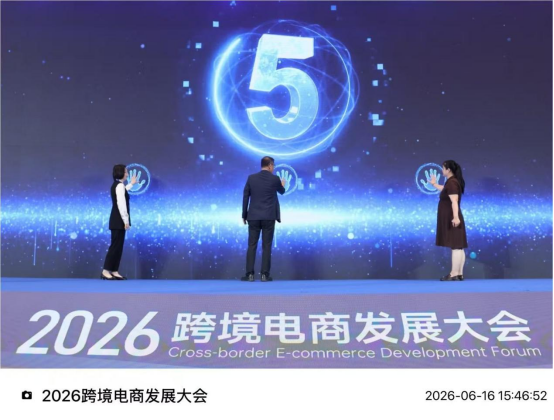
Image source:2026 Cross-Border E-Commerce Development Conference site
In the past, the most discussed topics in the cross-border e-commerce industry were platforms, traffic, logistics, and supply chains. However, as global market competition intensifies, relying solely on product and price advantages has become insufficient for building long-term competitiveness.
For more and more Chinese enterprises, the real issue that needs to be solved has shifted from“how to sell products” to “how to make overseas users trust you.”
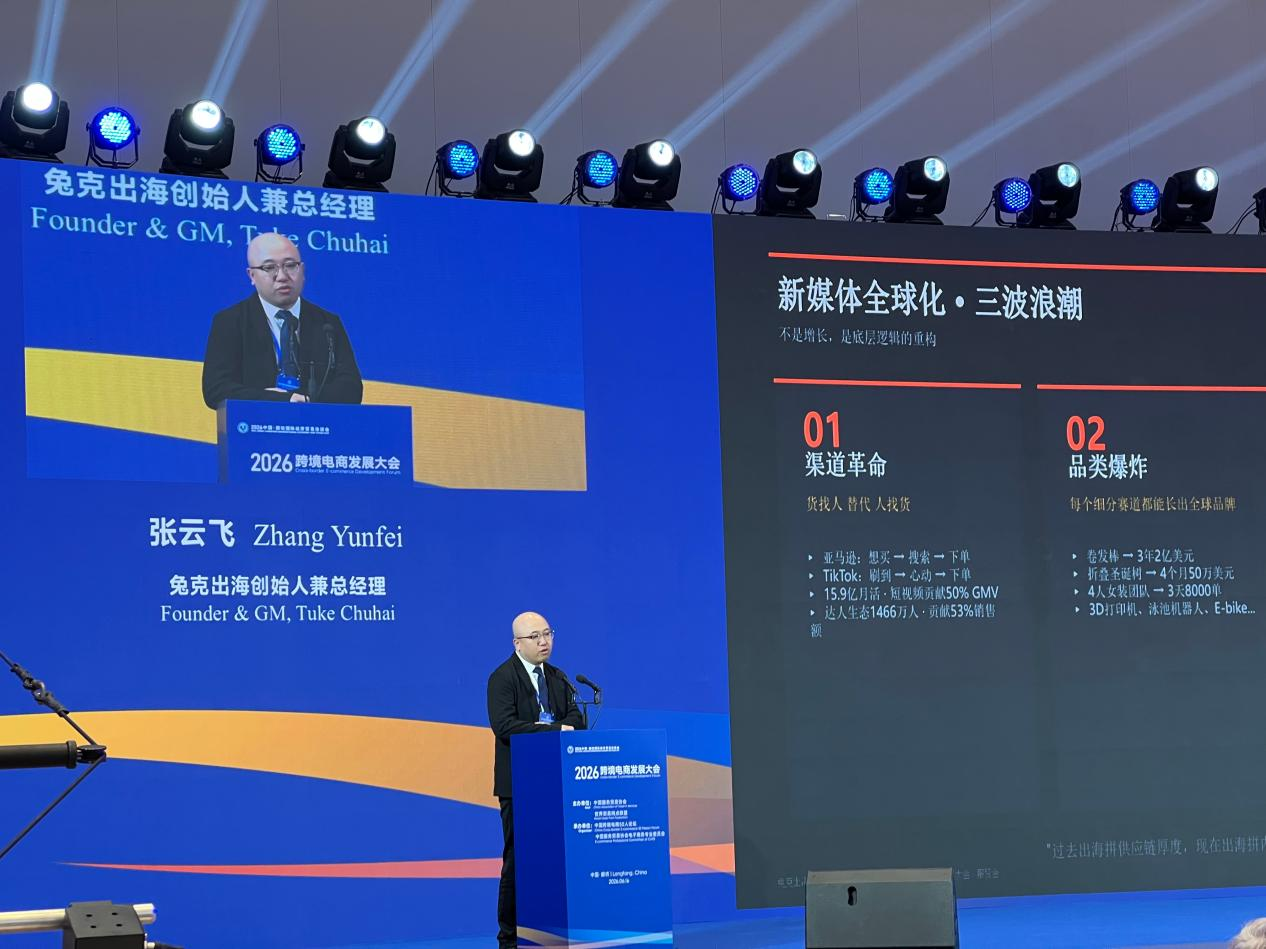
During the project roadshow session,Tuke Global Founder andCEO Zhang Yunfeibrought a keynote sharing titled “New Media Globalization: New Opportunities for Explosive Growth of Chinese Brands Going Global.” He put forward a viewpoint at the site:
“The first half of cross-border e-commerce is supply chain going global; the second half is content going global.”
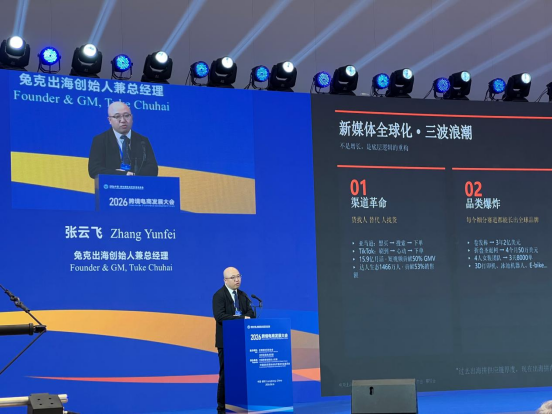
Image source:2026 Cross-Border E-Commerce Development Conference site
This statement actually reflects the changes in global consumption logic.
Over the past decade or so, Chinese enterprises have opened up overseas markets by relying on strong supply chain capabilities. Abundant industrial belt resources, rapid response capabilities, and a mature manufacturing system have made “Made in China” an important force in the global market.
But today, the overseas market is no longer short of goods.
Whether it is household items, beauty and personal care, or electric vehicles, pool robots,3D printers and other hot tracks, consumers are faced with more and more choices. For brands, the real difficulty is no longer selling products overseas, but how to make users believe that your product is worth buying.
This is exactly the reason repeatedly mentioned at this conferencefor “credible trade.”
World Trade Points Federation Chairman Bruno·In his speech at the conference, Maciej mentioned that trust is the most important 'currency' for digital trade.
It sounds like an industry concept, but when it comes to business operations, it's actually very specific:
Why are users willing to click on your ad?
Why are they willing to leave their contact information?
Why are they willing to complete their first purchase?
At the core of these questions lies trust.

Image source:2026 Cross-Border E-Commerce Development Conference Site
During his speech, Mr. Zhang shared a set of data:
TikTok Shop's global GMV is expected to reach $150 billion by 2026. From $33 billion in 2024 to $65 billion in 2025, and then to $150 billion in 2026, the platform's growth rate is noteworthy.
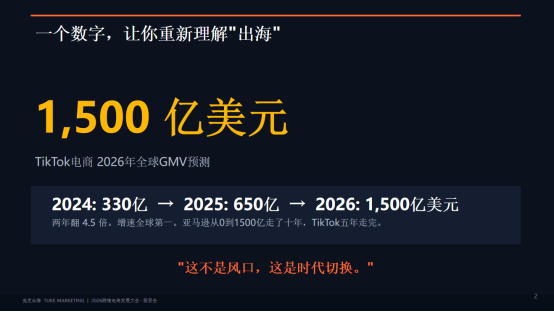
But in his view, compared tothe GMV growth itself, what deserves more attention is the change in consumer decision-making paths.
In the past, it was‘people searching for products.’
Users entered the platform with clear needs, completing purchases through searches, price comparisons, and reviewing evaluations.
Today, more and more often, it is‘products finding people.’
A user watching a short video, seeing a recommendation from a KOL, or entering a live stream can all become key touchpoints that drive a purchase.
In other words, in the past, brands waited on shelves for consumers to discover them, but today, brands need to proactively enter consumers' information flows.In the past, the traffic entry point was the search box, but today, the traffic entry point is becoming content.
This change is reshaping the way brands go global.
In Mr. Zhang's view,Content going global is most easily misunderstood as making videos, managing accounts, or starting live streams. But the real problem content solves is not traffic—it's trust.
For overseas users, they cannot see the production processes of Chinese factories, nor do they understand the company's R&D capabilities and quality standards. If this information cannot be effectively conveyed, even the best products will struggle to build awareness.
And content is precisely what makes these previously invisible capabilities visible.
Real factory scenes, product testing processes, user feedback, and brand stories are all helping enterprises build trust.
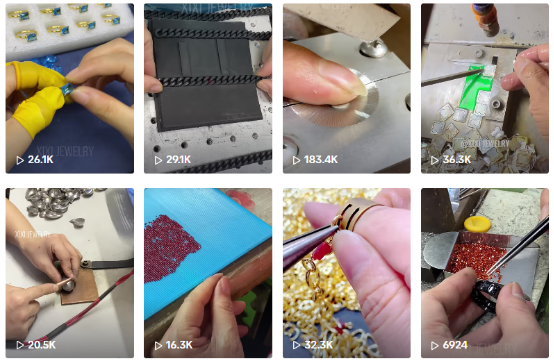
A video of jewelry processing in a factory Source:TikTok
From this perspective, the essence of content going global is not dissemination, but trust building.
In response to these changes, Tuke has been continuously exploring new paths for brand globalization in recent years. Whether it isB2B social media customer acquisition, TikTok e-commerce full-chain operations, or O2O live streaming dispatching — essentially all address the same issue: helping Chinese brands build trust overseas.
Looking back at this conference,“Trusted Trade” and “Content Going Global” are actually talking about the same thing.
Trusted Trade solves the trust issue at the rule level, while Content Going Global solves the trust issue at the brand level.
The supply chain solves the issue of whether there are good products.
Content solves the issue of why users are willing to trust your products.
In the past decade, Made in China has solvedthe problem of “making the products”; in the next decade, Chinese brands need to solve the problem of “making the world believe in you.”
When the global market enters the stage of brand competition, content is no longer just a marketing tool but is becoming a new infrastructure for Chinese brands to go global.
And this may be exactly an important signal released by this Cross-border E-commerce Development Conference.
What this signal means for growth teams
This market signal should be treated as an operating prompt, not a standalone trend. The brand question is whether the team can connect TikTok content, creators, paid media, commerce readiness, and reporting into one measurable growth cycle.
Commercial read
- Market signal: TikTok Marketing Information and Solutions
- Published: June 24, 2026
- Commercial lens: TikTok Ads, creators, TikTok Shop, live commerce, and reporting.
- Source transparency: the original source linked in this article
What brands should do next
- Identify the market, audience, product group, and KPI this signal could affect.
- Turn the insight into a small TikTok creative, creator, Shop, or paid media test before scaling spend.
- Add FAQ, offer clarity, product proof, and contact paths so traffic can convert instead of only reading.
- Review weekly performance across reach, click quality, Shop actions, creator output, and revenue impact.
Tuke Marketing helps brands connect TikTok Ads, creator partnerships, TikTok Shop operations, live commerce, and reporting into one accountable operating system.
What should brands do with this TikTok signal?
Brands should translate the signal into a focused operating test across creative, creators, TikTok Shop readiness, paid media, and reporting before increasing budget.
How does Tuke Marketing evaluate this kind of news?
Tuke Marketing reviews platform news through market timing, category demand, creator supply, commerce readiness, and measurable growth actions.
When should a team contact Tuke about this topic?
A team should contact Tuke when it needs to turn a TikTok market signal into a practical launch, creator, advertising, live commerce, or reporting plan.
Source transparency: Tuke cites the original source linked in this article and adds its own operating analysis for brands evaluating TikTok growth decisions.