
Recently,“store closure” has become a high-frequency term in the TikTok Shop seller community.
Many sellers suddenly saw pop-ups in their backend saying"Abnormal business entity information" or "Tax registration information does not match", and their stores directly entered the "retiring" status, funds frozen, without even having time to click the appeal window.
And these closed stores have one thing in common——they were all bought.
The backend is bound to the buyer’s contact information, but the business license and legal entity are still held by the original seller.
As insiders say: In the past, buying a store was for convenience and old store weight; now, looking back, it’s not buying a store, it’s burying a landmine for yourself, and the fuse has already burned to the end.
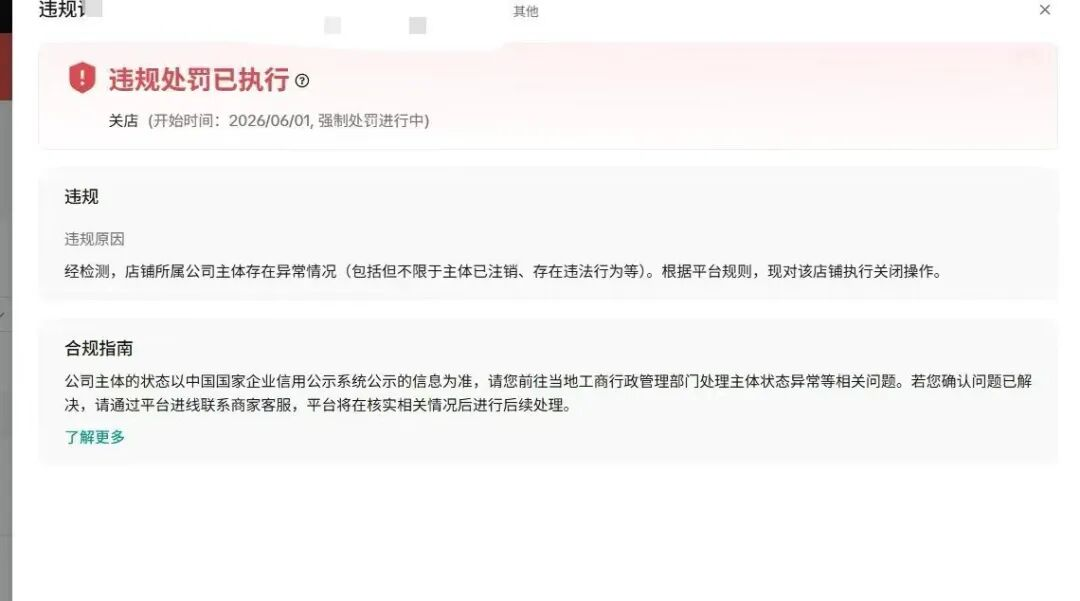
Image source: Internet
Why has “affiliation” suddenly become unworkable?
Let’s clarify the logic of this gray operation, it’s actually not complicated at all.
There has long been a practice in the store transfer market: the buyer pays, the service provider helps you change the phone number, email, and payment account in the backend to the buyer’s, but the business license and legal entity at the business registration level——remain unchanged.
Because“complete transfer”means going through business registration changes, tax liquidation, reopening bank accounts, platform qualification re-review… The whole process is time-consuming and labor-intensive, and you also have to deal with the division of tax responsibilities for historical orders. So many people choose a makeshift solution: I manage the store, but the entity is still your name.
This is the so-called affiliation model,On the surface, everything operates normally, the original legal person occasionally cooperates to scan a face or receive a verification code, and business continues as usual. During the stage when tax and regulation were relatively loose, this edge-ball approach did“work”.
But the problem is: the current regulatory environment no longer lets you muddle through.

Image source: Internet
Several changes have stacked together to block this path completely:
First, platform-sideKYC keeps upgrading.
TikTok Shop has been increasing the granularity of seller identity verification in the past two years, checking both sides of documents, representative information, and cross-checking entity consistency,Once the system finds"actual operator ≠ registered entity", it will mark as high risk. Especially since account reselling is a clear red line prohibited by the platform, once identified, the handling is to cut off from the root, not to give you a chance to rectify.
Second, tax-level penetration has started to take effect.
Domestic tax authorities require internet platform companies to report tax-related information of overseas operators relying on the platform,Identity information+income information must be fully reported, and the store’s unique identifier cannot be changed, ensuring the data chain is traceable. This means: how much turnover a store generates, whose name it’s under, where the funds go, there is a complete reconciliation path in the system.
Third, and the most fatal point——even if the original entity cooperates with the transfer, you still have to face historical burdens.
If the business license under the original legal person had tax flaws, arrears, or unreported records, you as the new owner may not be able to cut cleanly. You think you’re buying a store, but you may actually be inheriting tax debts and risks left by the previous owner.
Image source: Internet
Another headache: Even if you are compliant, the algorithm may still“misfire”
Alongside entity store closures, there is another scenario that makes sellers feel even more powerless.
Some sellers report: they sell genuine products, their supply chain is fine, but suddenly receive“Violation of anti-counterfeiting policy”notification——store closed directly, points deducted, withdrawal suspended, and the platform does not specify which product link triggered it. When appealing, there’s no way to investigate, only to anxiously wait through the window period of several days.
This is not new in the industry. Before major promotions, platform risk control algorithms usually increase sensitivity, and the following situations may be flagged as risks by the system:
-Supply chain traceability materials are not complete enough (even if the goods are genuine, missing an upstream invoice may get stuck)
-Customer complaint rate or refund rate fluctuates abnormally in the short term
Store device/IP/payment information is somehow associated with certain blacklisted accounts
-System judgment logic is probabilistic, but the consequence of store closure is definite.
This is why industry insiders suggest: Don’t trust so-called“guaranteed appeal success”third-party services. The truly useful approach is to align every policy clause mentioned in the notification word for word, organize all proof of genuine product sources according to platform requirements, and focus on what you can prove during appeal, not just your grievances.
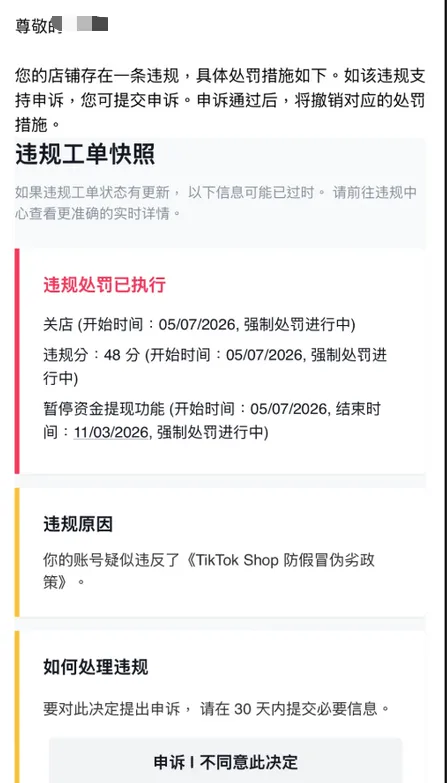
Image source: Internet
This wave of store closures points to something very simple: orders, funds, entity, and payment must all be in sync, and every step must withstand backtracking.
For sellers still operating in the gray area of“affiliation”, the most pragmatic move is not to look for more expensive “guaranteed channels”, but to stop and conduct a thorough compliance inventory.Whose entity is it, is the license clean, are there any tax tails, is the platform-reported information and documents perfectly matched.These are the load-bearing walls at the foundation; if the wall cracks, no matter how many bestsellers you build on top, it will collapse.
Compliance costs are indeed rising, but think about it the other way: when the soil for“document stores”and“nominal stores”is cleared, sellers who seriously pursue long-term operations won’t be undercut by low-priced gray industry anymore. The platform doesn’t necessarily want to drive anyone out, but wants everyone who stays to be legitimate and aboveboard.
What this signal means for growth teams
This market signal should be treated as an operating prompt, not a standalone trend. The brand question is whether the team can connect TikTok content, creators, paid media, commerce readiness, and reporting into one measurable growth cycle.
Commercial read
- Market signal: TikTok Marketing Information and Solutions
- Published: June 11, 2026
- Commercial lens: TikTok Ads, creators, TikTok Shop, live commerce, and reporting.
- Source transparency: the original source linked in this article
What brands should do next
- Identify the market, audience, product group, and KPI this signal could affect.
- Turn the insight into a small TikTok creative, creator, Shop, or paid media test before scaling spend.
- Add FAQ, offer clarity, product proof, and contact paths so traffic can convert instead of only reading.
- Review weekly performance across reach, click quality, Shop actions, creator output, and revenue impact.
Tuke Marketing helps brands connect TikTok Ads, creator partnerships, TikTok Shop operations, live commerce, and reporting into one accountable operating system.
What should brands do with this TikTok signal?
Brands should translate the signal into a focused operating test across creative, creators, TikTok Shop readiness, paid media, and reporting before increasing budget.
How does Tuke Marketing evaluate this kind of news?
Tuke Marketing reviews platform news through market timing, category demand, creator supply, commerce readiness, and measurable growth actions.
When should a team contact Tuke about this topic?
A team should contact Tuke when it needs to turn a TikTok market signal into a practical launch, creator, advertising, live commerce, or reporting plan.
Source transparency: Tuke cites the original source linked in this article and adds its own operating analysis for brands evaluating TikTok growth decisions.