
There is never a shortage of thrilling plots in the cross-border e-commerce industry.
Earlier this year, rumors and implementation of the US canceling the de minimis tax exemption policy for Chinese small parcels once made the industry worried forTuke. After all, this platform, which started with "direct mail small parcels," has largely relied on tax exemption benefits to maintain its ultra-low prices in the past.
However, the latest data from market research agencySimilarweb gave a surprising answer: Tuke's US site visits in April rebounded to about 353 million, up 5.55% from March. This figure has basically recovered the traffic lost due to policy changes, and it sends a clear signal to all overseas practitioners that the real demand of end consumers has not faded, and the platform's own adaptability is becoming the key to survival.
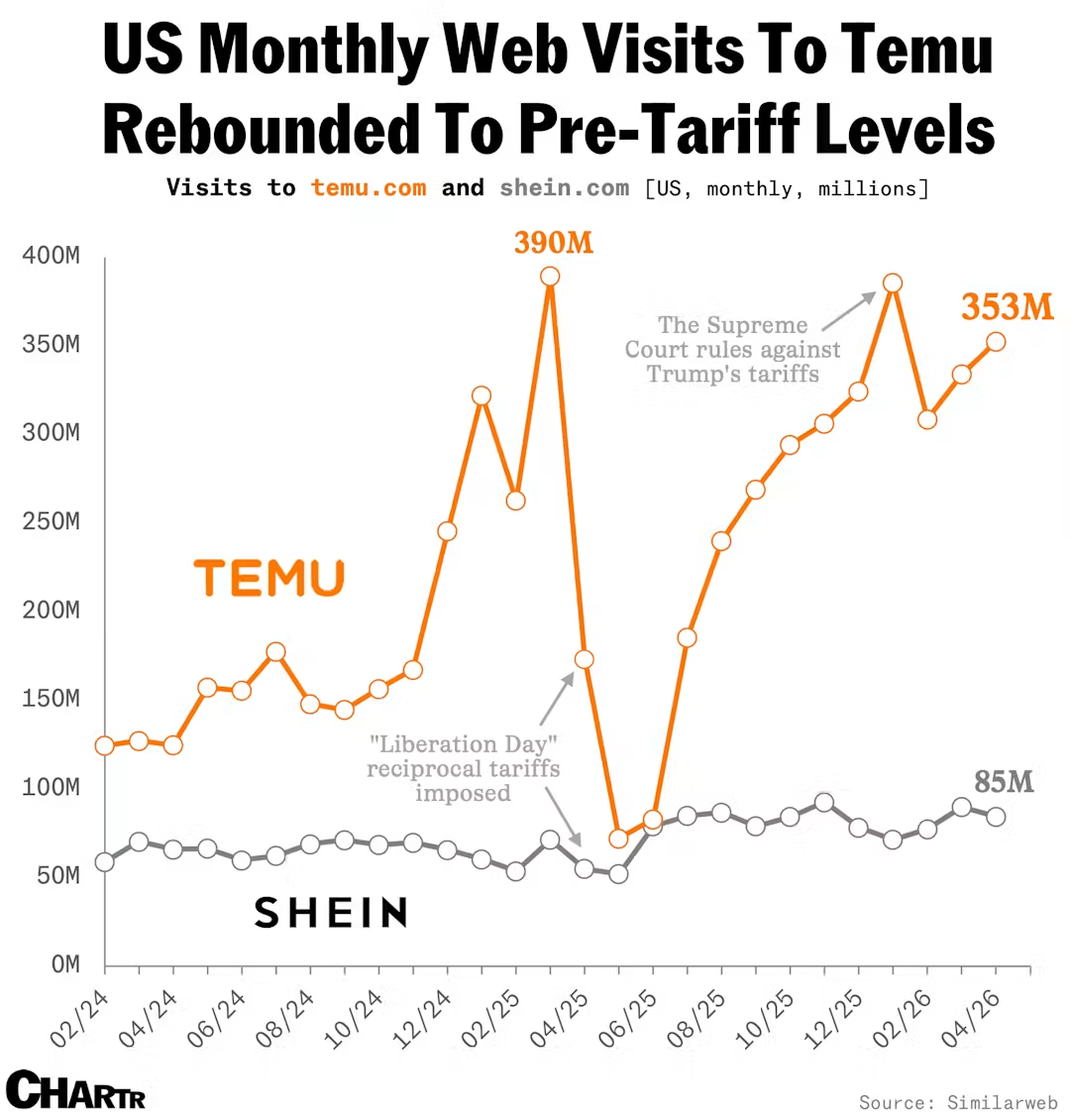
Image source:Sherwood News
I. From Sharp Decline to Rebound: The Consumption Resilience Behind the Traffic Data
Back when news broke that the US would cancel the de minimis tax exemption policy, many analysts predicted that Chinese direct mail e-commerce represented byTuke would be hit hard.
With rising tariff costs, more complicated customs clearance processes, and longer delivery times, it seemed that every link pointed to the same outcome: user loss.
However, the 353 million visits in April, a month-on-month increase of more than five percentage points, refuted the pessimistic view with facts. This data shows that American consumers' enthusiasm for high cost-performance products has not been quickly extinguished by policy adjustments. On the contrary, under the continued pressure of inflation, many families still tend to look for more affordable shopping channels.
Tuke's rebound is essentially the result of the combined effect of "rigid demand for low prices" and "platform adaptability." More importantly, the speed of traffic recovery exceeded expectations, showing that the platform has found an effective way to bypass policy barriers.
Image source:Google
II. Accelerated Implementation of Semi-Managed Model: A Structural Shift
The rebound in visits is not accidental. In the face of drastic changes in tariff and customs clearance policies,Tuke did not wait passively, but quickly launched major adjustments to its operational strategy.
The core move was to vigorously promote the semi-managed model and actively recruit local US sellers. At the same time, the platform guided existing merchants to stock goods in advance in US local warehouses, realizing the shift from"China direct mail" to "US local delivery".
This transformation seems to be just an adjustment of logistics routes, but in fact it involves the restructuring of the entire business model.
By shipping locally, the platform can greatly reduce the per-order tariff cost caused by the cancellation of the de minimis tax exemption, while avoiding uncertainties in the customs clearance process. Since the goods are already in the US, customs clearance issues are resolved at the warehousing stage, and consumers no longer have to wait for long international shipping and customs inspection after placing an order. Delivery time is shortened from the previous ten days or more to three to five days or even less, greatly improving user experience.
It can be said that the combination of semi-managed and local stocking has helpedTuke stabilize its core traffic and order base amid tightening policies.

Image source:Google
III. Deeper Impact on Sellers: Reshaping Stocking Logic and Rising Capital Pressure
For sellers operating onTuke, the platform's tilt toward semi-managed and local stocking means that the business logic is undergoing fundamental changes.
In the past, most sellers adopted a no-inventory or light-inventory model, shipping directly from China after receiving orders, with little capital occupation and controllable risk. But now, to meet the platform's local delivery requirements, sellers have to ship goods in bulk by sea or air to US warehouses in advance.
This first brings a significant increase in capital pressure, as pre-positioned inventory means that a large amount of procurement and logistics costs are tied up before the goods are sold. Secondly, inventory management risk is also amplified. If product selection is wrong or market demand fluctuates, goods piled up in US warehouses will face slow sales, rising storage fees, and the dilemma of clearance at a discount.
In addition, sellers need to recalculate their cost structure: although tariffs may be optimized through bulk customs clearance, US domestic storage fees, last-mile delivery fees, and capital turnover costs all need to be included in the pricing model. For small and medium-sized sellers, this undoubtedly raises the entry threshold.
Those merchants with weak capital strength and slow supply chain response may be eliminated in the transformation process. On the contrary, sellers with strong stocking ability and product selection experience have the opportunity to further consolidate their market share by taking advantage of the platform's traffic rebound.

Image source:Google
Conclusion
The 353 million visits published by Similarweb is not just a number, but the answer sheet submitted by Tuke after experiencing a policy "stress test" in the US market.
Looking to the future, asTuke's localization deepens, its position in the US e-commerce landscape is expected to be further consolidated. Those sellers who can keep up with the platform's pace and take the lead in upgrading their supply chains will also win their own growth space in the new round of reshuffling.
What this signal means for growth teams
This market signal should be treated as an operating prompt, not a standalone trend. The brand question is whether the team can connect TikTok content, creators, paid media, commerce readiness, and reporting into one measurable growth cycle.
Commercial read
- Market signal: TikTok Marketing Information and Solutions
- Published: June 10, 2026
- Commercial lens: TikTok Ads, creators, TikTok Shop, live commerce, and reporting.
- Source transparency: the original source linked in this article
What brands should do next
- Identify the market, audience, product group, and KPI this signal could affect.
- Turn the insight into a small TikTok creative, creator, Shop, or paid media test before scaling spend.
- Add FAQ, offer clarity, product proof, and contact paths so traffic can convert instead of only reading.
- Review weekly performance across reach, click quality, Shop actions, creator output, and revenue impact.
Tuke Marketing helps brands connect TikTok Ads, creator partnerships, TikTok Shop operations, live commerce, and reporting into one accountable operating system.
What should brands do with this TikTok signal?
Brands should translate the signal into a focused operating test across creative, creators, TikTok Shop readiness, paid media, and reporting before increasing budget.
How does Tuke Marketing evaluate this kind of news?
Tuke Marketing reviews platform news through market timing, category demand, creator supply, commerce readiness, and measurable growth actions.
When should a team contact Tuke about this topic?
A team should contact Tuke when it needs to turn a TikTok market signal into a practical launch, creator, advertising, live commerce, or reporting plan.
Source transparency: Tuke cites the original source linked in this article and adds its own operating analysis for brands evaluating TikTok growth decisions.