
Recently, an announcement from Tuke Shop Vietnam has attracted widespread attention from cross-border sellers, as the platform officially launched an account re-verification mechanism. Once the system detects a store with a large number of negative reviews, violations in sales, or other potential risk signals, sellers will be forced to resubmit identity information and business qualifications. Stores that fail to complete verification on time will face strict operational restrictions, and may even risk being shut down.
The implementation of this new regulation marks a substantial step forward in Tuke Shop's compliance governance in the Southeast Asian market, and sends a clear signal to all Tuke sellers: the platform ecosystem is evolving towards greater standardization and transparency.
Image source:Google
I. Re-verification Mechanism Implemented: Which Sellers Will Be “Targeted”?
According to the latest announcement from Tuke Shop Vietnam, this account re-verification is not carried out for all sellers, but adopts a “risk-triggered” model. When the system identifies abnormal conditions in a store through algorithms, the re-verification process will be automatically initiated.
Specifically, the triggering conditions mainly include three categories: first, the store accumulates a large number of negative consumer reviews and the rating continues to decline; second, there are clear violations in sales, such as selling counterfeit goods, prohibited items, or false advertising; third, the system detects other potential risk signals, such as abnormal account login, sudden changes in transaction patterns, or contradictory qualification information.
Once included in the re-verification list, the identity verification requirements for sellers will be stricter than when they first joined. Individual sellers need to provide ID card, full name, date of birth, address, and complete facial scan; business sellers must submit company registration documents, tax number, and registered address.
It is especially noteworthy that individual operators and business households must also upload additional identity information and facial recognition data of the actual controller (UBO). This means that even small businesses must fully disclose their real operating entity. In addition, the entire submission process can only be operated by the store's main account with administrator privileges, and sub-accounts have no authority, further strengthening the non-transferability of account ownership.
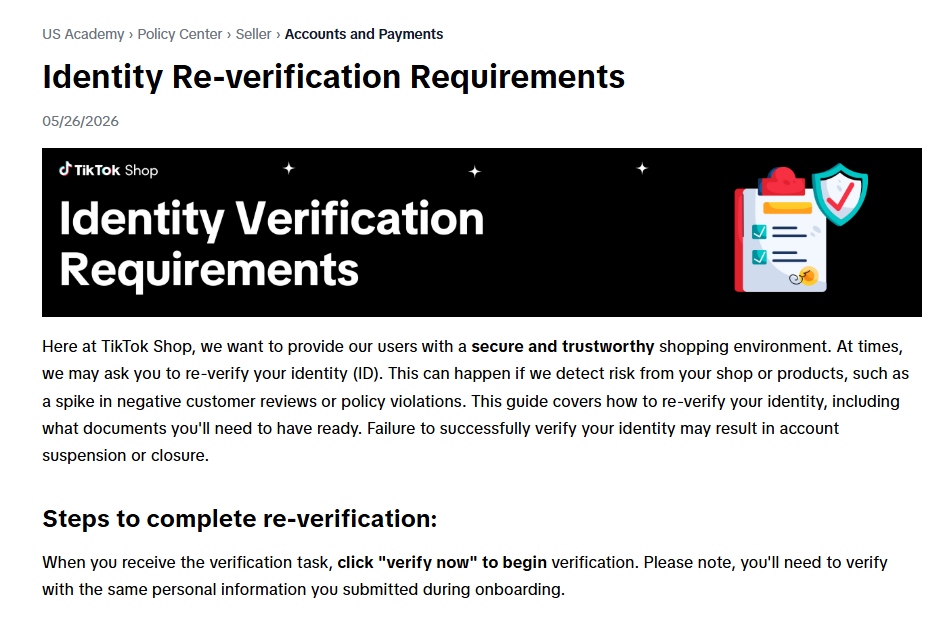
Identity verification process Image source:Tuke
II. Practical Challenges Sellers Face: Operational Interruption Risk and Rising Compliance Costs
For sellers deeply engaged in the Vietnam site, this re-verification mechanism undoubtedly brings double pressure. The most direct impact is the risk of operational interruption. Once a store is required to re-verify, before completing the entire process, the platform will impose operational restrictions——which may include suspending new product listings, limiting traffic exposure, freezing some transaction functions, or even completely closing the store.
For merchants who rely on Tuke short videos and live streaming to achieve stable sales, even just a few days of verification period may lead to a decline in traffic, loss of orders, and decreased fan trust.
Another challenge that cannot be ignored is the rising compliance costs. In the past, many sellers were not strict enough about the authenticity of qualification information when joining, and even borrowed others' documents or blurred corporate structures. Now facing re-verification requirements, if the contact information or document information reserved in the backend has expired, or the actual controller cannot cooperate to complete facial recognition, sellers will be passive. Especially for individual operators and business households, extra disclosure of UBO information is required, which means the platform's inquiry into “who is really running this store” becomes deeper. Sellers with unclear operating entities or incomplete qualification chains will face great difficulty in rectification.
Image source:Google
III. Impact on Platform Development: Short-term Pain for Long-term Trust
From the platform's perspective, the full implementation of the account re-verification mechanism may cause some small and medium-sized sellers to leave in the short term, and may even trigger dissatisfaction among some merchants. But in the long run, this is a necessary step for Tuke Shop Vietnam to consolidate its market position and enhance transaction security.
Competition among e-commerce platforms has long surpassed price and traffic, with compliance and trust becoming key variables for user retention. By eliminating stores with incomplete qualifications or long-term violations, the platform can effectively reduce the risk of consumers encountering fraud,goods not matching descriptionor lack of after-sales service, thereby improving the overall shopping experience. This “good money drives out bad” effect will ultimately attract more quality sellers and brands to join, forming a healthier business ecosystem.
At the same time, this policy also echoes the trend of Southeast Asian countries strengthening regulation of cross-border e-commerce. Vietnam has raised requirements for tax compliance, consumer protection, and data security on e-commerce platforms in recent years. Tuke Shop's proactive upgrade of the verification process is both a positive response to regulatory signals and a way to pave the road for larger-scale market expansion in the future.
Image source:Google
Conclusion
For Tuke sellers, this event is both a challenge and an opportunity for self-examination and upgrade. Merchants who can quickly adapt to compliance requirements and proactively improve qualification information will gain more stable development space in a clearer competitive environment. Conversely, sellers who still hold a fluke mentality and ignore the authenticity of qualifications will eventually be eliminated by the increasingly tight risk control system.
Compliance is turning from a “bonus” into a “ticket to entry”. In the future, we have reason to believe that as the platform's governance capabilities continue to improve, Tuke Shop's commercial value in Vietnam and the entire Southeast Asian market will be more fully unleashed.
What this signal means for growth teams
This market signal should be treated as an operating prompt, not a standalone trend. The brand question is whether the team can connect TikTok content, creators, paid media, commerce readiness, and reporting into one measurable growth cycle.
Commercial read
- Market signal: TikTok Marketing Information and Solutions
- Published: June 4, 2026
- Commercial lens: TikTok Ads, creators, TikTok Shop, live commerce, and reporting.
- Source transparency: the original source linked in this article
What brands should do next
- Identify the market, audience, product group, and KPI this signal could affect.
- Turn the insight into a small TikTok creative, creator, Shop, or paid media test before scaling spend.
- Add FAQ, offer clarity, product proof, and contact paths so traffic can convert instead of only reading.
- Review weekly performance across reach, click quality, Shop actions, creator output, and revenue impact.
Tuke Marketing helps brands connect TikTok Ads, creator partnerships, TikTok Shop operations, live commerce, and reporting into one accountable operating system.
What should brands do with this TikTok signal?
Brands should translate the signal into a focused operating test across creative, creators, TikTok Shop readiness, paid media, and reporting before increasing budget.
How does Tuke Marketing evaluate this kind of news?
Tuke Marketing reviews platform news through market timing, category demand, creator supply, commerce readiness, and measurable growth actions.
When should a team contact Tuke about this topic?
A team should contact Tuke when it needs to turn a TikTok market signal into a practical launch, creator, advertising, live commerce, or reporting plan.
Source transparency: Tuke cites the original source linked in this article and adds its own operating analysis for brands evaluating TikTok growth decisions.