
Recently,Tuke Shop US region has madeamajor adjustment to its return policy: Starting fromJune 2026, for returns caused by buyers changing their minds for reasons such as "no longer needed" or "wrong size," the shipping cost will be directly transferred to the seller.
Althoughthe new regulation has not yet taken effect, it has already attracted the attention and discussion of many sellers.
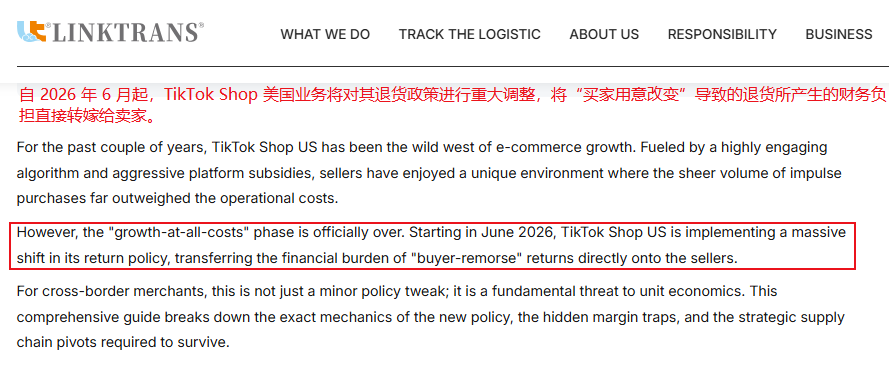
Image source:LINKTRANS
Core of the new regulation: All return-related costs are borne by the seller
According toTuke Shop's published rules, starting from June 2026, regardless of whether the return is due to the buyer or the seller, all related shipping costs will be borne by the seller. In other words, as long as a return occurs, the seller can hardly avoid paying for the shipping.
The only exception is: if all items in a batch return are not the seller's responsibility (i.e., all are due to the buyer),Tuke Shop will bear the return shipping cost; but as long as there is one item in the batch that is the seller's responsibility, the seller will still bear the shipping cost for the entire batch.
This rule design actually makes the seller bear the shipping cost in the vast majority of return scenarios.

Image source:Google
Direct impact on sellers: Significant increase in return cost pressure
The impact of this new regulation on sellers is direct and real. In the past, for returns due to buyer responsibility, the shipping cost was shared by multiple parties, and the seller's share was limited. After the new regulation is implemented, as long as the buyer initiates a return, whether the reason is"wrong size" or "no longer needed," the return shipping cost will fall on the seller.
For categories with already high return rates, such as clothing, shoes, hats, and other non-standard products, this means that monthly operating costs will increase significantly. Sellers need to re-examine their profit models and include return shipping as a fixed expense in their calculations.
What is even more noteworthy is that even if the vast majority of items in a batch return are due to the buyer, as long as there is one item that is the seller's responsibility, the seller will bear the shipping cost for the entire batch.
This"joint liability" mechanism further amplifies the seller's risk exposure. For small and medium-sized sellers who handle a large number of orders every day, any single shipping mistake may lead to additional costs.

Image source:Google
Seller's coping strategies: Optimize in advance, reduce buyer-responsibility returns
Although the new regulation will not officially take effect untilJune 2026, sellers can start preparing now.
Specifically, sellersshouldcarefully study the platform's latest return and refund details to understand which situations are buyer responsibility and which are seller responsibility, to avoid unnecessary costs due to misunderstanding.
Secondly, pricing strategies need to be re-examined, and the expected return shipping costs can be included in the product price to prevent profits from being greatly compressed after the new regulation takes effect.
Last but not least, it is important to improve the information on the product detail page. Many buyers return products because they are unsure about the size, cannot see the parameters clearly, or do not understand the functions.
If sellers can provide more detailed size charts, multi-angle real product photos, and clear product parameter descriptions on the detail page, they can effectively reduce the possibility of returns caused by information asymmetry.
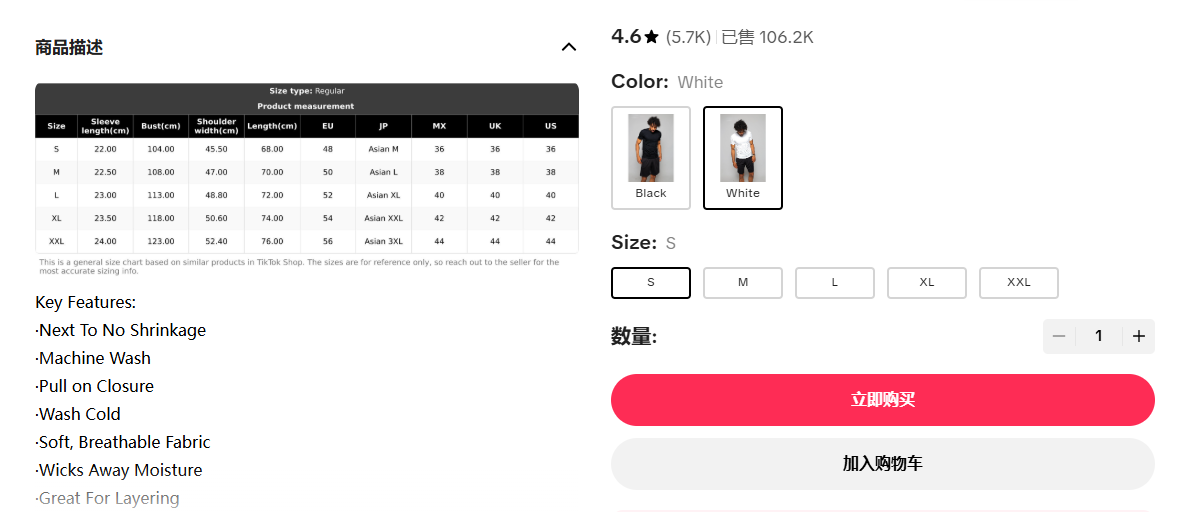
Image source:Tuke Shop
Conclusion
Tuke Shop US region's new return shipping policy is a double-edged sword.
For sellers, the increased cost pressure is a real challenge, but it is also an opportunity to force themselves to refine their operations. Adjusting pricing in advance, optimizing pages, carefully selecting products, and flexible after-sales are all strategies that can be implemented immediately.
With the official implementation of the new regulation in June, the cost structure of cross-border e-commerce shipping in the US region will be reshaped. Sellers who can quickly adapt to the rules and proactively optimize their operations may instead stand more firmly in the new round of reshuffling.
What this signal means for growth teams
This market signal should be treated as an operating prompt, not a standalone trend. The brand question is whether the team can connect TikTok content, creators, paid media, commerce readiness, and reporting into one measurable growth cycle.
Commercial read
- Market signal: TikTok Marketing Information and Solutions
- Published: May 13, 2026
- Commercial lens: TikTok Ads, creators, TikTok Shop, live commerce, and reporting.
- Source transparency: the original source linked in this article
What brands should do next
- Identify the market, audience, product group, and KPI this signal could affect.
- Turn the insight into a small TikTok creative, creator, Shop, or paid media test before scaling spend.
- Add FAQ, offer clarity, product proof, and contact paths so traffic can convert instead of only reading.
- Review weekly performance across reach, click quality, Shop actions, creator output, and revenue impact.
Tuke Marketing helps brands connect TikTok Ads, creator partnerships, TikTok Shop operations, live commerce, and reporting into one accountable operating system.
What should brands do with this TikTok signal?
Brands should translate the signal into a focused operating test across creative, creators, TikTok Shop readiness, paid media, and reporting before increasing budget.
How does Tuke Marketing evaluate this kind of news?
Tuke Marketing reviews platform news through market timing, category demand, creator supply, commerce readiness, and measurable growth actions.
When should a team contact Tuke about this topic?
A team should contact Tuke when it needs to turn a TikTok market signal into a practical launch, creator, advertising, live commerce, or reporting plan.
Source transparency: Tuke cites the original source linked in this article and adds its own operating analysis for brands evaluating TikTok growth decisions.