
On April 21, a piece of breaking news swept through the entire Southeast Asian cross-border circle: the Thai Senate officially submitted a comprehensive tax reform proposal, among which the most nerve-wracking for cross-border sellers is—foreign digital enterprises such as TikTok, Alibaba, eBay, etc., even if they do not set up entities in Thailand, as long as they generate income in Thailand, must pay corporate income tax at a rate of 20%.
This means that the last piece of the "low tax dividend" puzzle for Thailand's cross-border e-commerce may really disappear.
Image source: Internet
The government is "poor", and the tax system must be reformed
Why is Thailand taking the risk of market volatility and suddenly targeting major e-commerce platforms? The answer is simple: the government really has no money left.
According to a research report released by the Thai Senate, over the past decade, Thailand's fiscal deficit has averaged about 4% of GDP, far exceeding the 3% safety warning line set by fiscal discipline. Moreover, the committee also predicts that during 2027-2029, Thailand's public debt as a percentage of GDP is very likely to "explode", approaching or even breaking through the statutory ceiling in one fell swoop.
The Thai National Economic and Social Development Council also publicly warned that by 2029, the Thai government's debt may approach 69.3% of GDP. At the same time, government tax revenue has been low for a long time, and the huge fiscal pressure brought by an aging population means that if tax reform is not carried out, the government may even have to borrow money to pay salaries in the future. Committee chairman Kamphon Suphaphaeng made it clear that the short-sighted tax policies previously formulated to please voters have already left the treasury in deficit, and structural tax reform must be carried out to increase government revenue.
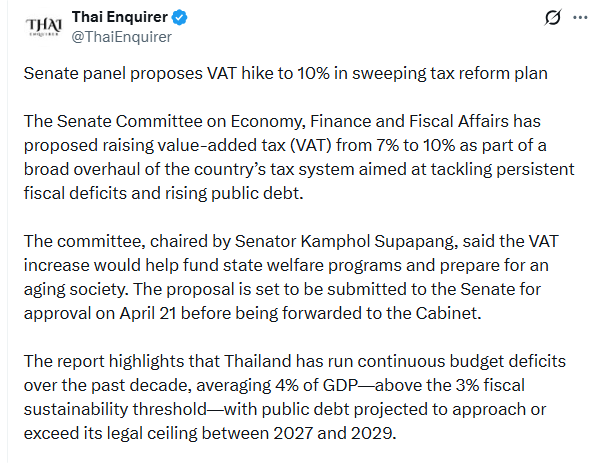
Image source: x
TikTok, Alibaba, eBay can't escape: 20% tax even without a local entity
The most shocking part of this reform proposal for the cross-border circle is undoubtedly the "heavy tax clause" targeting foreign digital enterprises.
According to the new regulations, foreign digital platforms such as TikTok Shop, eBay, and Alibaba, which have a huge user base in Thailand but no formal local entity, must obediently pay 20% corporate income tax as long as they generate commercial income within Thailand.
In the past, these platforms took advantage of the "no entity, no tax" loophole and enjoyed extremely favorable tax benefits for a long time, enabling them to attract a massive number of Thai consumers with very low prices, much to the dismay of local merchants. However, this protective umbrella will now be completely broken.
In addition to corporate income tax on headquarters, the reform proposal also requires major e-commerce platforms to act as "tax gatekeepers" during platform settlements, mandatorily withholding 2% of sellers' income as a pre-paid withholding tax. This means that the days when sellers could make money in the Thai market without actively declaring taxes are completely over.
For the Thai Ministry of Finance, this move kills two birds with one stone: it can directly lock in tax revenue at the source to prevent capital outflow, and also appease local SMEs that have long been suppressed in the name of "fair competition".
Image source: Internet
VAT rises to 10%, business costs rise again
If the 20% corporate income tax and 2% withholding tax only affect the company's books, then the increase of VAT from 7% to 10% is a comprehensive price shock that affects all consumers.
In order to support the ever-increasing social welfare expenditure, the committee unanimously recommended raising the standard VAT rate by 3 percentage points. To completely close tax loopholes, Thailand will also implement a mandatory e-invoice system and abolish the VAT exemption threshold for small businesses. The committee even came up with the idea of an "invoice lottery mechanism" to encourage consumers to actively request invoices, thereby improving tax compliance rates.
Although Thailand's caretaker cabinet decided as early as September 2025 to temporarily extend the preferential 7% tax rate until September 30, 2026, in order to ease the direct impact on people's livelihoods and the nascent economic recovery, the proposal submitted this time has clearly put the tax rate increase on the agenda, and sellers' pricing logic must be recalculated in the future.
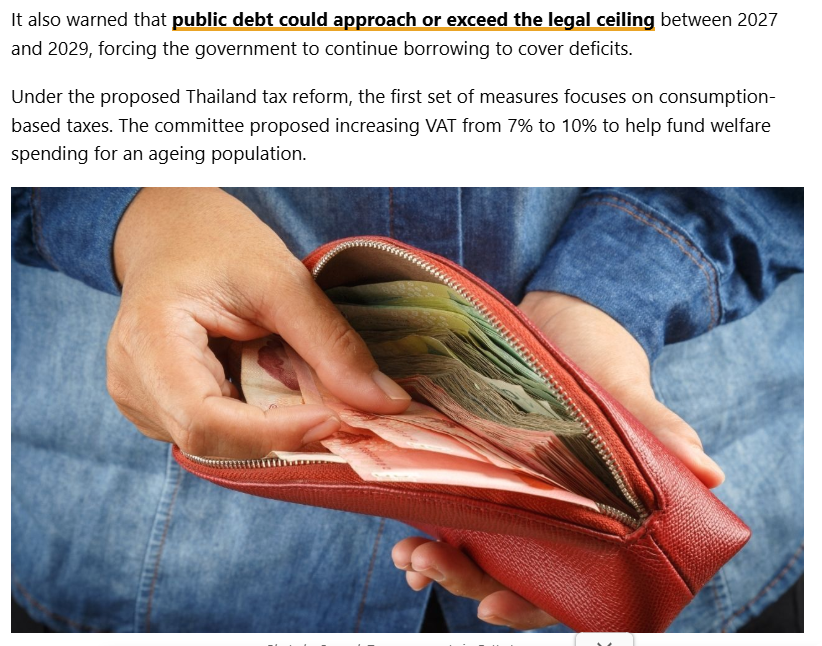
Image source: thethaige
Either operate with precision, or be eliminated
This series of tax iron fists sends a very clear signal to all cross-border sellers seeking gold in the Thai market: the era of rough operations relying on "loopholes" and low-price dumping is gone forever.
Undoubtedly, as major platforms such as TikTok and eBay begin to withhold and pay taxes, a large number of non-compliant small and micro businesses will be forced to raise prices and lose their core competitiveness. Even more fatal, if sellers cannot provide formal invoices and be included in tax supervision, their goods are likely to be directly detained under the new strict inspection system.
As the second largest e-commerce market in Southeast Asia, Thailand's move is likely to trigger a domino effect among neighboring countries such as Indonesia and Malaysia, shifting the entire Southeast Asian e-commerce competition track from a low-level "price war" to a higher-level "compliance war" and "quality war".
For sellers, if you still want to make money in the Thai market, you must act now: recalculate gross profit margins, adjust product pricing strategies, and obtain mandatory certifications such as TISI and FDA in Thailand as soon as possible. Only by embracing compliance early and keeping your accounts clear can you survive this round of tax reform storm in Thailand and find new growth opportunities.
What this signal means for growth teams
This market signal should be treated as an operating prompt, not a standalone trend. The brand question is whether the team can connect TikTok content, creators, paid media, commerce readiness, and reporting into one measurable growth cycle.
Commercial read
- Market signal: TikTok Marketing Information and Solutions
- Published: April 27, 2026
- Commercial lens: TikTok Ads, creators, TikTok Shop, live commerce, and reporting.
- Source transparency: the original source linked in this article
What brands should do next
- Identify the market, audience, product group, and KPI this signal could affect.
- Turn the insight into a small TikTok creative, creator, Shop, or paid media test before scaling spend.
- Add FAQ, offer clarity, product proof, and contact paths so traffic can convert instead of only reading.
- Review weekly performance across reach, click quality, Shop actions, creator output, and revenue impact.
Tuke Marketing helps brands connect TikTok Ads, creator partnerships, TikTok Shop operations, live commerce, and reporting into one accountable operating system.
What should brands do with this TikTok signal?
Brands should translate the signal into a focused operating test across creative, creators, TikTok Shop readiness, paid media, and reporting before increasing budget.
How does Tuke Marketing evaluate this kind of news?
Tuke Marketing reviews platform news through market timing, category demand, creator supply, commerce readiness, and measurable growth actions.
When should a team contact Tuke about this topic?
A team should contact Tuke when it needs to turn a TikTok market signal into a practical launch, creator, advertising, live commerce, or reporting plan.
Source transparency: Tuke cites the original source linked in this article and adds its own operating analysis for brands evaluating TikTok growth decisions.