
For cross-border e-commerce sellers who rely on overseas direct mail business, a long-standing period of policy dividends is about to come to an end.
Recently, the European Union officially approved a far-reaching tariff reform plan, announcing that from July 1, 2026, the tariff exemption policy for imported parcels valued at no more than 150 euros will be officially abolished.

Image source: Internet
This means that the "green channel" for low-priced goods, which has closely connected countless small and medium-sized sellers with global consumers, will be closed. A profound transformation around cost, model, and compliance is unfolding.
The implementation of this new regulation is not immediate, but a two-year transition period is set (July 1, 2026 to June 30, 2028).
During this period, for parcels valued at no more than 150 euros and sent directly to EU consumers, a fixed tariff of 3 euros per item will be uniformly levied according to the category of goods.
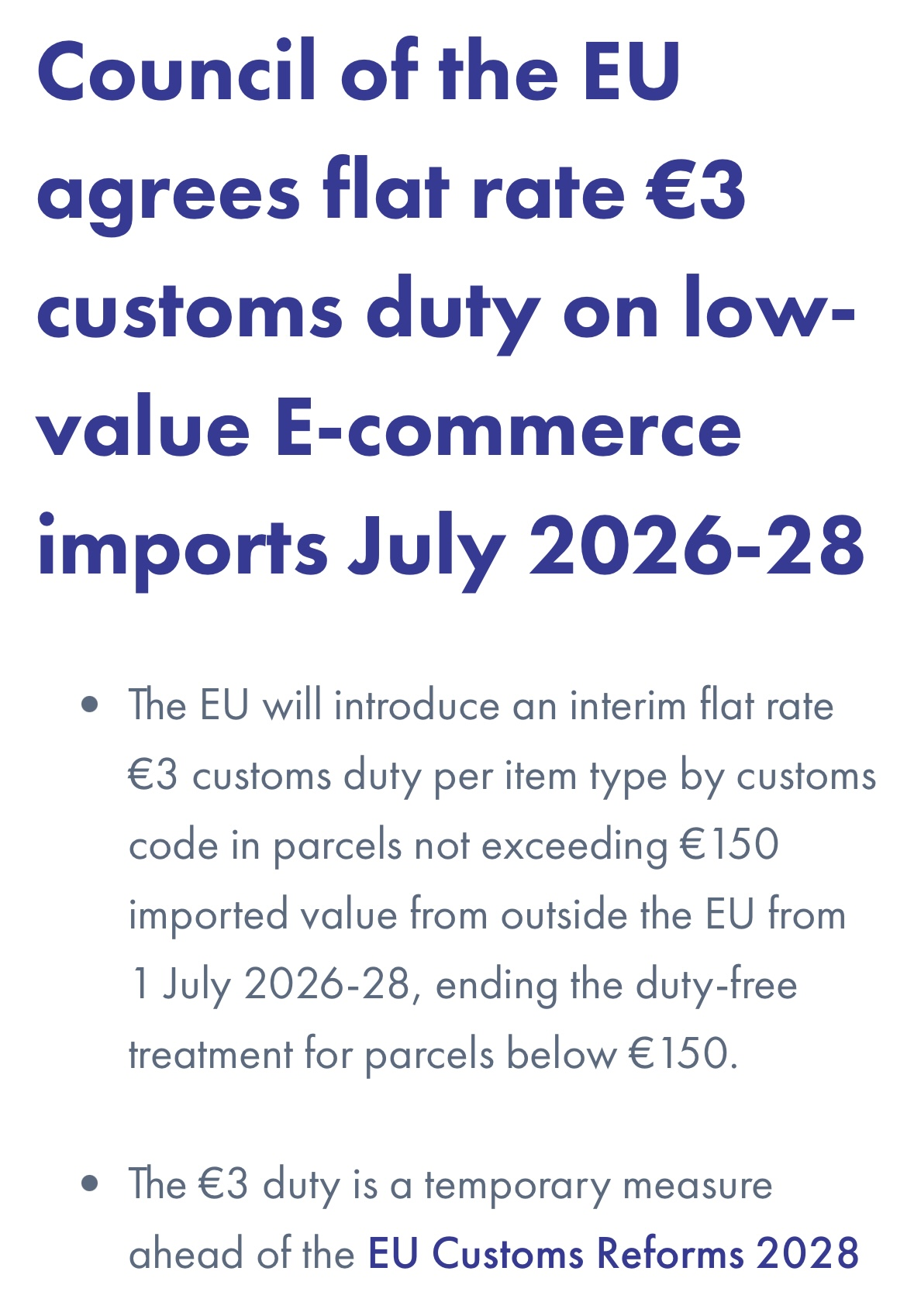
Image source:vatcalc
It is particularly important to note that if a parcel contains goods belonging to different categories, tariffs need to be calculated and paid separately. For example, a parcel containing both a silk blouse and a wool blouse, since they belong to two different categories, the payable tariff is 6 euros.
The scope of the new regulation is extremely broad. Whether goods are declared through the import one-stop service mechanism or traditional postal parcels, they will all be included in the new tax system, leaving almost no room for evasion.
Cost structure overturned, low-price distribution model faces survival test
With the implementation of the new regulation, those cross-border sellers who have long relied on low-price distribution strategies will bear the brunt.
According to statistics, currently nearly 180 direct mail parcels enter the EU market every second, of which as much as 97% are small items. On cross-border e-commerce platforms represented by Temu and Shein, more than 95% of the products are priced below 150 euros. The new policy is expected to increase the average cost of these products by 15% to 20%.

Image source: Internet
For sellers who focus on cost performance and already have limited profit margins, this is undoubtedly an almost devastating blow. The previous practice of splitting parcels and lowering declared values to avoid tariffs will be completely invalid, especially when parcels contain multiple categories of goods. The multiplied increase in tariff costs will directly swallow up the meager profits, forcing sellers to re-examine their pricing strategies and product selection logic.
Faced with the rigid increase in costs, sellers need to shift their response strategies from price wars to value wars.
On the one hand, they can optimize supply chain management, look for more cost-effective upstream resources, or dilute the tariff cost per item by means such as bundled sales and increasing the average order value.
On the other hand, and more fundamentally, the way out lies in accelerating the transformation from "Made in China, low-price sales" to "Tuke, quality-driven". By enhancing the added value of product design, function, and brand story, a brand moat can be built for which consumers are willing to pay a higher price, thus absorbing the additional tariff costs and achieving sustainable development.
In addition, actively exploring the establishment of overseas warehouses within the EU, converting scattered parcels into bulk goods for customs clearance and then local distribution, is also one of the feasible ways to avoid small parcel tariffs and improve logistics efficiency.
Image source: Internet
Conclusion
The EU's cancellation of the 150-euro tariff exemption marks the official end of the "barbaric growth" tax-free dividend period for cross-border e-commerce, and the entry into a stage of standardized development with clearer rules, more transparent costs, and more comprehensive competition.
This certainly brings growing pains to sellers accustomed to the traditional model, but it may also be an opportunity for survival of the fittest and to promote the overall upgrade of the industry.
For Chinese Tuke enterprises and platforms, only by facing changes, taking the initiative to adjust, internalizing compliance as the bottom line of operations, and regarding brand building as a long-term strategy, can they find their own path to growth under the new global trade rules.
What this signal means for growth teams
This market signal should be treated as an operating prompt, not a standalone trend. The brand question is whether the team can connect TikTok content, creators, paid media, commerce readiness, and reporting into one measurable growth cycle.
Commercial read
- Market signal: TikTok Marketing Information and Solutions
- Published: February 26, 2026
- Commercial lens: TikTok Ads, creators, TikTok Shop, live commerce, and reporting.
- Source transparency: the original source linked in this article
What brands should do next
- Identify the market, audience, product group, and KPI this signal could affect.
- Turn the insight into a small TikTok creative, creator, Shop, or paid media test before scaling spend.
- Add FAQ, offer clarity, product proof, and contact paths so traffic can convert instead of only reading.
- Review weekly performance across reach, click quality, Shop actions, creator output, and revenue impact.
Tuke Marketing helps brands connect TikTok Ads, creator partnerships, TikTok Shop operations, live commerce, and reporting into one accountable operating system.
What should brands do with this TikTok signal?
Brands should translate the signal into a focused operating test across creative, creators, TikTok Shop readiness, paid media, and reporting before increasing budget.
How does Tuke Marketing evaluate this kind of news?
Tuke Marketing reviews platform news through market timing, category demand, creator supply, commerce readiness, and measurable growth actions.
When should a team contact Tuke about this topic?
A team should contact Tuke when it needs to turn a TikTok market signal into a practical launch, creator, advertising, live commerce, or reporting plan.
Source transparency: Tuke cites the original source linked in this article and adds its own operating analysis for brands evaluating TikTok growth decisions.