
Recently,TikTok Shop announced an upgrade to its shipping fulfillment monitoring mechanism, planning to further shorten the shipping timeliness requirement from the current 4 working days to 2 working days starting January 26.
This change is a key signal that the platform is shifting from traffic-driven to refined operations.

Image source:Google
Interpretation of the New Regulation: From Speed to Precision, Building a Standardized Fulfillment System
This upgrade to TikTok Shop’s shipping fulfillment rules is not a simple adjustment of timeliness, but a systematic optimization of the entire platform’s transaction experience and reputation system. The new regulation is planned to be implemented in two phases, setting clear fulfillment time nodes and penalty mechanisms, aiming to improve service reliability across the platform.
According to platform requirements, in the first phase (January 12 to January 25), orders need to be updated to “in transit” status within 4 working days after creation; while the second phase (starting January 26) further tightens this to 2 working days.
At the same time, the platform will adopt a new Late Dispatch Rate (LDR) calculation logic to monitor orders that fail to update status within the specified time.
To ensure the effective implementation of the new regulation, the platform has introduced corresponding regulatory measures:If the proportion of delayed orders in a store exceeds10%, it will face multiple penalties including order volume restrictions, delayed fund settlement (settlement on the 31st day after goods arrival), and a $5 compensation per order.
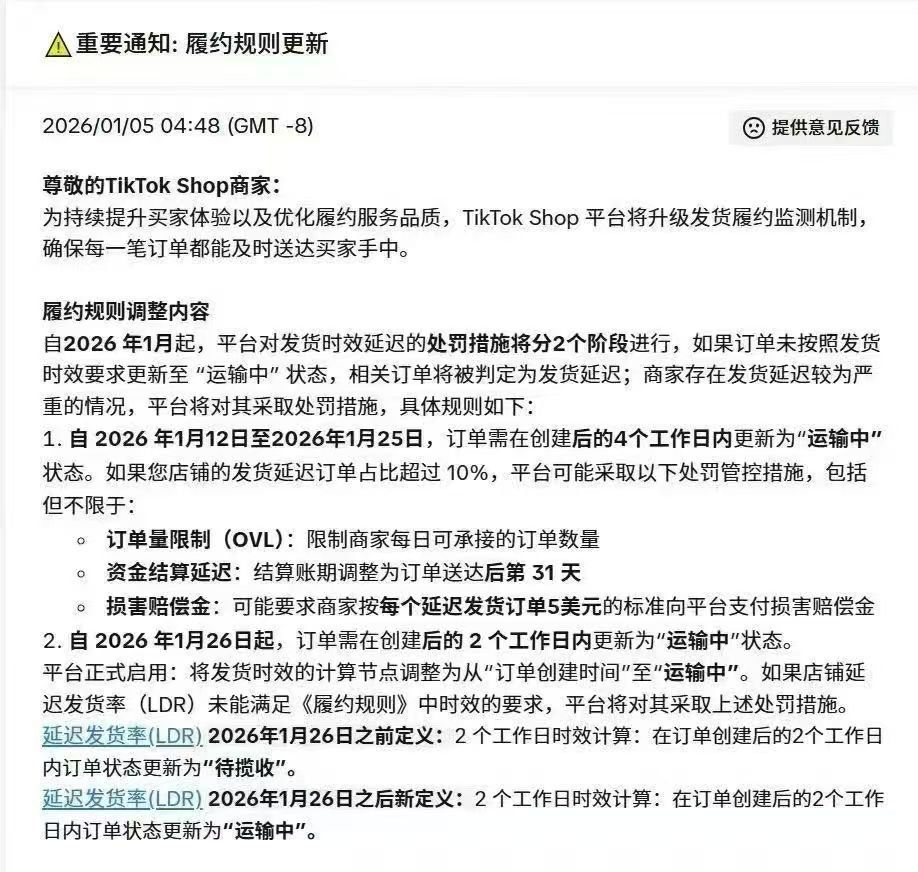
Image source:TikTok Shop
Impact on Sellers
This new regulation has a direct and profound impact on the seller community.
On one hand, operating costs and compliance pressure will increase significantly.The requirement to ship within two days means sellers need to comprehensively optimize existing warehouse management, order processing, and logistics coordination processes. Especially for merchants relying on third-party suppliers or dropshipping models, the stability of the supply chain will face even greater challenges.
On the other hand, this change may also reshape the competitive landscape within the platform.Sellers who can respond quickly, have stable warehousing and logistics capabilities, or have already set up overseas warehouses will build new competitive barriers through fulfillment efficiency. Those with insufficient response capabilities may face squeezed development space.

Image source:Google
Seller Response Strategies
In the face of this challenge, sellers need to adjust their operational strategies in the following areas:
Supply chain optimization is the top priority.It is recommended to introduce or upgrade the Order Management System (OMS), achieve real-time data connection with logistics providers, and ensure timely synchronization and updating of order status. At the same time, based on sales data analysis, reasonably allocate inventory and consider moving hot-selling products to storage nodes near target markets.
Establishing a flexible response mechanism is equally important.Develop contingency plans for unexpected logistics delays, including alternative logistics channels and customer communication plans, to reduce the risk of fulfillment failure due to external factors.
Turning“fulfillment capability” into a competitive advantage is also worth noting.Sellers can clearly indicate shipping timeliness on their store pages and use the platform’s fast fulfillment label to gain traffic support, turning compliance pressure into an opportunity to build consumer trust.
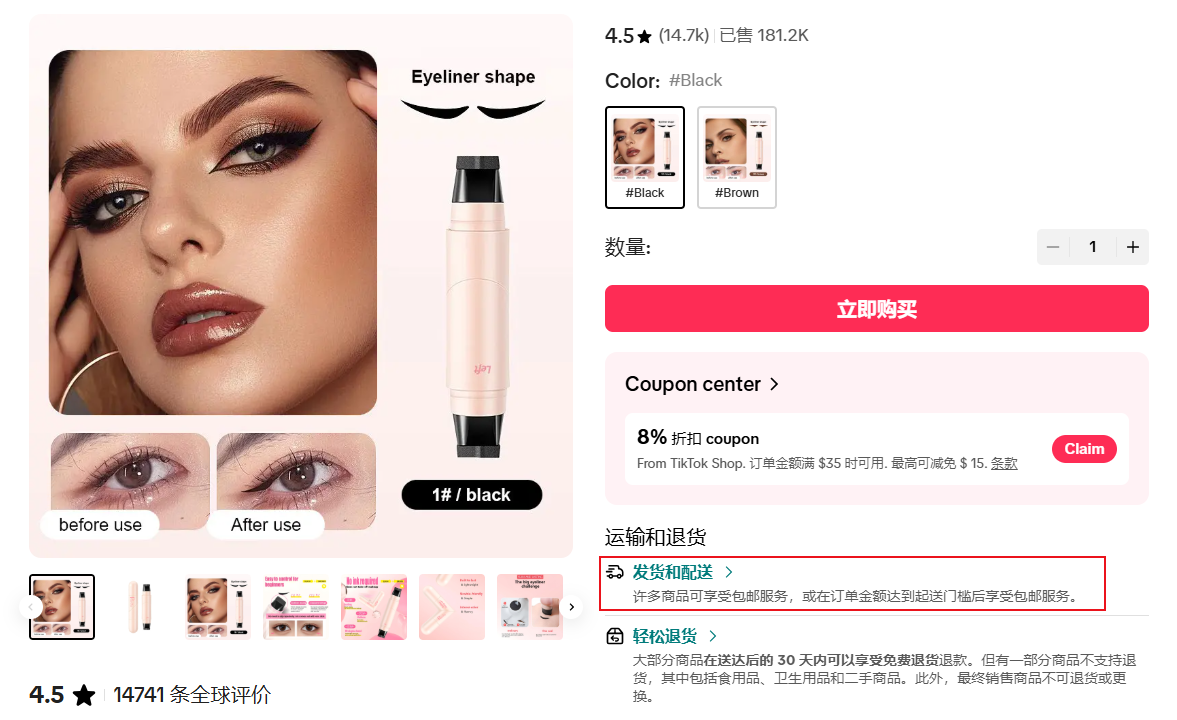
Image source:TikTok Shop
Conclusion
As the e-commerce industry enters the era of stock competition, refined operations have become the key direction for platform development.TikTok Shop’s improvement of shipping fulfillment standards is not only a test of merchants’ service capabilities, but also an important sign of the platform’s maturity.
For sellers, adapting to new platform rules requires not only adjustments in operational strategy, but also a systematic improvement in supply chain capabilities.
Only those merchants who can respond to changes in a timely manner and optimize operational processes can win sustainable development space in an increasingly regulated e-commerce environment.
What this signal means for growth teams
This market signal should be treated as an operating prompt, not a standalone trend. The brand question is whether the team can connect TikTok content, creators, paid media, commerce readiness, and reporting into one measurable growth cycle.
Commercial read
- Market signal: TikTok Marketing Information and Solutions
- Published: January 8, 2026
- Commercial lens: TikTok Ads, creators, TikTok Shop, live commerce, and reporting.
- Source transparency: the original source linked in this article
What brands should do next
- Identify the market, audience, product group, and KPI this signal could affect.
- Turn the insight into a small TikTok creative, creator, Shop, or paid media test before scaling spend.
- Add FAQ, offer clarity, product proof, and contact paths so traffic can convert instead of only reading.
- Review weekly performance across reach, click quality, Shop actions, creator output, and revenue impact.
Tuke Marketing helps brands connect TikTok Ads, creator partnerships, TikTok Shop operations, live commerce, and reporting into one accountable operating system.
What should brands do with this TikTok signal?
Brands should translate the signal into a focused operating test across creative, creators, TikTok Shop readiness, paid media, and reporting before increasing budget.
How does Tuke Marketing evaluate this kind of news?
Tuke Marketing reviews platform news through market timing, category demand, creator supply, commerce readiness, and measurable growth actions.
When should a team contact Tuke about this topic?
A team should contact Tuke when it needs to turn a TikTok market signal into a practical launch, creator, advertising, live commerce, or reporting plan.
Source transparency: Tuke cites the original source linked in this article and adds its own operating analysis for brands evaluating TikTok growth decisions.