
“In the arena of international public opinion, every fluctuation in China-US relations affects global nerves, and this time, the news from Kuala Lumpur has finally allowed the world to breathe a sigh of relief.”
After two days of intensive consultations, the China-US economic and trade teams reached a substantive framework agreement in Kuala Lumpur, Malaysia,with the US side clearly stating that it will no longer consider imposing100% tariffs on China.
This is the fifth face-to-face consultation between the China-US economic and trade teams since May this year, and also a breakthrough after more than a month of turbulence in trade relations.
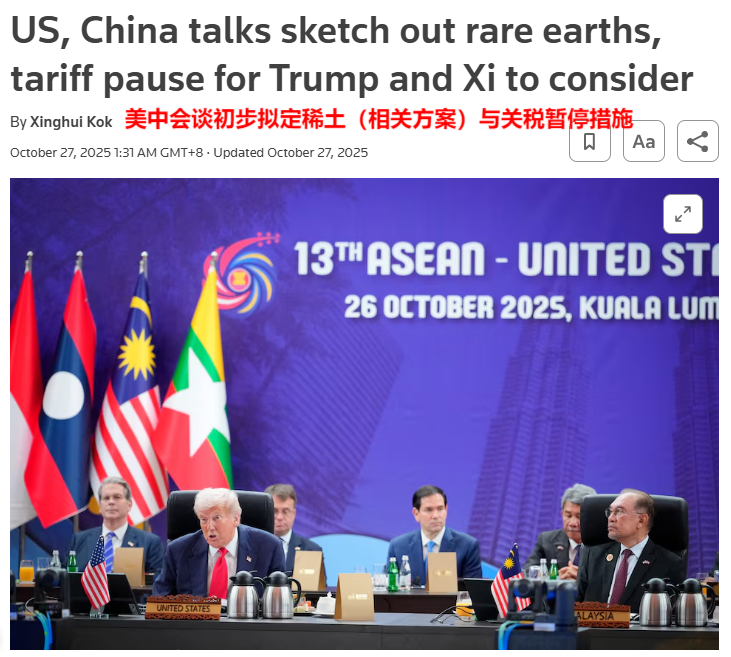
Image source: Reuters
This Kuala Lumpur consultation took place amid tense international trade conditions.
Previously, the Trump administration threatened that if China strengthened controls over rare earth exports and the technologies needed for their refining, it would impose 100% tariffs on Chinese goods starting fromNovember 1.
China-US economic and trade relations have experienced turbulence and volatility over the past month, with the US side introducing a penetrative rule for the entity list in September, extending thousands of Chinese companies into the“entity list”.
On October 14, the US also implemented port fees on Chinese-built ships.
In response to a series of US suppression measures, China launched a set of countermeasures, including imposing port fees on US-related ships and placing 5 US subsidiaries of Hanwha Ocean Corporation on the countermeasure list.
China also tightened rare earth export controls in accordance with international practice, directly targeting the vulnerabilities of the US electric vehicle, semiconductor, and defense industries.
Against this tense backdrop, both sides sat down at the negotiating table.
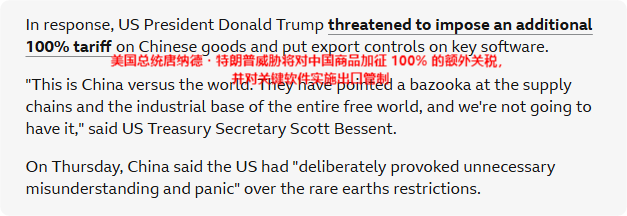
Image source:BBC
According toReuters, during this consultation, in addition to rare earths, they also discussed trade expansion, the US fentanyl crisis, US port entry fees, andtransferringTuke under US ownership control and other issues.
In the end, both sides reached a basic consensus on arrangements to address their respective concerns, agreed to further determine specific details, and to carry out their respective domestic approval procedures.
Compared with previous rounds of consultations, the US side showed a more pragmatic attitude this time.
Its position of“resolving differences through equality and respect” marks a shift in US strategy from unilateral pressure to more dialogue and cooperation.
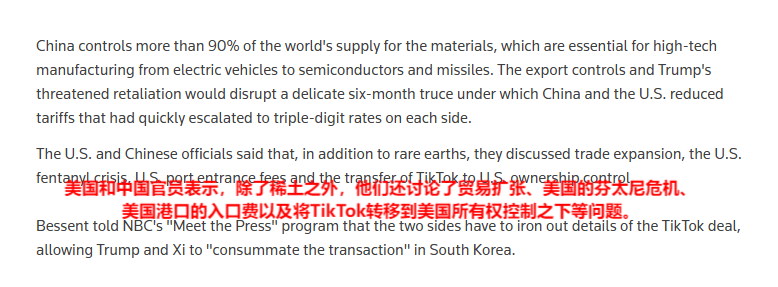
Image source: Reuters
The framework agreement reached in this consultation injects crucial stability into cross-border e-commerce, which has been wandering in uncertainty.
Among them, the US side clearly“will no longer consider” imposing 100% tariffs on China, which is undoubtedly a “reassurance pill” for cross-border e-commerce engaged in China-US trade.
Previously, the shadow of high tariffs forced many sellers to stock up in advance, raise prices, or even consider shrinking their business lines. The lifting of the threat means cost expectations have stabilized, and merchants now have a clearer vision for stocking, pricing, and long-term planning.
In addition, both sides agreed to“further extend the ‘reciprocal tariff’ suspension period”, directly easing the operating pressure on cross-border e-commerce.
The extension of the tariff suspension period allows many consumer goods exported from China to the US, such as furniture, home appliances, textiles, etc., to continue entering the US market at lower costs for a period of time, ensuring profit margins and price competitiveness for cross-border sellers.
Image source: Internet
For millions of cross-border e-commerce practitioners, the results of this consultation are more like a clear signal: the essence of trade is ultimately cooperation and win-win.
While the governments of both countries strive to dismantle the“tariff bomb” fuse, merchants should further hone their internal skills, find the best balance between stability and flexibility, and sail towards broader international markets.
What this signal means for growth teams
This market signal should be treated as an operating prompt, not a standalone trend. The brand question is whether the team can connect TikTok content, creators, paid media, commerce readiness, and reporting into one measurable growth cycle.
Commercial read
- Market signal: TikTok Marketing Information and Solutions
- Published: October 30, 2025
- Commercial lens: TikTok Ads, creators, TikTok Shop, live commerce, and reporting.
- Source transparency: the original source linked in this article
What brands should do next
- Identify the market, audience, product group, and KPI this signal could affect.
- Turn the insight into a small TikTok creative, creator, Shop, or paid media test before scaling spend.
- Add FAQ, offer clarity, product proof, and contact paths so traffic can convert instead of only reading.
- Review weekly performance across reach, click quality, Shop actions, creator output, and revenue impact.
Tuke Marketing helps brands connect TikTok Ads, creator partnerships, TikTok Shop operations, live commerce, and reporting into one accountable operating system.
What should brands do with this TikTok signal?
Brands should translate the signal into a focused operating test across creative, creators, TikTok Shop readiness, paid media, and reporting before increasing budget.
How does Tuke Marketing evaluate this kind of news?
Tuke Marketing reviews platform news through market timing, category demand, creator supply, commerce readiness, and measurable growth actions.
When should a team contact Tuke about this topic?
A team should contact Tuke when it needs to turn a TikTok market signal into a practical launch, creator, advertising, live commerce, or reporting plan.
Source transparency: Tuke cites the original source linked in this article and adds its own operating analysis for brands evaluating TikTok growth decisions.