
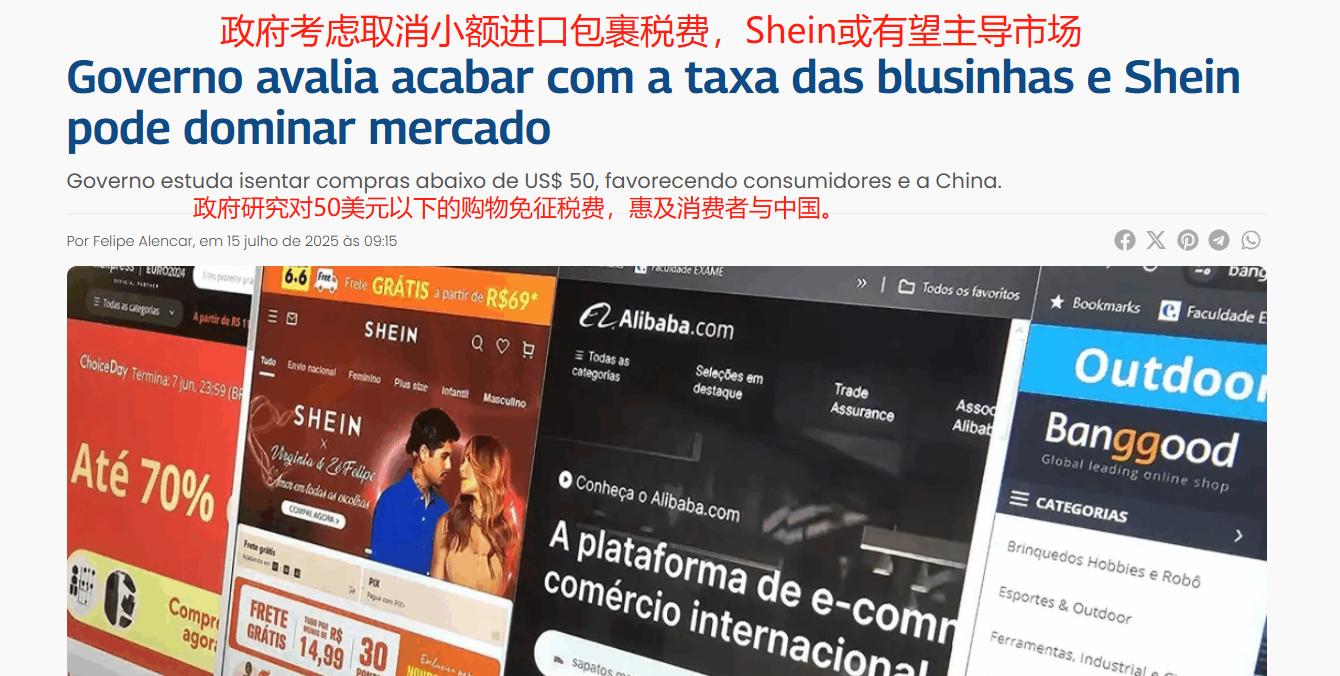
Recently, the Brazilian government released news that may bring relief to cross-border e-commerce sellers: they are discussing the cancellation of the 20% federal tax on imported goods under $50.
If this policy is implemented, platforms like Shein and Temu, which focus on low-priced products, will directly benefit.

Image source: hardware
In fact, Brazil has already wavered several times on the issue of import taxes.
At the beginning of 2023, Brazil planned to cancel the tax exemption for goods under $50, but by the end of the year, it announced a postponement. It wasn't until August 1, 2024, that the policy officially took effect: goods under $50 not only have to pay a 20% federal tax, but also an additional 17% state goods circulation tax, bringing the actual tax burden up to 44.5%.
However, Brazilian President Lula has always opposed this policy, and now the government is signaling a possible cancellation, which clearly has deeper reasons behind it.

Image source: passportglobal
This time, Brazil's sudden consideration of canceling the import tax is largely due to pressure from the United States.
Recently, U.S. President Trump has once again put pressure on tariffs, threatening to impose a 50% tariff on all Brazilian exports. If the policy takes effect, Brazil's export business will be greatly affected. Therefore, Brazil now has to reduce its dependence on the U.S. market, and relaxing import taxes to attract more overseas goods into the Brazilian market is one of their countermeasures.

Image source: exame
Although Brazil may relax its policy, globally, the trend of small-value tax exemptions is tightening. Several Southeast Asian countries have already taken the lead: Malaysia began imposing a 10% tax on imported goods under 500 ringgit from January 1, 2024; Singapore also imposed an 8% sales tax on goods under 400 Singapore dollars; and Vietnam directly canceled the tax exemption policy for goods under 1 million Vietnamese dong on February 18 this year.
Japan is also considering adjustments. Currently, Japan exempts import duties and consumption tax on goods under 10,000 yen (about 495.56 RMB), but the government is concerned this may lead to the influx of illegal goods, so it is discussing whether to cancel the tax exemption.

Image source: sum-rise
Over the past decade or so, the rapid growth of China's cross-border e-commerce has largely benefited from small-value tax exemption policies in various countries. But now, as global policies tighten, the survival space for low-price strategies is shrinking. Especially for platforms like Shein and Temu, which mainly rely on direct mail of low-priced small parcels, once the tax exemption advantage disappears, costs will rise sharply.
However, Chinese sellers are not without countermeasures. In fact, even after Brazil increased taxes in August 2024, sales of Chinese goods locally remained high. Data from April shows that Temu even rose to second place in Brazil's e-commerce traffic rankings. This shows that while price is important, the competitiveness of Chinese goods is no longer just about low prices, but a comprehensive advantage in supply chain, product quality, and service.

Image source: chinesellers
In the short term, adjustments to tax exemption policies will indeed increase costs for some sellers, but in the long run, this may actually be an opportunity. In the past, many Chinese sellers relied on low prices to compete for market share, but now global policy changes are forcing the industry to upgrade. Future competition will no longer be a simple price war, but about who can provide better products, a more stable supply chain, and higher quality after-sales service.
For sellers, what needs to be done now is not to worry about policy changes, but to think about how to improve their own competitiveness. After all, the market is always changing, and those who survive are always the most adaptable players.
What this signal means for growth teams
This market signal should be treated as an operating prompt, not a standalone trend. The brand question is whether the team can connect TikTok content, creators, paid media, commerce readiness, and reporting into one measurable growth cycle.
Commercial read
- Market signal: TikTok Marketing Information and Solutions
- Published: July 22, 2025
- Commercial lens: TikTok Ads, creators, TikTok Shop, live commerce, and reporting.
- Source transparency: the original source linked in this article
What brands should do next
- Identify the market, audience, product group, and KPI this signal could affect.
- Turn the insight into a small TikTok creative, creator, Shop, or paid media test before scaling spend.
- Add FAQ, offer clarity, product proof, and contact paths so traffic can convert instead of only reading.
- Review weekly performance across reach, click quality, Shop actions, creator output, and revenue impact.
Tuke Marketing helps brands connect TikTok Ads, creator partnerships, TikTok Shop operations, live commerce, and reporting into one accountable operating system.
What should brands do with this TikTok signal?
Brands should translate the signal into a focused operating test across creative, creators, TikTok Shop readiness, paid media, and reporting before increasing budget.
How does Tuke Marketing evaluate this kind of news?
Tuke Marketing reviews platform news through market timing, category demand, creator supply, commerce readiness, and measurable growth actions.
When should a team contact Tuke about this topic?
A team should contact Tuke when it needs to turn a TikTok market signal into a practical launch, creator, advertising, live commerce, or reporting plan.
Source transparency: Tuke cites the original source linked in this article and adds its own operating analysis for brands evaluating TikTok growth decisions.