
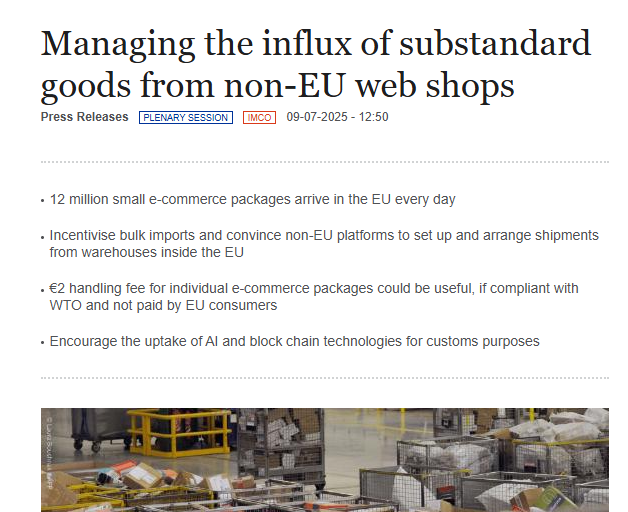
The European Parliament overwhelmingly passed a proposal with 619 votes in favor and 26 against, one of which concerns the regulation of non-EU online stores selling non-compliant goods.
According to data from the European Commission, in 2024, the number of low-value goods entering the EU reached 4.6 billion, equivalent to 12 million parcels entering the EU market every day by taking advantage of tax exemptions and low costs.
As much as 91% of these parcels come from China.
EU parliamentarian Salvatore De Meo spoke bluntly about this: "Every online purchase may hide risks to health, safety, and consumer rights—and these risks often come from non-EU operators who circumvent the rules. Our businesses cannot be expected to compete under such unfair conditions."

Image source: European Parliament
01 The End of the Tax-Free Era
The EU's dissatisfaction with the tax exemption policy for small-value goods has a long history. As early as 2023, the European Commission proposed the most ambitious reform since the establishment of the Customs Union, suggesting the abolition of tax exemption policies for low-value imported goods.
This policy was originally the core advantage for platforms like Temu and Shein to "sweep Europe with low prices." After the new regulations are implemented, all goods will be subject to an average tariff of 10%–20%, and the profit margin for low-value goods will be significantly squeezed.
Suppose a piece of clothing is priced at 50 euros, a new 15% tariff would directly increase the cost per item by 7.5 euros.
But this is just the "appetizer"—the EU also plans to add an "environmental handling fee" of 1–3 euros per parcel. Assuming an average of 1,000 orders per day, this fee alone would easily exceed 360,000 euros a year.
With both tariffs and handling fees, the overall cost for many sellers will directly soar by 30%–50%.
What's more troublesome is that all parcels must have their full documentation—ingredients, safety certifications, etc.—uploaded in advance before customs clearance, and customs will conduct strict inspections on each item. The original "7-day delivery" for fast fashion will now take at least 3–5 more days, which is a major blow for sellers who are sensitive to delivery times.

Image source: irish times
02 Global Domino Effect
The EU's actions are not an isolated case; the "domino effect" of global tariff barriers is toppling. On May 2 this year, the United States officially canceled the tax exemption policy for Chinese goods under $800, ending the T86 customs clearance model.
Japan's Ministry of Finance also announced a new draft, planning to impose a 10% consumption tax on imported goods under 10,000 yen (about 495 RMB) starting in 2026. As the world's fourth-largest e-commerce market, Japan's policy adjustment will directly affect the competitiveness of low-priced goods such as clothing and 3C accessories.
Although the UK has left the EU, its policy pace remains in sync with the EU. The British Chancellor of the Exchequer has stated that the tax regime for low-value imported goods will be reviewed, with consideration given to abolishing the tax exemption for parcels under £135.
The global tax environment has changed dramatically, signaling the official end of the "wild era" of cross-border e-commerce with no thresholds. According to the latest EU data, the 4.6 billion low-priced parcels flooding into Europe in 2024 are already double the number in 2023 and triple that of 2022; even more alarming, a large number of these goods have been found in spot checks to fall far short of European safety and environmental standards.

Image source: vatupdate
03 Industry Life-and-Death Breakthrough
In the face of policy changes, leading platforms have already begun urgent transformations. To cope with the new regulations, Temu has launched a European local warehouse plan, requiring merchants to stock goods in advance in warehouses in Poland and Germany, and has implemented a "semi-managed model"—the platform is responsible for logistics, while sellers bear inventory risks.
According to internal data, in 2024, Temu's European local warehouses account for less than 15%, and its low-price advantage may be further weakened under the new regulations.
Previously, some sellers avoided taxes by splitting orders (e.g., dividing a 200-euro item into two 100-euro parcels), but after the new regulations are implemented, customs will strictly investigate such "ant moving" behavior, and violators face hefty fines or even account suspension.

04 Ways to Break the Deadlock
Simply put, it is now a foregone conclusion that the EU and other countries will abolish the small-value tax exemption policy, which is a major blow to sellers relying on low-price strategies. To meet the challenge, sellers need to start doing the following:
Consider using overseas warehouses: Stock goods in advance in European warehouses to save on taxes and ship faster.
Sell better products: Reduce items that compete solely on price, and sell more high-quality, distinctive, and higher-margin products.
Build your brand: Make customers remember your brand and be willing to pay more for your products, so you won't fear rising costs.
Although costs have increased, this is actually an opportunity for the entire industry to move towards more standardized and quality-focused development. For sellers, it's time to adjust your mindset and make your business more solid.
What this signal means for growth teams
This market signal should be treated as an operating prompt, not a standalone trend. The brand question is whether the team can connect TikTok content, creators, paid media, commerce readiness, and reporting into one measurable growth cycle.
Commercial read
- Market signal: TikTok Marketing Information and Solutions
- Published: July 15, 2025
- Commercial lens: TikTok Ads, creators, TikTok Shop, live commerce, and reporting.
- Source transparency: the original source linked in this article
What brands should do next
- Identify the market, audience, product group, and KPI this signal could affect.
- Turn the insight into a small TikTok creative, creator, Shop, or paid media test before scaling spend.
- Add FAQ, offer clarity, product proof, and contact paths so traffic can convert instead of only reading.
- Review weekly performance across reach, click quality, Shop actions, creator output, and revenue impact.
Tuke Marketing helps brands connect TikTok Ads, creator partnerships, TikTok Shop operations, live commerce, and reporting into one accountable operating system.
What should brands do with this TikTok signal?
Brands should translate the signal into a focused operating test across creative, creators, TikTok Shop readiness, paid media, and reporting before increasing budget.
How does Tuke Marketing evaluate this kind of news?
Tuke Marketing reviews platform news through market timing, category demand, creator supply, commerce readiness, and measurable growth actions.
When should a team contact Tuke about this topic?
A team should contact Tuke when it needs to turn a TikTok market signal into a practical launch, creator, advertising, live commerce, or reporting plan.
Source transparency: Tuke cites the original source linked in this article and adds its own operating analysis for brands evaluating TikTok growth decisions.