
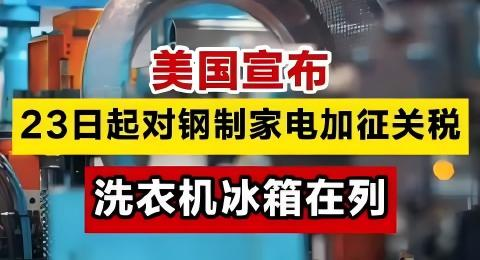
Starting from June 23, the United States will officially impose tariffs of up to 50% on imported steel household appliances. This is not a simple trade adjustment, but a real heavy blow, hitting domestic home appliance export companies right in the heart!
For many small and medium-sized manufacturing enterprises that still rely on OEM survival, this new policy has almost overnight changed their survival logic.

Image source: Internet
Export orders plummet, OEM factories simply can't withstand the pressure
"We just signed an order with the US side, but they said the price needs to be renegotiated, otherwise they'll cancel." This is a real complaint from the head of a medium-sized home appliance OEM factory in Ningbo in a WeChat group. Voices like this have been increasing over the past two months.
Exporting steel household appliances to the US already had extremely low profit margins, relying on scale and volume. Once a 50% tariff is added, this little profit is basically "wiped out". Moreover, the tax is not calculated on the whole machine price, but is levied separately on the steel parts. In other words, as long as you use steel, you have to pay more.
Many factories tried to grit their teeth and continue supplying, but soon found that US customers were also delaying payments. Advance payments disappeared, payment cycles lengthened, cash flow couldn't hold up, and even employee salaries became a problem. And in reality, there aren't many "solutions" that can be spoken of.

Image source: 21st Century Business Herald
Where to "go overseas"? Everyone starts looking at markets outside the US
In the past, when talking about "going overseas", many people defaulted to targeting the US market. But now, this logic is starting to be broken.
Vietnam, Thailand, and Indonesia have become the first batch of "backup markets". Many factories have started to connect with local factories, or simply consider investing in building their own plants.
Some companies have begun to truly value the African market, which was previously considered "low profit, small market". For example, Ningbo Feilong Appliances launched a smart anti-mold washing machine in Nigeria, which sold unexpectedly well, with export volume up 50% year-on-year in five months.
These markets have a high acceptance of high cost-performance products, competition is not as fierce, and may even support a "new channel".

Ningbo Feilong Appliances interview Image source: CCTV13
Big brands have strong resilience, but it's not that easy either
Many people think big brands are less affected because they "have money, channels, and bases". Indeed, Haier has GE in the US, Midea has factories in Mexico, and Gree has long had a global layout. On the surface, they have room to maneuver.
But this is not a universal card. On one hand, global raw material prices are rising, steel itself is more expensive, and now with added tariffs, manufacturing costs are rising even higher; on the other hand, building supply chains, brand trust, and after-sales service systems overseas is itself a major investment.
Many brands also have to recalculate: which products can stay? Which businesses need to transform? It's not that "having overseas factories" means you have nothing to fear.

Image source: Internet
Taking advantage of this wave of tariffs, a forced product upgrade has begun
Some industry insiders admit that tariffs are actually forcing companies to transform.
The path of relying on OEM and price wars is getting narrower, and those who laid out intelligent and high-end routes in advance now appear more composed.
For example, some manufacturers are trying to use composite materials instead of steel, others are making AI washing machines and smart refrigerators, directly bypassing the "steel" point and playing the added value card.
TCL launched an AI air conditioner that supports remote control. Although the price is 30% higher than ordinary products, it sells very well in Mexico. This also shows that the high-end route is not "too expensive to sell", but whether you can make a difference.
Sometimes, being "forced" is actually the beginning of industrial upgrading!

 TCL participates in China Home Appliances and Consumer Electronics Expo Image source: TCL
This storm is far from over
Trade friction is not new this year, but the pace of this 50% tariff increase is obviously faster and harsher than before. From steel to steel household appliances, a chain of moves makes it hard not to think of an "artificial restructuring" of the industrial chain.
For Chinese manufacturing, this is definitely not a simple external risk, but more like a mirror, reflecting our shortcomings in export structure, brand capability, and global layout.
Perhaps some companies will be forced to withdraw, some brands will stop here, but there will definitely be those who seize this opportunity and step onto a new track.
The word "going overseas" now is no longer just about selling goods abroad. It means pricing power, product strength, brand influence, and the comprehensive strength of global manufacturing collaboration.
This is a reshuffling, and only those who remain are truly strong!
What this signal means for growth teams
This market signal should be treated as an operating prompt, not a standalone trend. The brand question is whether the team can connect TikTok content, creators, paid media, commerce readiness, and reporting into one measurable growth cycle.
Commercial read
- Market signal: TikTok Marketing Information and Solutions
- Published: June 18, 2025
- Commercial lens: TikTok Ads, creators, TikTok Shop, live commerce, and reporting.
- Source transparency: the original source linked in this article
What brands should do next
- Identify the market, audience, product group, and KPI this signal could affect.
- Turn the insight into a small TikTok creative, creator, Shop, or paid media test before scaling spend.
- Add FAQ, offer clarity, product proof, and contact paths so traffic can convert instead of only reading.
- Review weekly performance across reach, click quality, Shop actions, creator output, and revenue impact.
Tuke Marketing helps brands connect TikTok Ads, creator partnerships, TikTok Shop operations, live commerce, and reporting into one accountable operating system.
What should brands do with this TikTok signal?
Brands should translate the signal into a focused operating test across creative, creators, TikTok Shop readiness, paid media, and reporting before increasing budget.
How does Tuke Marketing evaluate this kind of news?
Tuke Marketing reviews platform news through market timing, category demand, creator supply, commerce readiness, and measurable growth actions.
When should a team contact Tuke about this topic?
A team should contact Tuke when it needs to turn a TikTok market signal into a practical launch, creator, advertising, live commerce, or reporting plan.
Source transparency: Tuke cites the original source linked in this article and adds its own operating analysis for brands evaluating TikTok growth decisions.