
With the tightening of U.S. tariff policies, many cross-border sellers have begun to turn their attention to emerging markets to diversify risks and seek new growth points. Against this backdrop, Saudi Arabia, with its rapidly expanding e-commerce scale, has become the focus of global sellers' attention.
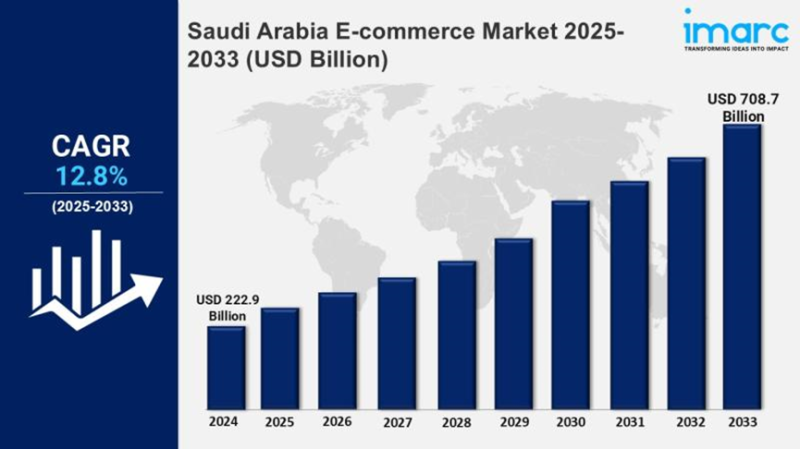
According to the latest report from imarc, the Saudi e-commerce market is projected to exceed $700 billion by 2033, demonstrating enormous development potential. This provides new opportunities for sellers, but at the same time, it also places higher demands on the development of e-commerce platforms.


Image source: imarc
Growth Drivers of the Saudi E-commerce Market
The rapid growth of the Saudi e-commerce market is not accidental, but the result of multiple factors working together.
The popularization of the Internet and smartphones has laid a solid foundation for the development of e-commerce. With the continuous improvement of network infrastructure, more and more Saudi consumers have become accustomed to online shopping, enjoying the convenience and diverse choices brought by e-commerce platforms.
Secondly, the Saudi government is actively promoting economic diversification and has clearly stated in the "Saudi Vision 2030" that it will vigorously develop the digital economy. This strategy includes the optimization of the logistics system and also covers the improvement of digital payment systems, aiming to create a more efficient and secure e-commerce ecosystem.
In addition, changes in consumer behavior are also a key factor driving market expansion. The proportion of young people in Saudi Arabia is high, and they have a higher acceptance of digital lifestyles, being more inclined to purchase goods through online channels. E-commerce platforms further stimulate consumer demand by offering competitive prices and a wide variety of products, resulting in the continuous expansion of the market size.


Image source: Google
What Are the Impacts and Opportunities for Sellers?
For cross-border sellers, the rapid growth of the Saudi e-commerce market is undoubtedly a major opportunity. The expansion of the market size means more potential customers and sales opportunities, especially as the U.S. and European markets become saturated. Emerging markets like Saudi Arabia can provide sellers with new growth space.
However, opportunities often come with challenges. Although the Saudi market has great potential, sellers still need to face issues such as low logistics and delivery efficiency and insufficient infrastructure in rural areas. In addition, Saudi consumers still have concerns about the security of online payments, which places higher demands on sellers' payment solutions.
To gain a foothold in the Saudi market, sellers need to adopt targeted strategies.
For example, optimize logistics cooperation by choosing local warehousing or partnering with efficient delivery service providers to improve the last-mile delivery experience. At the same time, offer a variety of payment methods, including cash on delivery (COD) and locally popular digital wallets, to enhance consumer trust. In-depth understanding of local culture and consumption habits, and localized operations, are also key to improving market competitiveness.


Image source: Google
Conclusion
The rapid growth of the Saudi e-commerce market reflects the country's vibrant digital economy and also provides new development opportunities for global sellers. Although there are still challenges in logistics and payments, with the dual drive of government policy support and market demand, this market is expected to achieve higher-quality growth in the coming years.
For sellers, seizing the opportunities in the Saudi market requires flexible strategy adjustments, a focus on localized operations, and actively responding to market challenges. For e-commerce platforms, improving technological capabilities and service levels will be the key to winning the competition.
Overall, the fact that the Saudi e-commerce market is about to break through the $700 billion mark is not the end, but a new starting point, with broad development space still waiting to be explored in the future.
What this signal means for growth teams
This market signal should be treated as an operating prompt, not a standalone trend. The brand question is whether the team can connect TikTok content, creators, paid media, commerce readiness, and reporting into one measurable growth cycle.
Commercial read
- Market signal: TikTok Marketing Information and Solutions
- Published: June 11, 2025
- Commercial lens: TikTok Ads, creators, TikTok Shop, live commerce, and reporting.
- Source transparency: the original source linked in this article
What brands should do next
- Identify the market, audience, product group, and KPI this signal could affect.
- Turn the insight into a small TikTok creative, creator, Shop, or paid media test before scaling spend.
- Add FAQ, offer clarity, product proof, and contact paths so traffic can convert instead of only reading.
- Review weekly performance across reach, click quality, Shop actions, creator output, and revenue impact.
Tuke Marketing helps brands connect TikTok Ads, creator partnerships, TikTok Shop operations, live commerce, and reporting into one accountable operating system.
What should brands do with this TikTok signal?
Brands should translate the signal into a focused operating test across creative, creators, TikTok Shop readiness, paid media, and reporting before increasing budget.
How does Tuke Marketing evaluate this kind of news?
Tuke Marketing reviews platform news through market timing, category demand, creator supply, commerce readiness, and measurable growth actions.
When should a team contact Tuke about this topic?
A team should contact Tuke when it needs to turn a TikTok market signal into a practical launch, creator, advertising, live commerce, or reporting plan.
Source transparency: Tuke cites the original source linked in this article and adds its own operating analysis for brands evaluating TikTok growth decisions.