
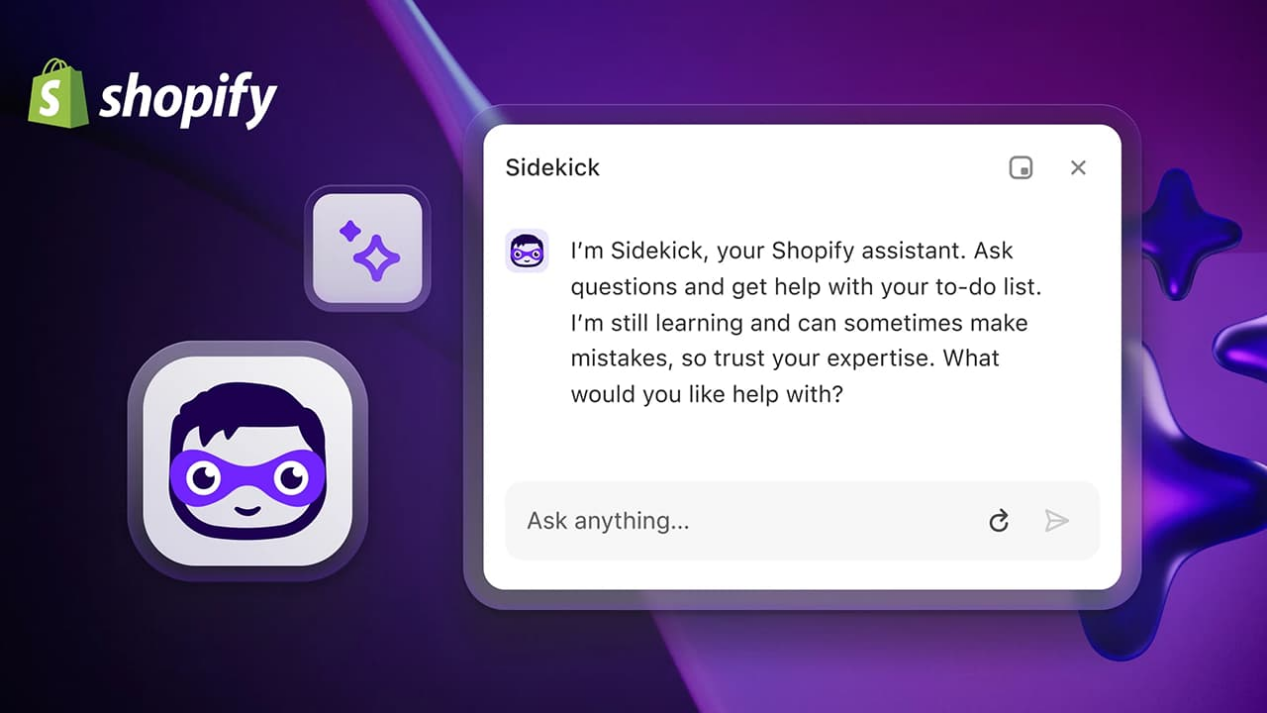
Recently, Shopify's AI business assistant Sidekick has made new moves, ushering in a major upgrade. The addition of multi-step reasoning and image generation functions provides merchants with smarter and more convenient operational support. This upgrade enhances the practicality of Sidekick and signals that AI applications in the e-commerce sector are entering a new stage.


Image source: Google
Empowering Merchants in All Aspects, from Data Analysis to Visual Creativity
The core of this Shopify Sidekick upgrade lies in the expansion of both the depth and breadth of its functions. The addition of multi-step reasoning enables Sidekick to act like an experienced business consultant, helping merchants solve complex problems.
When store sales decline, Sidekick is no longer limited to providing simple data reports. Instead, it can comprehensively analyze multi-dimensional data such as inventory levels, marketing campaign effectiveness, and customer behavior patterns, unravel the root causes of problems, and offer specific solution suggestions, such as adjusting advertising strategies, optimizing product pricing, or clearing unsold inventory.


Image source: Google
The addition of image generation fills the gap in merchants' needs for visual content creation. Merchants only need to enter a simple text description, and Sidekick can generate high-quality product main images, marketing banners, or blog illustrations. This saves merchants the time and cost of finding designers or learning professional graphic software, and also helps them quickly test different visual styles to find the most creative solutions to attract their target audience.


Image source: Google
Efficiency Improvement and Cost Optimization, but Challenges Remain
The upgrade of Sidekick will undoubtedly bring significant improvements in efficiency and cost optimization for merchants. Automated data analysis and report generation functions can free up a large amount of merchants' time, allowing them to focus their energy on higher-value work such as strategic decision-making, product development, and customer relationship management. Meanwhile, the AI image generation function lowers the threshold for visual content creation, enabling even small merchants or individual entrepreneurs to easily create a professional store image.
However, the popularization of AI tools also brings some challenges.
First, merchants need to adapt to new workflows and learn how to interact effectively with Sidekick to fully unleash its potential. Second, over-reliance on AI may cause merchants to overlook the understanding and judgment of the essence of their business. For example, although AI-generated marketing copy or images are efficient, they may lack human touch and brand uniqueness, making it difficult to establish deep emotional connections with consumers.


Image source: Google
Merchant Response Strategies
In the face of the opportunities and challenges brought by Sidekick, merchants should adopt proactive response strategies. They should actively learn and explore the various functions of Sidekick, integrating it into all aspects of daily operations. For example, they can use Sidekick's data analysis function to monitor store performance and detect problems in a timely manner; use the image generation function to quickly create A/B test materials and optimize conversion rates.
At the same time, merchants should maintain independent thinking, treating AI as an auxiliary tool rather than relying on it completely. The suggestions and analysis results provided by AI should be verified and adjusted by merchants to ensure they align with brand positioning and business goals. For example, AI-generated marketing copy can serve as a draft, which merchants can polish and optimize to inject brand personality.


Image source: Google
Conclusion
This upgrade of Shopify Sidekick means that the application of AI in the e-commerce sector has entered a new stage, undoubtedly accelerating the intelligent and automated development of the e-commerce industry.
However, technological progress is always just a means, not an end. While embracing AI, merchants should also maintain a deep understanding of the essence of their business, combining technology with human wisdom to remain invincible in fierce market competition.
The future is here. Let us wait and see how AI will continue to rewrite the rules of e-commerce.
What this signal means for growth teams
This market signal should be treated as an operating prompt, not a standalone trend. The brand question is whether the team can connect TikTok content, creators, paid media, commerce readiness, and reporting into one measurable growth cycle.
Commercial read
- Market signal: TikTok Marketing Information and Solutions
- Published: May 30, 2025
- Commercial lens: TikTok Ads, creators, TikTok Shop, live commerce, and reporting.
- Source transparency: the original source linked in this article
What brands should do next
- Identify the market, audience, product group, and KPI this signal could affect.
- Turn the insight into a small TikTok creative, creator, Shop, or paid media test before scaling spend.
- Add FAQ, offer clarity, product proof, and contact paths so traffic can convert instead of only reading.
- Review weekly performance across reach, click quality, Shop actions, creator output, and revenue impact.
Tuke Marketing helps brands connect TikTok Ads, creator partnerships, TikTok Shop operations, live commerce, and reporting into one accountable operating system.
What should brands do with this TikTok signal?
Brands should translate the signal into a focused operating test across creative, creators, TikTok Shop readiness, paid media, and reporting before increasing budget.
How does Tuke Marketing evaluate this kind of news?
Tuke Marketing reviews platform news through market timing, category demand, creator supply, commerce readiness, and measurable growth actions.
When should a team contact Tuke about this topic?
A team should contact Tuke when it needs to turn a TikTok market signal into a practical launch, creator, advertising, live commerce, or reporting plan.
Source transparency: Tuke cites the original source linked in this article and adds its own operating analysis for brands evaluating TikTok growth decisions.