
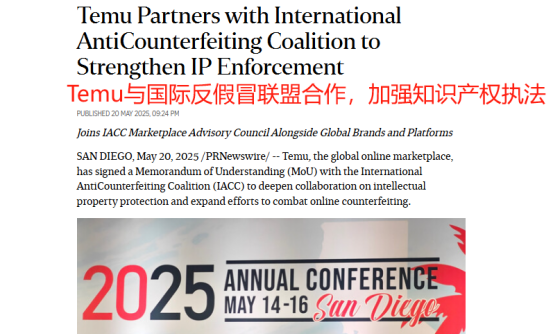
Recently, at the International Anti-Counterfeiting Coalition (IACC) annual meeting in San Diego, USA, Temu, the cross-border e-commerce platform under Pinduoduo, officially signed a Memorandum of Understanding (MoU), focusing on strengthening intellectual property protection and intensifying efforts to combat counterfeit goods.
This platform, known for its low-priced products, has now set its sights on counterfeits. It will become a founding member of the IACC’s newly established Market Advisory Committee, sitting at the same table as giants like Amazon and PayPal.

Temu and the International Anti-Counterfeiting Coalition reach a cooperation agreement. Image source: The Straits Times
What is the background of the International Anti-Counterfeiting Coalition?
The International Anti-Counterfeiting Coalition was founded in 1978, initially established by 15 internationally renowned manufacturers. After 47 years of development, it has now brought together well-known brands from various fields around the world. The organization mainly combats counterfeit goods by promoting regulatory improvements, assisting government supervision, and educating consumers. Alibaba joined the coalition in 2016, and now Temu is following suit, marking another step in international compliance for Chinese e-commerce platforms.

International Anti-Counterfeiting Coalition. Image source: Google
Christine Casaceli, Temu’s Head of IP Compliance in the US, stated that this cooperation demonstrates the platform’s determination to create a trustworthy e-commerce environment. In fact, to curb counterfeiting, Temu has invested heavily in recent years to build a comprehensive protection system. Specific measures include: strict seller qualification reviews, 24-hour algorithmic scanning of product information (combined with manual review), opening brand complaint channels, and intellectual property registration services. These actions target the core links of counterfeit sales, setting up checkpoints throughout the process from onboarding to sales.

Temu representative signs Memorandum of Understanding. Image source: The Straits Times
Cross-border platforms collectively “compete” in anti-counterfeiting
In fact, anti-counterfeiting has become a compulsory course for global e-commerce platforms. According to a report just released by Amazon this year, in 2024 they seized 15 million counterfeit goods worldwide, 1.5 times more than two years ago; Russian e-commerce platform Ozon directly imposes fines, penalizing sellers 10,000 rubles (about 904 RMB) for each counterfeit item sold, with no refunds under any circumstances.
In addition to self-discipline by platforms, regulatory agencies in various countries are also taking action. In the first half of Thailand’s 2025 fiscal year (October 2024 - March 2025), 18,000 counterfeit cases were handled, with fines exceeding 2.7 billion baht (about 600 million RMB). The Philippines went further by joining forces with 18 companies to sign an anti-infringement agreement, directly elevating anti-counterfeiting to the level of national cooperation.

In 2024, Amazon seized over 15 million counterfeit products. Image source: PYMNTS
Anti-counterfeiting is a protracted battle
Despite the efforts of all parties, the fight against counterfeiting remains a long-term challenge. As Pinduoduo founder Huang Zheng said: "Combating counterfeit goods is a protracted battle, and there will never be an end to it."
Nowadays, counterfeiting methods are constantly evolving, such as separating genuine packaging from counterfeit goods during transportation, forging inspection reports, etc., all of which increase the difficulty for platforms to identify fakes. The industry consensus is that it is impossible to eradicate counterfeits relying on one party alone; it requires collaboration among brands, platforms, and governments.
Now that cross-border e-commerce competition has entered the second half, beyond price wars, who can truly uphold the bottom line of quality may be the key to determining the winner. Temu’s high-profile partnership with an international organization this time at least sends one signal: Chinese platforms are serious this time.
What this signal means for growth teams
This market signal should be treated as an operating prompt, not a standalone trend. The brand question is whether the team can connect TikTok content, creators, paid media, commerce readiness, and reporting into one measurable growth cycle.
Commercial read
- Market signal: TikTok Marketing Information and Solutions
- Published: May 26, 2025
- Commercial lens: TikTok Ads, creators, TikTok Shop, live commerce, and reporting.
- Source transparency: the original source linked in this article
What brands should do next
- Identify the market, audience, product group, and KPI this signal could affect.
- Turn the insight into a small TikTok creative, creator, Shop, or paid media test before scaling spend.
- Add FAQ, offer clarity, product proof, and contact paths so traffic can convert instead of only reading.
- Review weekly performance across reach, click quality, Shop actions, creator output, and revenue impact.
Tuke Marketing helps brands connect TikTok Ads, creator partnerships, TikTok Shop operations, live commerce, and reporting into one accountable operating system.
What should brands do with this TikTok signal?
Brands should translate the signal into a focused operating test across creative, creators, TikTok Shop readiness, paid media, and reporting before increasing budget.
How does Tuke Marketing evaluate this kind of news?
Tuke Marketing reviews platform news through market timing, category demand, creator supply, commerce readiness, and measurable growth actions.
When should a team contact Tuke about this topic?
A team should contact Tuke when it needs to turn a TikTok market signal into a practical launch, creator, advertising, live commerce, or reporting plan.
Source transparency: Tuke cites the original source linked in this article and adds its own operating analysis for brands evaluating TikTok growth decisions.