
In recent years, the global cleaning products market has remained hot. According to IMARC Group data, the global household cleaning products market reached $38.7 billion in 2024, with eco-friendly cleaning categories showing significant growth.
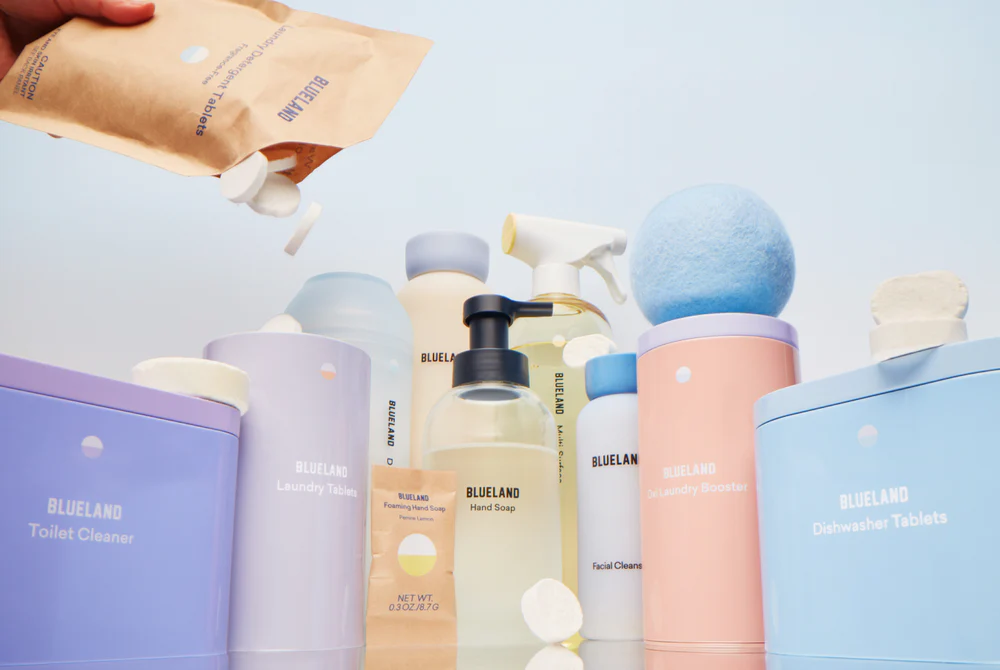
In this market environment, a brand founded by Asian women—Blueland—has become an industry focal point in just four years thanks to its innovative “zero plastic packaging” concept.
Since its establishment in 2019, Blueland has raised over$40 million, entered retail giants such as Target and Walmart, and become a phenomenal brand in the eco-friendly cleaning sector.

Image source: Blueland
Motherly Love Beyond the Family
Blueland founder Sarah Paiji Yoo’s experience is a typical example of “mom entrepreneurship.”
According to reports, while trying to mix formula for her son, she discovered that microplastic pollution was common in both tap and bottled water in the US. Moreover, 90% of cleaning agents on the market are made up of water, yet these products are packaged in single-use plastic bottles, ultimately becoming an environmental burden.
Determined to find an alternative cleaning product without plastic packaging, she officially launched the Blueland brand.

Sarah Paiji Yoo and her family. Image source: Internet
Sarah and co-founder John Mascari searched LinkedIn for chemists to help realize their cleaning tablet idea, and also recruited a former executive from a major natural cleaning company.
After extensive research and development, Blueland’s basic cleaning kit was officially launched in April 2019. Seven months after launch, the brand achieved sales of $42 million.
Capital quickly followed: $3 million seed round, $9 million Series A, and another $20 million investment in 2021…
Currently, Blueland has launched dozens of products, has over 1 million members, and its body wash is sold in 250 Target stores across the US.

Image source: Capitalism
The “Green Revolution” Behind a $30 Billion+ Market
Blueland’s rise coincides with the global boom in the eco-friendly cleaning market. Take China as an example: in 2023, the stain remover powder market reached 8.6 billion yuan, up 8.3% year-on-year, and is expected to exceed 10 billion by 2025.
Consumer research shows that 46.4% of users consider “environmental friendliness” the core criterion for household cleaning products, followed by “ingredient safety” and “efficiency and convenience.”

"2025-2030 China Stain Remover Powder Industry Development Trend and Outlook Research Report"
This trend is even more pronounced in Europe and the US. In 2024, the global household cleaning products market reached $38.7 billion, and consumers are no longer satisfied with “harmlessness,” but are pursuing full lifecycle environmental protection, such as plant-based formulas, concentrated technology, and biodegradable packaging.
Blueland’s cleaning tablets hit three major pain points: each tablet only needs water to activate, the paper packaging is fully degradable, and the per-use cost is 30% lower than traditional products. This “subtractive innovation” helped the brand sell 80,000 kits in its first week at Target and win widespread support.

Image source: Blueland
Traffic Code: “Eco-Friendly Socialization” Behind Millions of Views”
In overseas markets where traffic costs are high, Blueland has built a multi-dimensional marketing matrix.
1. TikTok
On TikTok, Blueland’s content strategy centers on “visualizing pain points, scenario penetration, and emotional resonance.”
Although the official account @blueland has only 101,000 followers, its hard-hitting science videos such as “cleaning tablet dissolving process” and “real footage of plastic pollution” frequently reach millions of views.

Image source: TikTok
For example, a science video released in April 2023 titled “Laundry pods are not biodegradable” received 2.5 million views upon release. The comments section was filled with various jokes, bringing considerable traffic and attention to its eco-friendly products.

Image source: TikTok
Additionally, Blueland collaborates with TikTok influencers to expand brand awareness.
For example, TikTok influencer @krystalynngier (50,700 followers) posted a promotional video in March 2024. In the video, she subtly embedded the brand’s advantages through a Q&A format, reducing the sense of hard selling and strengthening brand image. The video ultimately received 347,800 views.

Image source: TikTok
2. Instagram
Unlike its “eco-expert” positioning on TikTok, Blueland on Instagram reduces direct product promotion and instead focuses on “life hacks” and “eco-friendly tips” to promote the brand indirectly.
Although these contents are not directly related to product usage, by conveying eco-friendly concepts and lifestyle inspiration, users can experience a more sustainable way of living, thus enhancing their recognition of brand value.
Currently, the brand’s Instagram account @Blueland has 453,000 followers, which is quite impressive among brands in the same field.

Image source: Instagram
3. Independent Website
The independent website is Blueland’s core base. Blueland offers subscription-based regular delivery of cleaning tablets, combined with a member points system to effectively increase user stickiness.
Data shows that its US market users account for 86.22%, with female consumers aged 25-34 making up 71.27%, forming a stable core customer group.

Image source: SimilarWeb
This operating model not only reduces customer acquisition costs but also establishes a sustainable user relationship.
According to third-party platforms, from February to March 2025, Blueland’s independent website had 1.119 million monthly visits, with direct traffic accounting for 47.68% and organic traffic for 28.91%.

Image source: SimilarWeb
Conclusion: The Next Blue Ocean for Chinese Enterprises
From Blueland’s development, it is clear that simple product functionality is no longer the only competitive edge. Brand values and user experience are becoming key factors in consumer decision-making.
For Chinese companies with mature supply chains, this is a rare window of opportunity. By combining manufacturing advantages with innovative concepts, Chinese brands can achieve differentiated breakthroughs in overseas markets.
Today, from eco-friendly technology to smart home, more and more niche sectors are waiting for Chinese brands with global vision to explore. This may well be the key breakthrough for Chinese brands’ globalization in the next decade.
What this signal means for growth teams
This market signal should be treated as an operating prompt, not a standalone trend. The brand question is whether the team can connect TikTok content, creators, paid media, commerce readiness, and reporting into one measurable growth cycle.
Commercial read
- Market signal: TikTok marketing tips - short video marketing methods
- Published: May 12, 2025
- Commercial lens: TikTok Ads, creators, TikTok Shop, live commerce, and reporting.
- Source transparency: the original source linked in this article
What brands should do next
- Identify the market, audience, product group, and KPI this signal could affect.
- Turn the insight into a small TikTok creative, creator, Shop, or paid media test before scaling spend.
- Add FAQ, offer clarity, product proof, and contact paths so traffic can convert instead of only reading.
- Review weekly performance across reach, click quality, Shop actions, creator output, and revenue impact.
Tuke Marketing helps brands connect TikTok Ads, creator partnerships, TikTok Shop operations, live commerce, and reporting into one accountable operating system.
What should brands do with this TikTok signal?
Brands should translate the signal into a focused operating test across creative, creators, TikTok Shop readiness, paid media, and reporting before increasing budget.
How does Tuke Marketing evaluate this kind of news?
Tuke Marketing reviews platform news through market timing, category demand, creator supply, commerce readiness, and measurable growth actions.
When should a team contact Tuke about this topic?
A team should contact Tuke when it needs to turn a TikTok market signal into a practical launch, creator, advertising, live commerce, or reporting plan.
Source transparency: Tuke cites the original source linked in this article and adds its own operating analysis for brands evaluating TikTok growth decisions.