
Recently, Amazon released its financial report for the first quarter of the fiscal year.
The company's net sales for the three months reached 1.1 trillion yuan (155.67 billion USD), a 9% increase compared to the same period last year. Excluding the impact of exchange rate fluctuations, the actual growth rate reached 10%. Net profit soared 64% year-on-year to 17.127 billion USD, and earnings per share increased from 0.98 USD to 1.59 USD.
This marks the third consecutive quarter that Amazon has achieved a profit growth rate exceeding its revenue growth rate.

The financial report data is impressive. Source: aboutamazon
International Business Thrives Against Headwinds
In the context of intensified competition in the European and American markets, Amazon's international division (covering markets such as the UK, Germany, France, Japan, and China) delivered better-than-expected results: first-quarter sales reached 33.513 billion USD, a 5% year-on-year increase, with actual growth of 8% after excluding exchange rate factors. More importantly, the operating profit margin increased from 2.8% to 3.0%, with operating profit rising by 114 million USD. This indicates that Amazon has achieved effective cost control in its international business.
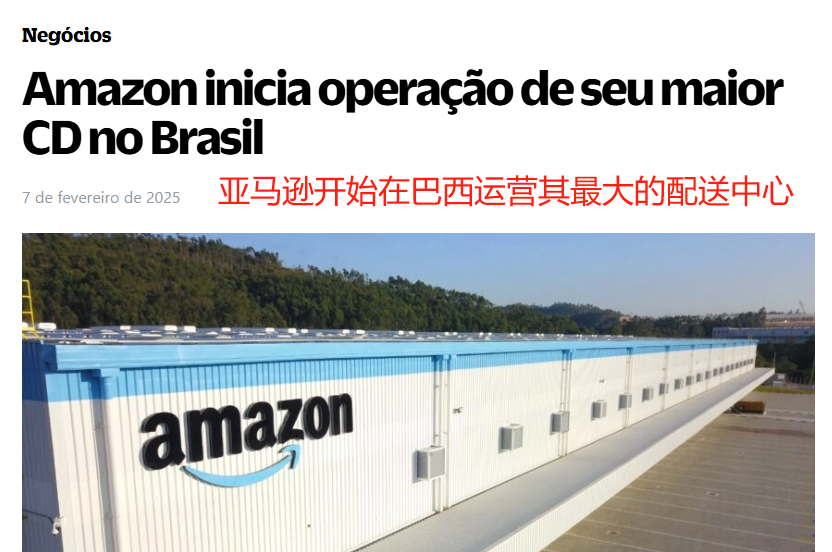
Supporting this achievement is Amazon's continuous investment in logistics infrastructure. For example, the newly built 75,000 square meter distribution center in Cajamar, São Paulo, Brazil, has directly improved delivery speed for Brazilian consumers, becoming the largest logistics hub in the area.

The largest distribution center in Brazil. Source: braziljournal
Cloud Services Carry the Profit Flag
Although this financial report did not separately disclose the performance of AWS (Amazon Web Services), it clearly stated that this business remains a core growth engine. Combining the financial data for 2024, of the total operating profit of 68.6 billion USD for the year, AWS contributed more than half, highlighting the critical role of cloud services in profitability.
In recent years, AWS's market share has continued to expand, providing enterprise customers with technical services such as data storage and server leasing. These high-margin businesses effectively offset the competitive pressure in e-commerce.

2024 Annual Financial Report Data. Source: Amazon
Seller Ecosystem Continues to Benefit
For cross-border sellers, Amazon remains an important channel for going global. The platform has a clear traffic advantage: in 2024, 73% of U.S. online shoppers chose Amazon, maintaining a leading position in mature markets such as Canada and the UK. New sellers can quickly get started using the operational tools provided by the platform, such as advertising systems and inventory management interfaces.
The logistics system is another major competitive advantage. In addition to the new warehouse in Brazil, Amazon operates over a hundred distribution centers globally. These infrastructures help sellers reduce the average delivery cycle to 2-3 days, with some areas achieving next-day delivery.

Amazon Dominates Traffic in the U.S. Source: Jungle Scout
Concerns Behind the Growth
Despite the impressive performance, Amazon still faces two major challenges.
First, the North American market has a disproportionately high share, and the e-commerce growth rate in this region has gradually slowed; second, there is cost pressure from investments in emerging markets. For instance, the operating profit margin of the international division is still far lower than that of the North American market.
From a long-term perspective, Amazon's strategy is clear, with projected revenue growth of 11% year-on-year to 638 billion USD in 2024, and net profit of 59.2 billion USD, setting a new historical high. The company is reinvesting cloud service profits into its e-commerce business and continuously expanding its overseas logistics network. This model of "making money through technology and defending the city with infrastructure" may become a new benchmark in the cross-border e-commerce industry.
What this signal means for growth teams
This market signal should be treated as an operating prompt, not a standalone trend. The brand question is whether the team can connect TikTok content, creators, paid media, commerce readiness, and reporting into one measurable growth cycle.
Commercial read
- Market signal: TikTok Marketing Information and Solutions
- Published: May 9, 2025
- Commercial lens: TikTok Ads, creators, TikTok Shop, live commerce, and reporting.
- Source transparency: the original source linked in this article
What brands should do next
- Identify the market, audience, product group, and KPI this signal could affect.
- Turn the insight into a small TikTok creative, creator, Shop, or paid media test before scaling spend.
- Add FAQ, offer clarity, product proof, and contact paths so traffic can convert instead of only reading.
- Review weekly performance across reach, click quality, Shop actions, creator output, and revenue impact.
Tuke Marketing helps brands connect TikTok Ads, creator partnerships, TikTok Shop operations, live commerce, and reporting into one accountable operating system.
What should brands do with this TikTok signal?
Brands should translate the signal into a focused operating test across creative, creators, TikTok Shop readiness, paid media, and reporting before increasing budget.
How does Tuke Marketing evaluate this kind of news?
Tuke Marketing reviews platform news through market timing, category demand, creator supply, commerce readiness, and measurable growth actions.
When should a team contact Tuke about this topic?
A team should contact Tuke when it needs to turn a TikTok market signal into a practical launch, creator, advertising, live commerce, or reporting plan.
Source transparency: Tuke cites the original source linked in this article and adds its own operating analysis for brands evaluating TikTok growth decisions.