
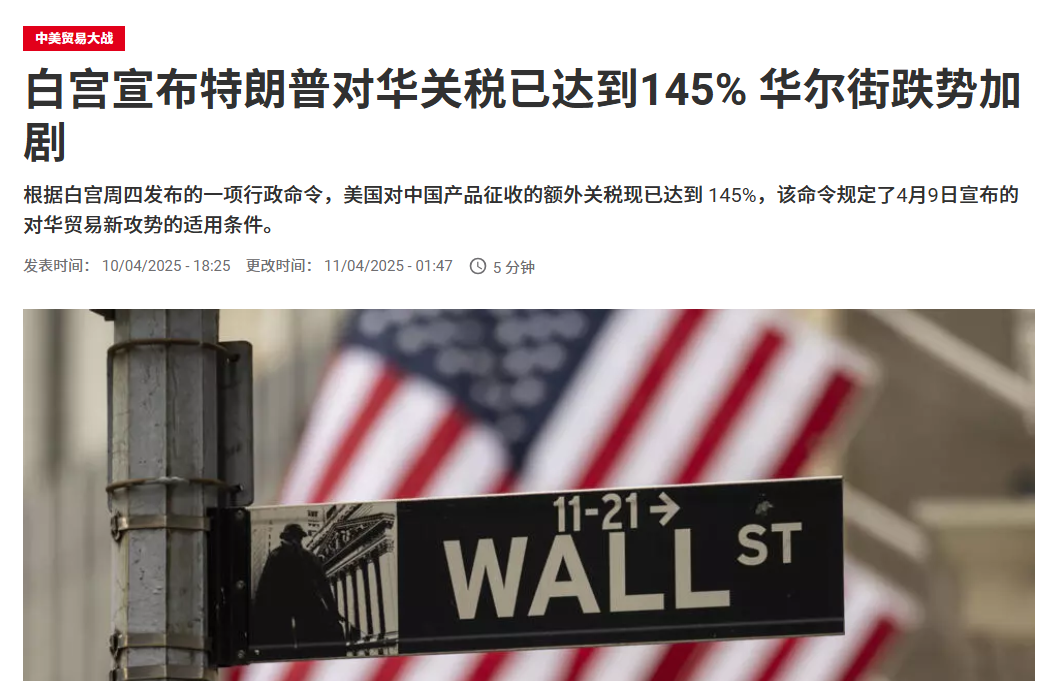
Recently, the name of former US President Trump has once again dominated global trending searches. But this time, it’s not because of campaign rallies, but because his “tariff adventure” has backfired. After waiting all night without receiving a call from China, Trump ended up raising tariffs yet again, with the cumulative tariff rate now reaching 145%.
Chinese sellers’ costs have soared, American consumers’ wallets have been emptied, and in the end, Trump’s “tariff stick” may hurt Americans themselves the most.

Image source: AFP
Tariff War Escalates: From “Reciprocal Tariffs” to a Crazy 125%
Trump’s tariff policy is like a runaway roller coaster.
On April 2, he made a high-profile announcement to impose a 10% “baseline tariff” on all trading partners, and slapped punitive tariffs of 20%-34% on major economies like China and the EU. But just a week later, he suddenly raised tariffs on Chinese goods exported to the US to 125%, while giving a reprieve to 75 countries by temporarily suspending 906.
This flip-flopping left even the White House unprepared—Bloomberg revealed that the government hadn’t even finalized the specific rates before the policy was announced.

Trump speaking on “reciprocal tariffs” Image source: Xinhua News Agency
Why is Trump so obsessed with tariffs? On the surface, it’s to “revitalize American manufacturing,” but in reality, it’s a four-pronged calculation: forcing companies to return to the US, plugging fiscal holes, reducing the trade deficit, and using tariffs as a bargaining chip.
But the data has slapped him in the face—America’s trade deficit with China in 2024 has risen to $361 billion, 12% higher than before Trump launched the trade war in 2017.
Even more ironically, US inflation has rebounded to 3.5% due to tariffs, and ordinary people can barely afford eggs.

Image source: Internet
“Wave of Price Hikes” Sweeps the Globe: Cross-Border E-Commerce’s Race Against Time
Trump’s tariff stick first hit cross-border sellers. Take Chinese cross-border e-commerce as an example:
Giant Star Technology directly “fought back”: Announced price increases across the board the day after the new policy, with management bluntly saying “the whole industry will soon follow.”
Anker Innovations played “invisible price hikes”: Reduced promotional discounts, raised prices for new products, and cut the proportion of North American market revenue from 60% to 40%, fully expanding into Southeast Asia and Latin America.
Zhiou Technology opted for a “great migration”: Moved furniture production capacity to Vietnam, slapped on “Made in Vietnam” labels to avoid tariffs, but Trump had already set his sights on Southeast Asia, demanding strict checks on origin.

Image source: CLS
US domestic companies aren’t spared either. Home brand Simple Modern spent an extra $40 million due to tariffs and was forced to lay off staff; Walmart’s Chinese supply chain broke down, leaving 80% of electronics shelves empty. On Amazon, trash cans are up 5%, bathroom fans up 11%, painter’s tape up 17%. Consumers are frantically stockpiling, social media is full of complaints: “Wages haven’t gone up, but prices have gone crazy!”

Image source: OKLAHOMA BUSINESS VOLCE
America’s “Backlash” Scene: Anger from Wall Street to Main Street
Ever since it was revealed that Trump imposed a 10% tariff on Heard Island and McDonald Islands, which are only inhabited by penguins, Americans have been speechless about their president. It’s actually pretty funny—penguins have become the first creatures to fight a trade war with humans...

Image source: Internet
Trump probably didn’t expect that the first to collapse in this tariff war would be the US itself.
Stock market crashed: Nasdaq plunged 9% in a single week, Apple and Nike shares tumbled 7%, Goldman Sachs warned that 2 million retail jobs are at risk.
Supply chain broke: Vietnamese apparel orders lost due to 46% tariffs, low-income Americans face a “wardrobe crisis”; Tesla’s Shanghai factory expansion paused, Apple’s supply chain relocation costs surged 30%.
People are furious: 500,000 took to the streets to protest “Stop Trump,” holding signs saying “Everything is getting more expensive.” Republican stronghold states turned against him as the EU retaliated with tariffs on whiskey and motorcycles.

Image source: YouTube BBC News
Even more ironically, although China is affected, its domestic market has held up the fundamentals. The semiconductor and new energy industries have grown against the trend, forcing US companies to secretly buy Chinese goods via Southeast Asia.
Conclusion
Ultimately, Trump’s tariff stick is like swinging a hammer at his own foot. Globalization can’t be reversed by raising taxes. Companies want profits, consumers want cheap goods, and supply chains are already deeply intertwined—forcing them apart will only hurt everyone together. How will this farce end? No one knows, but one thing is clear—when the tariff war becomes a test of endurance to see who collapses first, the one swinging the stick may be the first to fall.
(Note: All information in this article comes from public reports and platform data; actual circumstances are subject to official information.)
What this signal means for growth teams
This market signal should be treated as an operating prompt, not a standalone trend. The brand question is whether the team can connect TikTok content, creators, paid media, commerce readiness, and reporting into one measurable growth cycle.
Commercial read
- Market signal: TikTok Marketing Information and Solutions
- Published: April 14, 2025
- Commercial lens: TikTok Ads, creators, TikTok Shop, live commerce, and reporting.
- Source transparency: the original source linked in this article
What brands should do next
- Identify the market, audience, product group, and KPI this signal could affect.
- Turn the insight into a small TikTok creative, creator, Shop, or paid media test before scaling spend.
- Add FAQ, offer clarity, product proof, and contact paths so traffic can convert instead of only reading.
- Review weekly performance across reach, click quality, Shop actions, creator output, and revenue impact.
Tuke Marketing helps brands connect TikTok Ads, creator partnerships, TikTok Shop operations, live commerce, and reporting into one accountable operating system.
What should brands do with this TikTok signal?
Brands should translate the signal into a focused operating test across creative, creators, TikTok Shop readiness, paid media, and reporting before increasing budget.
How does Tuke Marketing evaluate this kind of news?
Tuke Marketing reviews platform news through market timing, category demand, creator supply, commerce readiness, and measurable growth actions.
When should a team contact Tuke about this topic?
A team should contact Tuke when it needs to turn a TikTok market signal into a practical launch, creator, advertising, live commerce, or reporting plan.
Source transparency: Tuke cites the original source linked in this article and adds its own operating analysis for brands evaluating TikTok growth decisions.