
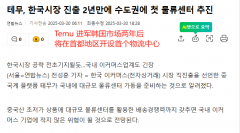
Among the Chinese e-commerce companies expanding overseas, Temu from the Pinduoduo group has always been known as a “price butcher.”
But recently, this dark horse suddenly changed its strategy, renting a super logistics center of 165,000 square meters in Gyeonggi-do, South Korea, right next to Incheon Airport and Gimpo Port.
Those in the know understand that Temu doesn’t want to rely solely on the 9.9 yuan free shipping model anymore; it’s gearing up to compete with local Korean giants on speed.

Temu establishes a logistics center in Korea. Image source: nate
A warehouse the size of 16 football fields hides Temu’s ambition
How big is this logistics center? It’s equivalent to 23 standard football fields.
Even more crucial is its location—less than half an hour’s drive from Incheon Airport. Goods flown in from China can be stored directly upon arrival. Temu also plans to set up a Korean office inside, clearly intending to take root locally. According to the plan, once operational, the delivery time for Chinese goods can be cut in half; small commodities from Yiwu that used to take two weeks may now reach Korean buyers in just five days.
But Temu’s real killer move is the L2L (Local to Local) model launched in February this year. Simply put, it brings Korean local sellers on board, and after consumers place orders, goods are shipped directly from their homes, with next-day delivery at the fastest. This move directly transforms the cross-border model into local e-commerce, even challenging Coupang’s “Rocket Delivery.”

Temu is recruiting Korean sellers in full swing. Image source: The JoongAng
The secret behind 8 million monthly active users: Are Koreans addicted to “slashing deals”?
Although Temu has only been in Korea for a little over two years, its data already makes competitors envious.
By the end of last year, its monthly active users in Korea surged to 8.23 million, and this year’s sales are expected to exceed 600 billion won. Although this can’t compare to Coupang’s annual revenue of 20 trillion won, the growth rate is astonishing—especially considering Temu entered Korea almost four years later than AliExpress.
Korean young people are especially receptive to Temu’s tactics. Browsing their phones at midnight, they see wireless earbuds for $9.9, slash the price and share with a few friends, and finally get them for $3. This kind of social viral marketing, which has been played out in China, turns out to be a dimensionality reduction attack in Korea.

Image source: Google
Logistics arms race: Chinese giants besiege Korean local players
Temu’s latest move is actually adding fuel to the already fierce logistics war in Korea.
Local leader Coupang just announced a 300 billion won investment to build an AI logistics center, with plans to invest a total of 3 trillion won by 2027; AliExpress is cooperating with Korea’s Shinsegae Group while planning to build its own $200 million logistics base; even the second-hand platform Karrot is offering same-city half-day delivery.
The most intense competition is in delivery times. Naver has reduced its average delivery time to 5.8 hours, 11Street has launched weekend express delivery, Temu’s L2L model now achieves next-day delivery, but Korean consumers clearly want more. Surveys show that 50% of people consider speed their top priority when placing orders.

Coupang’s newly built AI logistics center. Image source: nate
Behind the money-burning war: Who can survive until shipping fees rise?
Now, all companies are competing in logistics, which essentially means burning money to gain market share. Temu’s logistics center rent plus seller subsidies cost at least several billion won per month; Coupang’s logistics investment accounts for 12% of its revenue, twice the industry average.
But no one dares to loosen their grip first. After all, Korea’s e-commerce market reached 242 trillion won (1.4 trillion RMB) last year, and the gap between the top two, Coupang and Naver, is less than 2 percentage points.

Image source: Google
The cross-border war spreads to the supply chain
Temu renting a warehouse in Korea sends a signal that’s more dangerous than imagined.
Chinese manufacturing + local warehousing + ultra-low prices—this combination not only hurts Coupang, but also Korean small and medium sellers.
When $3 shirts and $5 Bluetooth earphones are shipped from the Incheon warehouse, who would still go to Dongdaemun wholesale market to haggle?
Behind this logistics war is actually a comprehensive strangling of the supply chain.
As for whether Temu will ultimately disrupt Korean e-commerce, or local giants will stage a comeback, it may all depend on whose investors have deeper pockets.
What this signal means for growth teams
This market signal should be treated as an operating prompt, not a standalone trend. The brand question is whether the team can connect TikTok content, creators, paid media, commerce readiness, and reporting into one measurable growth cycle.
Commercial read
- Market signal: TikTok Marketing Information and Solutions
- Published: March 28, 2025
- Commercial lens: TikTok Ads, creators, TikTok Shop, live commerce, and reporting.
- Source transparency: the original source linked in this article
What brands should do next
- Identify the market, audience, product group, and KPI this signal could affect.
- Turn the insight into a small TikTok creative, creator, Shop, or paid media test before scaling spend.
- Add FAQ, offer clarity, product proof, and contact paths so traffic can convert instead of only reading.
- Review weekly performance across reach, click quality, Shop actions, creator output, and revenue impact.
Tuke Marketing helps brands connect TikTok Ads, creator partnerships, TikTok Shop operations, live commerce, and reporting into one accountable operating system.
What should brands do with this TikTok signal?
Brands should translate the signal into a focused operating test across creative, creators, TikTok Shop readiness, paid media, and reporting before increasing budget.
How does Tuke Marketing evaluate this kind of news?
Tuke Marketing reviews platform news through market timing, category demand, creator supply, commerce readiness, and measurable growth actions.
When should a team contact Tuke about this topic?
A team should contact Tuke when it needs to turn a TikTok market signal into a practical launch, creator, advertising, live commerce, or reporting plan.
Source transparency: Tuke cites the original source linked in this article and adds its own operating analysis for brands evaluating TikTok growth decisions.