
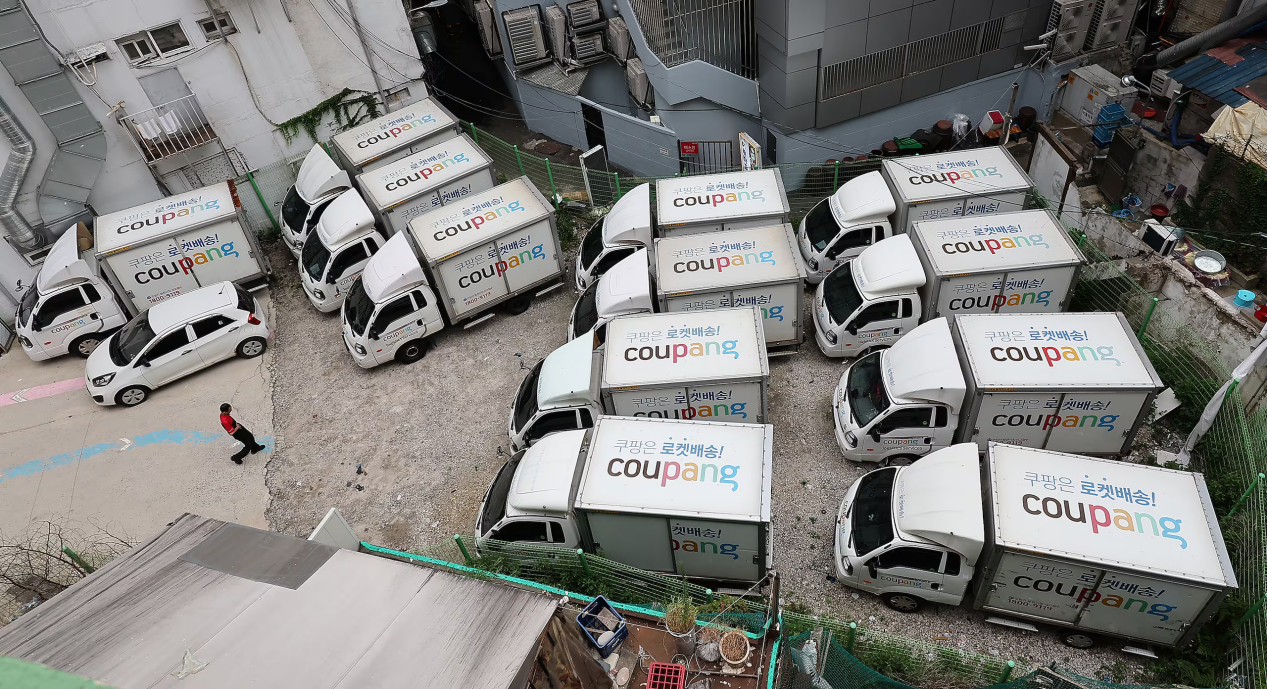
The logistics competition in South Korea's e-commerce market is entering a white-hot stage.
Industry leader Coupang recently announced that it will invest 100 billion KRW in Jecheon, North Chungcheong Province, to build a new generation AI logistics center, which is planned to be operational by June 2026. This is another key move in logistics infrastructure after previously investing 200 billion KRW in an automated logistics base in Gimhae, South Gyeongsang Province.

Coupang's newly built AI logistics center Image source: nate
3 Trillion KRW Bet on Logistics Infrastructure
As the long-term leader in South Korea's e-commerce market, Coupang's ambitions go far beyond two logistics centers. In March last year, the company announced an investment plan totaling 3 trillion KRW, aiming to cover nine core regions in South Korea with its logistics network by the end of 2026 and fully realize nationwide "Rocket Delivery." The name of this service directly reflects its core advantage: relying on a dense warehousing network, over 80% of Korean users can enjoy same-day or next-day delivery.
There is a clear business logic behind the heavy investment. According to Statista, 24.7% of Korean consumers list delivery speed as the third most important factor in online shopping decisions, second only to product cost-effectiveness (44.5%) and shopping experience (33.1%). Supplementary data from FedEx is even more striking: 50% of consumers will directly change their purchase decisions due to delivery timeliness. Clearly, logistics efficiency has become the core battleground for e-commerce platforms to compete for users.

Logistics efficiency becomes the primary consideration for online shopping Image source: Statista
Encirclement Battle by Domestic and International Giants
Coupang's aggressive expansion is not without pressure. International e-commerce giant Alibaba has announced a $200 million investment to build an integrated logistics center in South Korea, attempting to grab a share of the market. Local rival Naver has launched the "Naver Delivery" service, which uses algorithm optimization to shorten average delivery time by two hours and plans to fully implement it by the end of this year.
Small and medium platforms are also unwilling to be left behind: Gmarket has partnered with CJ Logistics to launch a 7-day delivery system operating year-round; 11Street has introduced "Express Weekend Delivery" for the Seoul metropolitan area, allowing consumers to receive same-day delivery if they place orders before 11 a.m. on Saturdays. These innovative services are continuously raising industry standards, forcing leading companies to keep increasing their investment in technology.

Naver's diversified delivery services Image source: Naver
The Strategic Significance of AI Logistics Centers
Facing competitive pressure, Coupang has chosen AI technology as the key to breaking the deadlock. The newly built Jecheon logistics center will fully apply intelligent sorting systems and dynamic route planning algorithms, which are estimated to greatly increase daily processing capacity and reduce error rates. Combined with the Gimhae logistics center's specialized delivery capability for daily necessities, the company is attempting to build a complete supply chain from daily fast-moving consumer goods to high-end products.
It is worth noting that while investing in technology, Coupang also plans to add more than 10,000 new logistics positions. This parallel strategy of "machine replacing humans" and "expanding manpower" not only ensures service stability during the automation transition period but also reserves human resources for future business expansion.

Image source: Chosun.com
Industry Reshuffle Behind the Logistics Competition
This trillion-level logistics competition is essentially a battle for the time value of consumers. When "same-day delivery" becomes a basic service, segmented demands such as "on-time delivery" and "scheduled delivery" are creating new market space. Some analysts point out that in the next three years, the scale of e-commerce logistics investment in South Korea may exceed 5 trillion KRW, and intelligence, grid-based, and specialization will be the key to victory.
For ordinary consumers, the service upgrades brought by the giants' battle are already clearly perceptible. From one-hour fresh delivery to next-morning arrival for midnight orders, ever-improving timeliness standards are reshaping Koreans' shopping habits. From an industry perspective, in this never-ending marathon, only players with both technological accumulation and financial strength may have the last laugh.
What this signal means for growth teams
This market signal should be treated as an operating prompt, not a standalone trend. The brand question is whether the team can connect TikTok content, creators, paid media, commerce readiness, and reporting into one measurable growth cycle.
Commercial read
- Market signal: TikTok Marketing Information and Solutions
- Published: March 26, 2025
- Commercial lens: TikTok Ads, creators, TikTok Shop, live commerce, and reporting.
- Source transparency: the original source linked in this article
What brands should do next
- Identify the market, audience, product group, and KPI this signal could affect.
- Turn the insight into a small TikTok creative, creator, Shop, or paid media test before scaling spend.
- Add FAQ, offer clarity, product proof, and contact paths so traffic can convert instead of only reading.
- Review weekly performance across reach, click quality, Shop actions, creator output, and revenue impact.
Tuke Marketing helps brands connect TikTok Ads, creator partnerships, TikTok Shop operations, live commerce, and reporting into one accountable operating system.
What should brands do with this TikTok signal?
Brands should translate the signal into a focused operating test across creative, creators, TikTok Shop readiness, paid media, and reporting before increasing budget.
How does Tuke Marketing evaluate this kind of news?
Tuke Marketing reviews platform news through market timing, category demand, creator supply, commerce readiness, and measurable growth actions.
When should a team contact Tuke about this topic?
A team should contact Tuke when it needs to turn a TikTok market signal into a practical launch, creator, advertising, live commerce, or reporting plan.
Source transparency: Tuke cites the original source linked in this article and adds its own operating analysis for brands evaluating TikTok growth decisions.