
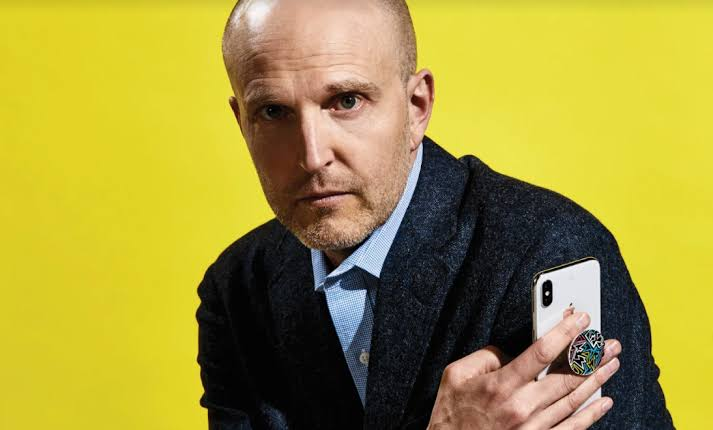
You may not have heard of PopSockets, but you’ve definitely seen that expandable “bubble grip” phone holder on social media. Hollywood star Emma Roberts uses it for selfies, tennis legend Serena Williams uses it to binge-watch shows, and even former US Vice President Joe Biden has become a loyal user!
Originally created to solve the problem of tangled earphone wires, this “little round disc” has nowsold over 250 million units, covering 75 countries worldwide, with annual revenue once surpassing $200 million. It was ranked 24th on The Verge’s list of “The Coolest Tech Products of the Past Decade,” beating out the Dyson hair dryer and Google Glass.
What exactly makes this “little round disc” so attractive?

Emma Roberts taking a selfie with a PopSockets grip. Source: Facebook
From Philosophy Professor’s “Brainwave” to Global Bestseller
It all started back in 2010. At the time, American philosophy professor David Barnett was driven crazy by tangled earphone wires, so he glued two buttons to the back of his phone to wrap the wires and prevent knots—unexpectedly, this became the prototype for the PopSockets phone grip.

David Barnett. Source: Facebook
In 2012, Barnett launched a Kickstarter campaign for a phone case with an integrated grip, but factory delays forced him to refund the cases. To make matters worse, a fire destroyed his home during this period, leaving him with nothing overnight.
Despite this, Barnett persisted with the help of insurance money and donations, and finally established the brand in 2014, selling 30,000 products in its first year.

Source: Kickstarter
A year after launch, PopSockets partnered with T-Mobile for retail, officially entering the mainstream market. The brand then entered a period of rapid growth, with sales soaring to 35 million units in 2018 and annual revenue surpassing $169 million.
In 2023, PopSockets launched an AI customizer, allowing users to input text or upload images to generate a personalized design and print it on a phone case within 60 seconds. This made them the first accessories brand to offer consumers a direct AI customization experience.

Source: PopSockets
3C Accessories Market: The “Invisible Driver” Behind a Billion-Dollar Track
The rise of the PopSockets brand is no accident; it’s arguably an inevitable result of digital technology’s development.
According to third-party platforms, the global 3C digital accessories market surpassed $19.542 billion in 2023 and is expected to reach $38.082 billion by 2031. Behind this massive market size is a profound shift in consumer demand: people are no longer satisfied with the basic function of “protecting the phone,” but are seeking personal expression and scenario adaptation.
The rise of PopSockets is a microcosm of this trend. In the fiercely competitive 3C accessories market, the era of competing solely on specs is long gone; emotional value and cultural symbols are now the key to breaking through.

Source: Cognitive Market Research
Multi-Platform Social Media Matrix Layout
With the booming development of e-commerce platforms in recent years, consumers are increasingly inclined to buy 3C accessories online, and social media promotion and traffic generation have become the top priority for brands in online sales.
PopSockets mainly builds its traffic through platforms like TikTok and Instagram.
1. TikTok: User Co-Creation Captures Gen Z
On TikTok, Gen Z consumers prefer participation and interaction rather than passively receiving ads. Therefore, PopSockets’ core strategy is “user co-creation + scenario-based marketing,” which allows them to build deep connections with users through content, not just one-way product promotion.
Based on this strategy, PopSockets has built a matrix of four accounts on TikTok, forming a multi-layered content distribution network. The main account @popsockets has over 283,600 followers and about 214.2 million total views.

Some brand account information. Source: Chaodian Youshu
To further enhance user engagement, PopSockets encourages TikTok users to post videos showcasing creative uses of the product. This allows more users to see the product’s versatility and its close integration with everyday life.
Currently, TikTok’s #popsockets user-generated videos have exceeded 23,900, with a cumulative view count of about 25 million.

Source: TikTok
Meanwhile, PopSockets also collaborates deeply with fashion and tech KOLs, using unboxing videos and scenario-based demonstrations to intuitively showcase the product’s diverse uses.
For example, TikTok influencer @aspynovard (1.1 million followers) posted a PopSockets grip unboxing video, which attracted 638,300 views thanks to its straightforward introduction and exaggerated tone.
Such collaborations with KOLs not only amplify brand awareness but also lower users’ decision-making barriers through real-life scenario demonstrations.

Source: TikTok
2. Instagram: High-Value “Visual Bombardment”
On Instagram, PopSockets adopts a different strategy, using high-value visual content to strengthen its brand image and further expand its influence.
Currently, the brand’s account @popsockets has over 379,000 followers. Through carefully designed images and short videos, they showcase the product’s use in various scenarios, such as pairing with fashion outfits, blending into home environments, and even as travel accessories.

Source: Instagram
This content model successfully upgrades the product from a functional accessory to a fashionable item, attracting many consumers who value quality of life and aesthetic expression.

Source: Instagram
Independent Website: The “Effortless Win” Secret of SEO + Organic Traffic
If social media platforms’ traffic accumulation is the first step in brand marketing, then the independent website is the core battleground for converting traffic into sales.
PopSockets has invested heavily in SEO optimization. According to third-party data, the PopSockets independent site had 1.89 million visits from May to August 2024, with an average monthly traffic of 930,000. Of this, 31.9% came from organic search, and social accounted for 15.1%.

Source: Internet
This “social platform traffic generation + independent site conversion” model not only helps PopSockets efficiently utilize traffic, but also builds a core user base for the brand through its independent site.
Conclusion
Looking at the development of the PopSockets brand, it’s clear that going global is never just about “listing products” and winning effortlessly. Today, the competitive logic of overseas markets has changed: users are not buying products, but the answer to “Who am I?”
Whether it’s through TikTok seeding, independent site accumulation, or AI-powered personalization, the essence is to make the product a tool for users’ self-expression and to create value for them.
And there are actually many similar products in China...
As the founder of Minority Party said, the dividend of “Made in China” is fading, and the era of “Created in China” is coming.
(Note: All information in this article comes from public reports and platform data; actual conditions are subject to official information.)
What this signal means for growth teams
This market signal should be treated as an operating prompt, not a standalone trend. The brand question is whether the team can connect TikTok content, creators, paid media, commerce readiness, and reporting into one measurable growth cycle.
Commercial read
- Market signal: TikTok marketing tips - short video marketing methods
- Published: March 14, 2025
- Commercial lens: TikTok Ads, creators, TikTok Shop, live commerce, and reporting.
- Source transparency: the original source linked in this article
What brands should do next
- Identify the market, audience, product group, and KPI this signal could affect.
- Turn the insight into a small TikTok creative, creator, Shop, or paid media test before scaling spend.
- Add FAQ, offer clarity, product proof, and contact paths so traffic can convert instead of only reading.
- Review weekly performance across reach, click quality, Shop actions, creator output, and revenue impact.
Tuke Marketing helps brands connect TikTok Ads, creator partnerships, TikTok Shop operations, live commerce, and reporting into one accountable operating system.
What should brands do with this TikTok signal?
Brands should translate the signal into a focused operating test across creative, creators, TikTok Shop readiness, paid media, and reporting before increasing budget.
How does Tuke Marketing evaluate this kind of news?
Tuke Marketing reviews platform news through market timing, category demand, creator supply, commerce readiness, and measurable growth actions.
When should a team contact Tuke about this topic?
A team should contact Tuke when it needs to turn a TikTok market signal into a practical launch, creator, advertising, live commerce, or reporting plan.
Source transparency: Tuke cites the original source linked in this article and adds its own operating analysis for brands evaluating TikTok growth decisions.