
For European consumers, "Made in China" has quietly integrated into their daily lives.
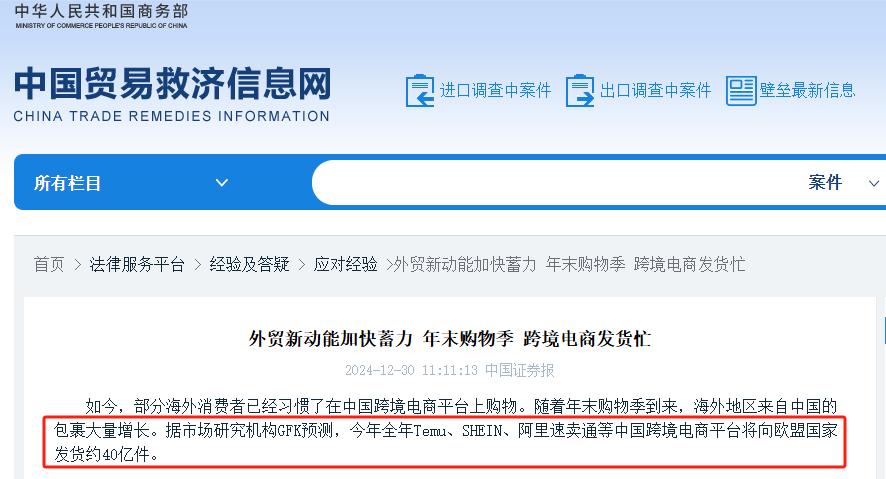
From household goods to clothing and beauty products, from high-tech items to traditional crafts, the presence of Chinese-made products is everywhere. This influence is also reflected in the data. In 2024, it is expected that Chinese cross-border e-commerce platforms will ship 4 billion parcels to the 27 EU countries—equivalent to each country receiving an average of about 150 million Chinese parcels. These parcels not only carry the story of the rise of Chinese e-commerce, but also allow global consumers to see the potential of "Made in China".

About 4 billion international shipments from China to the EU. Image source: Ministry of Commerce of the People's Republic of China
How do 4 billion parcels conquer Europe?
Finland is a typical example. According to data from the Finnish Customs, in 2024, the country's parcel imports from non-EU regions surged sixfold, rising from 4 million to 25 million. Among them, goods from China are almost dominant, especially in the category of small items valued at less than 150 euros, accounting for as much as 87%. In other words, out of every 10 parcels received, nearly 9 are from China.
This trend is not unique to Finland. In Spain, the three major Chinese e-commerce platforms—SHEIN, Temu, and AliExpress—have already captured one-third of the local e-commerce market. In major markets such as France, Italy, and Germany, the influence of these platforms is also expanding year by year. From traditionally woven tote bags to new Chinese-style clothing, to rice water shampoos and drones, Chinese products have won over European consumers with their high cost performance and wide variety.
Moreover, the operating models of e-commerce platforms have also played a significant role. Through highly interactive shopping experiences, limited-time discounts, group buying deals, and other "gamified" features, these platforms not only allow consumers to buy cheaply, but also make shopping fun.

Chinese e-commerce platforms take root in the European market. Image source: Emarketer
The European market is an opportunity, but also hides pressure
Although the European market is full of potential, the challenges cannot be ignored. In recent years, the EU has been discussing the cancellation of the tariff exemption policy for goods under 150 euros. Once implemented, Chinese sellers who focus on low-priced products may face higher cost pressures. For sellers who rely on a low-profit, high-volume model, this will be a severe test.
At the same time, the demand for localization of logistics and services is gradually increasing. European consumers' requirements for product quality, logistics efficiency, and after-sales service are rising, which puts higher demands on Chinese sellers' supply chain management capabilities. If the service experience is lacking, it is likely to lose the competitive edge.

The EU plans to cancel the tax exemption policy for low-priced imported goods under 150 euros. Image source: vatupdate
Policy support, backing for sellers going global
In the face of these challenges, the Chinese government is also actively providing support for the overseas expansion of cross-border e-commerce.
This year, the General Administration of Customs of China issued new measures, from canceling the registration of overseas warehouse enterprises to simplifying export procedures, and expanding the pilot scope of "inspection before loading", optimizing export policies in multiple aspects. The implementation of these policies not only reduces the operational burden on sellers, but also enhances their competitiveness in overseas markets.
In addition, the government is continuously improving tax and logistics support policies for cross-border e-commerce, fundamentally providing strong backing for sellers and helping them cope with the complex overseas market environment.

Four optimization measures. Image source: General Administration of Customs
4 billion parcels are just the beginning, the future of Chinese cross-border e-commerce is promising
Opportunities and challenges coexist in the European market, and behind the 4 billion parcels is proof of the profound influence of Chinese cross-border e-commerce on the global market.
Although the future remains uncertain, one thing is certain: with the multiple advantages of products, platforms, and policies, Chinese sellers will not stop moving forward. The European market is just a starting point. In the future, more Chinese parcels will continue to travel across the seas, carrying the story of "Made in China" to a broader world.
What this signal means for growth teams
This market signal should be treated as an operating prompt, not a standalone trend. The brand question is whether the team can connect TikTok content, creators, paid media, commerce readiness, and reporting into one measurable growth cycle.
Commercial read
- Market signal: TikTok Marketing Information and Solutions
- Published: January 4, 2025
- Commercial lens: TikTok Ads, creators, TikTok Shop, live commerce, and reporting.
- Source transparency: the original source linked in this article
What brands should do next
- Identify the market, audience, product group, and KPI this signal could affect.
- Turn the insight into a small TikTok creative, creator, Shop, or paid media test before scaling spend.
- Add FAQ, offer clarity, product proof, and contact paths so traffic can convert instead of only reading.
- Review weekly performance across reach, click quality, Shop actions, creator output, and revenue impact.
Tuke Marketing helps brands connect TikTok Ads, creator partnerships, TikTok Shop operations, live commerce, and reporting into one accountable operating system.
What should brands do with this TikTok signal?
Brands should translate the signal into a focused operating test across creative, creators, TikTok Shop readiness, paid media, and reporting before increasing budget.
How does Tuke Marketing evaluate this kind of news?
Tuke Marketing reviews platform news through market timing, category demand, creator supply, commerce readiness, and measurable growth actions.
When should a team contact Tuke about this topic?
A team should contact Tuke when it needs to turn a TikTok market signal into a practical launch, creator, advertising, live commerce, or reporting plan.
Source transparency: Tuke cites the original source linked in this article and adds its own operating analysis for brands evaluating TikTok growth decisions.