
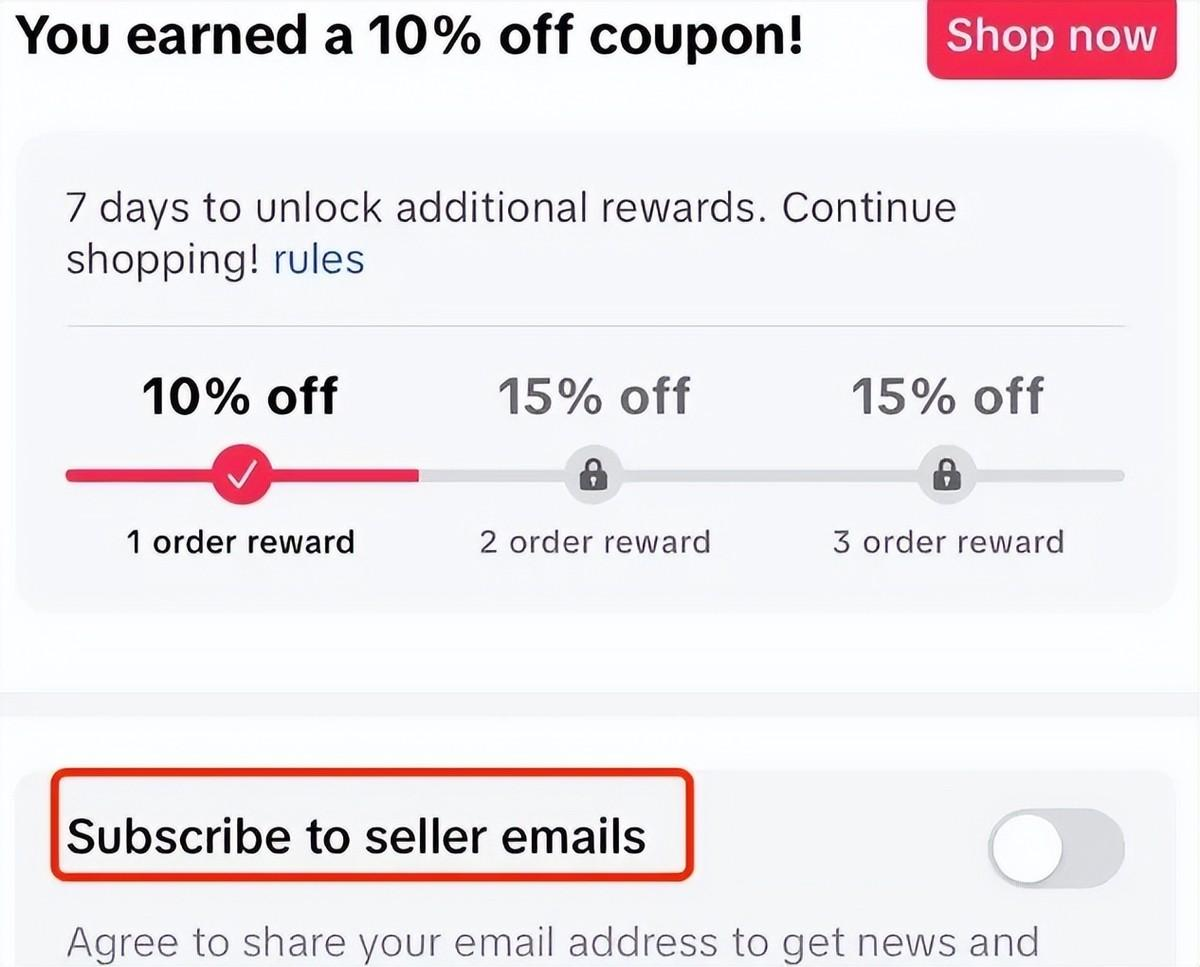
In the e-commerce sector, every update to platform features can bring new growth opportunities for merchants. The “Subscribe to Seller Emails” feature launched by TikTok Shop on October 14 is a prime example.
This feature allows users, under the premise of complying with privacy policies, to receive the latest news and promotional information from sellers through subscription. This helps sellers better manage and expand their customer base.

Image source: TikTok Shop
On e-commerce platforms, apart from their own independent websites, sellers usually can only rely on the platform’s built-in communication tools to interact with buyers. It is difficult to control the acquisition of private domain traffic and the accuracy of fans.
However, this new feature of TikTok Shop provides sellers with an additional channel, enabling them to interact with users more directly and thus enhance users’ sense of brand identity.
It also allows sellers to build their own private domain traffic more conveniently, thereby improving conversion rates.
In fact, some sellers have long noticed that competing for traffic solely within the TikTok platform is not only inaccurate but also prone to loss. Therefore,building their own traffic pool and converting public domain traffic into private domain traffic becomes very necessary.

So how can sellers use this new TikTok Shop feature to convert private domain traffic?
Sellers can adopt the following strategies:
1. Clarify the value proposition of subscription
First, sellers need to clearly communicate the value of subscribing to emails to users. This may include exclusive offers, new product previews, personalized recommendations, etc. By highlighting these benefits, users are motivated to subscribe, helping sellers build a loyal subscriber base.
2. Create high-quality content
Content is key to attracting and retaining subscribers. Sellers should invest time and resources in creating high-quality content that not only grabs users’ attention but also provides value, encouraging users to keep following and interacting.
3. Optimize email marketing strategies
Sellers should use email marketing best practices, including personalized emails, segmented mailing lists, A/B testing, etc., to improve email open and click rates. Through these strategies, sellers can communicate with users more effectively and increase conversion rates.

4. Guide users to take action
In emails, sellers should clearly guide users to take action, such as visiting independent websites, participating in promotional activities, or leaving feedback. Through clear calls to action, sellers can increase user engagement and conversion rates.
5. Track and analyze data
Sellers need to track and analyze the effectiveness of email marketing, including key metrics such as open rates, click rates, and conversion rates. With this data, sellers can understand which strategies are effective and which need improvement, continuously optimizing their email marketing strategies.
6. Protect user privacy
When collecting and using user data, sellers must strictly comply with privacy policies to ensure the security of user information. This not only helps build user trust but is also required by laws and regulations.
7. Cross-platform integration
Sellers should integrate the email subscription feature with other social media platforms, such as adding subscription links in TikTok video descriptions or promoting the benefits of email subscriptions on other social media. Through cross-platform integration, sellers can more comprehensively attract and retain users.

With these strategies, sellers can effectively use TikTok Shop’s “Subscribe to Seller Emails” feature to convert public domain traffic into private domain traffic, thereby enhancing brand influence and sales performance.
This process requires sellers to continuously test, learn, and adapt to ensure the effectiveness of their email marketing strategies. Over time, sellers will be able to build a strong private domain traffic pool, laying a solid foundation for the long-term development of their brand.
What this signal means for growth teams
This market signal should be treated as an operating prompt, not a standalone trend. The brand question is whether the team can connect TikTok content, creators, paid media, commerce readiness, and reporting into one measurable growth cycle.
Commercial read
- Market signal: TikTok Marketing Information and Solutions
- Published: October 17, 2024
- Commercial lens: TikTok Ads, creators, TikTok Shop, live commerce, and reporting.
- Source transparency: the original source linked in this article
What brands should do next
- Identify the market, audience, product group, and KPI this signal could affect.
- Turn the insight into a small TikTok creative, creator, Shop, or paid media test before scaling spend.
- Add FAQ, offer clarity, product proof, and contact paths so traffic can convert instead of only reading.
- Review weekly performance across reach, click quality, Shop actions, creator output, and revenue impact.
Tuke Marketing helps brands connect TikTok Ads, creator partnerships, TikTok Shop operations, live commerce, and reporting into one accountable operating system.
What should brands do with this TikTok signal?
Brands should translate the signal into a focused operating test across creative, creators, TikTok Shop readiness, paid media, and reporting before increasing budget.
How does Tuke Marketing evaluate this kind of news?
Tuke Marketing reviews platform news through market timing, category demand, creator supply, commerce readiness, and measurable growth actions.
When should a team contact Tuke about this topic?
A team should contact Tuke when it needs to turn a TikTok market signal into a practical launch, creator, advertising, live commerce, or reporting plan.
Source transparency: Tuke cites the original source linked in this article and adds its own operating analysis for brands evaluating TikTok growth decisions.