
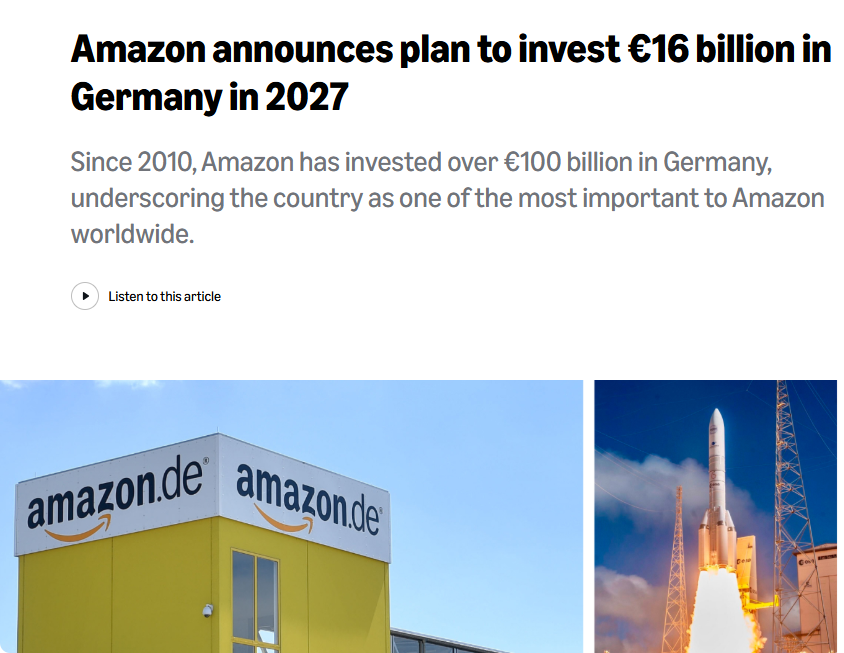
At a recent summit held in Berlin, Amazon officially announced plans to invest more than 16 billion euros (approximately RMB 120 billion) in the German market by 2027.
This funding will comprehensively cover multiple fields including cloud computing, artificial intelligence, satellite internet, logistics fulfillment, and local film and television production. In terms of Amazon's single-year investment records in Europe in recent years, the scale of this move ranks among the top.

Image source: about amazon
Looking at the overall account from a longer perspective, Amazon's preference for Germany actually has traces to follow.
Since 2010, Amazon's cumulative investment in Germany has exceeded 100 billion euros. Looking only at 2025 data, Amazon's net sales attributable to Germany reached USD 45.9 billion, surpassing the UK and Japan in one stroke and firmly ranking as its largest single overseas market. Clearly, Amazon is turning Germany into its absolute base for taking root in Europe.

Image source: about amazon
For Amazon, the German market not only has strong consumer power itself but also plays an important role as a European cross-border hub. Data shows that in 2025 Germany's online retail sales reached approximately 92.3 billion euros, with more than half of transactions occurring on various e-commerce platforms. More importantly, local small and medium-sized enterprises operating on Amazon Germany have annual sales exceeding 20 billion euros, of which nearly 6 billion euros come from exports. Through Germany's mature warehousing and logistics network, merchants can smoothly sell goods to neighboring countries such as France, Italy, and Austria.
This hub value of benefiting both ends is precisely the foundation for Amazon's willingness to continue spending money.

Image source: einzelhandel
Once the business grows large, what is competed on is the hard strength of the supply chain. Amazon currently has more than 100 facilities in Germany. To cope with an increasingly huge order volume, Amazon is planning intelligent upgrades to existing logistics centers in Koblenz, Dortmund, and other places, while building and launching new fulfillment centers to further compress delivery times.
Of course, Amazon is by no means the only one eyeing the European pie.
In recent years, Joybuy under JD.com has accelerated the rollout of European logistics infrastructure, tackling the last mile through self-operated delivery; Temu under Pinduoduo has also deepened cooperation with German local logistics giant DHL, leveraging the local network to achieve local shipping.

Image source: Joybuy
From the competitive landscape, the playbook in the European e-commerce market has undergone profound changes: in the past, everyone competed on who could deliver cross-border parcels; now, the competition is over who can stock goods locally earlier, who can replenish faster when out of stock, and whether delivery fulfillment is stable enough.
For cross-border sellers at large, the warehouse network tug-of-war among platforms is not a bad thing. When major giants use infrastructure investment to exchange for speed and speed to exchange for consumer trust, sellers can also enjoy more complete logistics guarantees. As for who can gain more share in this red ocean in Europe, ultimately it still depends on each company's real capabilities in supply chain and service details.
What this signal means for growth teams
This market signal should be treated as an operating prompt, not a standalone trend. The brand question is whether the team can connect TikTok content, creators, paid media, commerce readiness, and reporting into one measurable growth cycle.
Commercial read
- Market signal: TikTok Marketing Information and Solutions
- Published: October 28, 2026
- Commercial lens: TikTok Ads, creators, TikTok Shop, live commerce, and reporting.
- Source transparency: the original source linked in this article
What brands should do next
- Identify the market, audience, product group, and KPI this signal could affect.
- Turn the insight into a small TikTok creative, creator, Shop, or paid media test before scaling spend.
- Add FAQ, offer clarity, product proof, and contact paths so traffic can convert instead of only reading.
- Review weekly performance across reach, click quality, Shop actions, creator output, and revenue impact.
Tuke Marketing helps brands connect TikTok Ads, creator partnerships, TikTok Shop operations, live commerce, and reporting into one accountable operating system.
What should brands do with this TikTok signal?
Brands should translate the signal into a focused operating test across creative, creators, TikTok Shop readiness, paid media, and reporting before increasing budget.
How does Tuke Marketing evaluate this kind of news?
Tuke Marketing reviews platform news through market timing, category demand, creator supply, commerce readiness, and measurable growth actions.
When should a team contact Tuke about this topic?
A team should contact Tuke when it needs to turn a TikTok market signal into a practical launch, creator, advertising, live commerce, or reporting plan.
Source transparency: Tuke cites the original source linked in this article and adds its own operating analysis for brands evaluating TikTok growth decisions.