
Southeast Asia's pet market is undergoing an identity reconstruction.
In the past, people regarded cats and dogs as tools for guarding the home or playthings for leisure companionship; today, more and more people view them as formal family members, and behind the new label 'pet parent' is a fundamental shift in consumer logic.
In 2025, the regional pet market size is expected to exceed US$20 billion, and the pet supplies segment is expected to surpass US$3.2 billion in 2026. Beyond the numbers, what is more noteworthy is that domestic sellers have already used Lazada to carve out replicable paths in the Philippines, Thailand, and Malaysia.

Image source: Lazada
And in the major promotion that just passed, the GMV of the pet category on the Malaysia site reached a highest month-on-month increase of 1715%; this figure is enough to make any cross-border practitioner re-examine the explosive power of this market.
Same track, different approaches
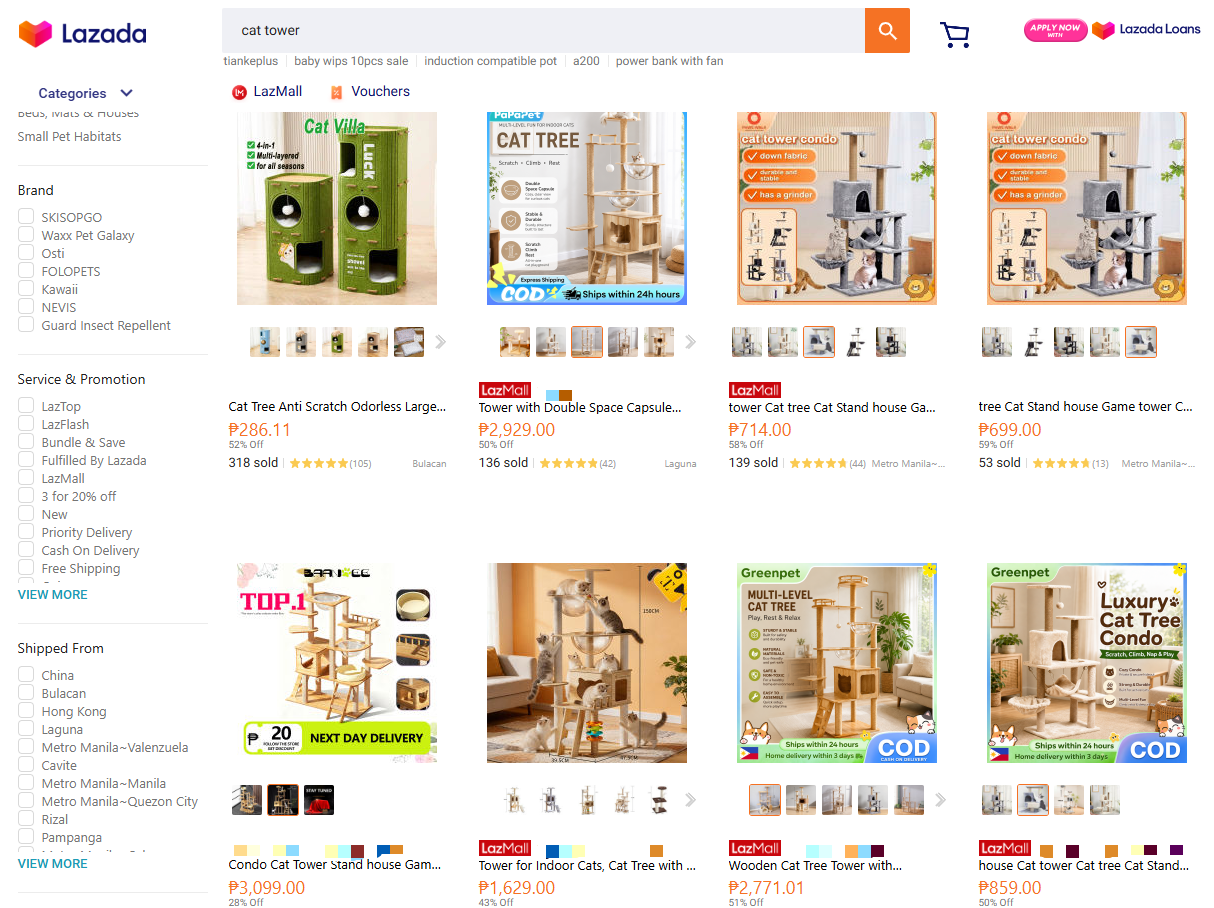
The approach in the Philippine market tends to be from the inside out. Sellers first enter functional health supplements, starting with rigid-demand health issues such as pet joints, gastrointestinal health, and skin and coat to build trust, then gradually expand to durable goods such as cat beds and cat trees.

Image source: Lazada
The cleverness of this strategy lies in the fact that health supplements are a category with high repurchase rates and high average order value in consumers' minds; once consumers recognize a brand, the customer acquisition cost for subsequently expanding into other categories will drop significantly.
The Thai market shows another rhythm. Sellers focus on food bowls, water dispensers, and care supplies; GMV doubled month-on-month in May and continued to rise 159.5% in August. Consecutive growth shows that this is not a pulse brought by short-term promotions, but a signal that consumption habits are being formed.

Image source: Lazada
Thai consumers' demand for refined pet supplies is rising quickly, and details such as water intake and eating posture are beginning to be taken seriously.
Malaysia's explosion is the most dramatic; the beauty and grooming category surged 1715% month-on-month in July. Behind this figure is the concentrated release of Malaysian pet owners' appearance management needs; from washing and care to trimming, from daily cleaning to professional grooming, demand was intensively activated in a short period.

Image source: Lazada
Although the three sites all belong to Southeast Asia, their consumer preferences and category rhythms differ markedly; the idea of using the same product portfolio to conquer the world does not work here.
The thresholds and tests behind hot-selling products
Currently, the volume-driving categories are concentrated in cat trees, cat litter, smart feeders, pet strollers, and health supplements, among which supplement products can achieve an average order value of more than US$30.
But the other side of the hot-selling list is market access thresholds: food and health supplements need to complete registration and filing in the destination country, smart devices must pass electronic certification and battery regulations, and cleaning products mostly require MSDS.

Image source: Google
These requirements mean sellers can no longer operate in the rough-and-ready way of listing first and supplementing certificates later; compliance capability is becoming the first filter for screening sellers.
For sellers who have already paved the path, the next focus of competition will shift from whether they have goods to whether the goods are right. For branding, the direction depends on formula differentiation and smart feature differentiation, while white-label sellers compete on supply chain efficiency and speed of product testing.
From a product-listing mindset to localized deep cultivation
Facing the differentiated market characteristics of the three sites, sellers need to do three things.
Match the product portfolio to each site: the Philippines mainly promotes a combination of health supplements and durable goods, Thailand goes deep into food and drink utensils and care consumables, and Malaysia seizes the explosive window for beauty and grooming.
Move compliance forward to the product selection stage instead of waiting until after orders come in to supplement materials; otherwise, the risk of being delisted as soon as sales surge will directly eat into profits.
Use the new merchant benefits offered by the platform to reduce trial-and-error costs. Lazada's policies, such as opening a store in as fast as 5 to 7 days, 90 days without a deposit, 120 days commission-free for overseas warehouses in Malaysia and Vietnam, and 1-for-1 ad credit top-ups, are essentially helping sellers minimize fixed costs during the startup period.

Image source: Google
Conclusion
From 'keeping pets' to 'raising family members,' what changes is not just the label but the weighting of the entire consumer decision-making process.
When pet owners are willing to repeatedly compare prices for a cat tree and study the ingredient list for a bottle of pet joint supplements, this market is no longer a place where you can make easy money just by stocking random products.
What this signal means for growth teams
This market signal should be treated as an operating prompt, not a standalone trend. The brand question is whether the team can connect TikTok content, creators, paid media, commerce readiness, and reporting into one measurable growth cycle.
Commercial read
- Market signal: TikTok Marketing Information and Solutions
- Published: October 19, 2026
- Commercial lens: TikTok Ads, creators, TikTok Shop, live commerce, and reporting.
- Source transparency: the original source linked in this article
What brands should do next
- Identify the market, audience, product group, and KPI this signal could affect.
- Turn the insight into a small TikTok creative, creator, Shop, or paid media test before scaling spend.
- Add FAQ, offer clarity, product proof, and contact paths so traffic can convert instead of only reading.
- Review weekly performance across reach, click quality, Shop actions, creator output, and revenue impact.
Tuke Marketing helps brands connect TikTok Ads, creator partnerships, TikTok Shop operations, live commerce, and reporting into one accountable operating system.
What should brands do with this TikTok signal?
Brands should translate the signal into a focused operating test across creative, creators, TikTok Shop readiness, paid media, and reporting before increasing budget.
How does Tuke Marketing evaluate this kind of news?
Tuke Marketing reviews platform news through market timing, category demand, creator supply, commerce readiness, and measurable growth actions.
When should a team contact Tuke about this topic?
A team should contact Tuke when it needs to turn a TikTok market signal into a practical launch, creator, advertising, live commerce, or reporting plan.
Source transparency: Tuke cites the original source linked in this article and adds its own operating analysis for brands evaluating TikTok growth decisions.