
Half a year ago, a financing news item went viral in the overseas sports tech world:
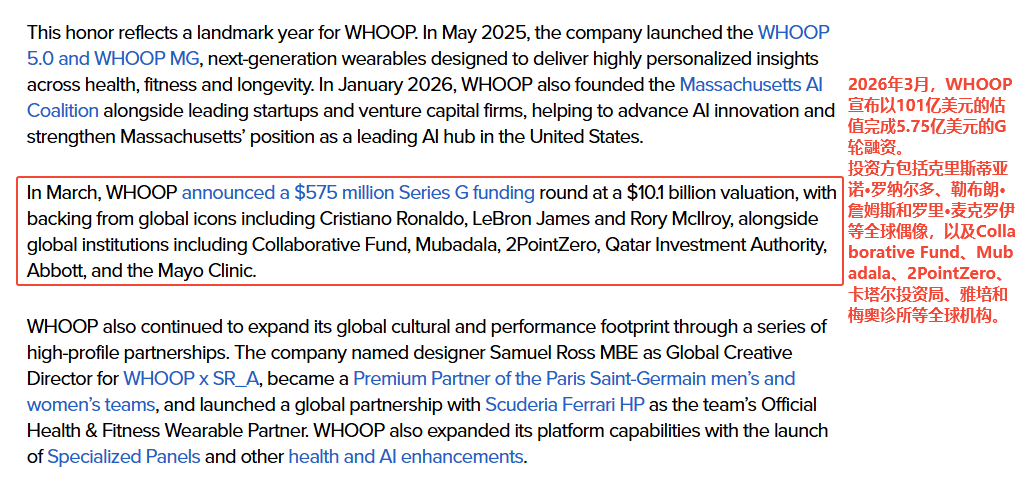
In its latest Series G funding round, WHOOP secured $575 million, and its valuation climbed to $10.1 billion. Compared with $3.6 billion in the previous round, it nearly tripled.
The investor lineup is very impressive: the Qatar Investment Authority, Abbott, Collaborative Fund, Mubadala Investment Company, 2PointZero, and Mayo Clinic all participated.

Image source: WHOOP
However, what really made this funding round a hot topic was not these veteran capital firms.
Cristiano Ronaldo, LeBron James, Rory McIlroyand 9 sports legends from different disciplines all participated as individual investors—they did not come to be spokespeople, but as shareholders of the brand.

Image source: Google
What kind of brand can gather so many top athletes willing to pay out of their own pockets to take equity?
The rise of WHOOP begins with a screenless wristband.
More than a decade of persistence, all for one thing
According to public information, the startup story of the WHOOP brand stems from founder Will Ahmed's personal experience.
While studying at Harvard University, he was a member of the school squash team. Long-term overtraining left his body depleted and him constantly injured.
Even with professional coaching, at the time there was a lack of tools that could read the body's internal signals, making it impossible to determine whether the body was at its peak or on the verge of its limit.

Image source: WHOOP
After studying more than 500 medical papers, he determined the product's core direction: 24/7 collection of heart rate variability, monitoring of sleep quality, and assessment of exercise load and physical recovery levels.
With just a screenless wristband, it tells users whether their body is suited for high-intensity training that day or needs rest.
And so, in 2012, 22-year-old Ahmed founded the predecessor of WHOOP in a Harvard lab.

Image source: WHOOP
Embedding itself in the professional athlete community and accumulating authentic reputation
However, the early days of the startup were arduous. Between 2012 and 2014, the team approached 143 investors in total, every fundraising attempt failed, and the company was once on the brink of bankruptcy.
By 2015, things finally began to improve, and WHOOP's first-generation product was officially launched that year.
The brand chose to prioritize entering North American professional sports leagues such as the NBA and NFL, breaking through via the professional athlete community, focusing on sleep tracking, physical recovery, and training data, and completing product validation by running in-team tests with professional athletes.

Image source: Google
After focusing on this niche segment, WHOOP quickly gained recognition from top athletes such as LeBron James and Phelps.
In 2016, it also iteratively launched the 2.0 band, becoming standard equipment for elite North American athletes and quickly becoming popular within a small circle.
Abandoning the pure hardware sales model, relying on subscriptions to break through the growth ceiling
Although it made a name for itself in athletes' circles, the pure hardware sales model soon hit a growth bottleneck.
To pursue long-term development, WHOOP made a disruptive adjustment in 2018:It stopped selling band hardware separately and fully shifted to a membership subscription model.
This business model innovation helped the brand move completely from professional circles into the mass market. The model of paying monthly/yearly to unlock the full set of physiological data analysis drove user scale to surge by 400%.

Image source: Google
Cristiano Ronaldo joins, and multi-channel efforts continue to build momentum
Opening up the mass market was only the first step. To gain a firm foothold in the market, brand IP building and channel layout are indispensable.
In 2024, WHOOP announced that football superstar Cristiano Ronaldo had taken a stake and would serve as global brand ambassador. Leveraging Ronaldo's massive fan base and global influence, it shaped a professional and reliable brand image.

Image source: Google
In addition, in terms of sales channels, it also carried out a comprehensive online + offline layout.
Online, WHOOP takes its standalone site as the core, serving as the main transaction battleground and accumulating first-party user data; it also uses Amazon as a secondary supplementary channel to support localized fulfillment in Europe and Asia-Pacific.

Image source: Amazon
Offline, the brand did not broadly distribute through ordinary supermarkets and stores, but selected only high-end locations. It focused on brand display and offline try-ons, while order transactions were still directed to online subscriptions to safeguard the profit of the subscription business.
It is reported that in the full fiscal year 2025, WHOOP's Bookings run-rate reached $1.1 billion (converted to more than RMB 7.3 billion), and this amount includes the total order value of hardware devices and membership subscriptions.
In March 2026, WHOOP even announced the completion of a $575 million Series G financing at a valuation of $10.1 billion, and the situation was completely opened up.

Image source: Google
Leveraging social media traffic,conveybrand professionalism
To enable potential users to deeply understand the brand and products, social media is an indispensable battlefield for WHOOP.
In line with the product's own approach of deeply cultivating professionalism, WHOOP on platforms such as TikTok abandoned exaggerated selling and eye-catching traffic tactics.
Its operational approach is to leverage platform algorithms and traffic so that professional content can be seen and recognized by more people.
Therefore, the content direction of the brand's official TikTok account @WHOOP is very clear:It focuses on athletes' real training scenes, user-measured data, and accessible explanations of the product's hardcore technology.
As of now, it has gained 402,400 followers and up to 3.9 million likes.

Image source: TikTok
For example, the account has posted many videos related to football superstar Cristiano Ronaldo, including footage of him wearing the WHOOP band during daily training, as well as an exclusive interview in which he discusses product technology with the brand founder and shares his real user experience.
It uses Ronaldo's perspective to interpret the brand philosophy and product capabilities, leveraging the influence of a sports superstar to amplify social media communication effects.

Image source: TikTok
In addition, WHOOP has partnered with many fitness influencers on TikTok to demonstrate how the band solves the common pain point of 'overtraining without realizing it.'
This type of content does not blindly pursue view counts; instead, it relies on physiological data tracking in real scenarios to quietly convey professional value.
When users see a fitness blogger compare the gap between WHOOP and ordinary bands in deep sleep monitoring accuracy, they can perceive the product's core value and are more likely to accept its relatively high pricing.

Image source: TikTok
Conclusion
From the WHOOP brand, domestic companies expanding into overseas markets can actually learn quite a lot.
For example, choose a sufficiently vertical niche, build trust with professional capabilities, and then open up long-term growth space through a subscription or service-based model; for example, in channel layout, there is no need to be greedy for size and completeness—using an independent site to accumulate data and selected offline locations for experiences can instead form a healthier profit structure; and for example, on social media, do not chase short-term traffic, but let real scenarios and professional content speak for themselves.
In the final analysis, the playbook that domestic companies have been used to in the past may not necessarily work in overseas markets. Only by stepping out of traffic thinking and taking long-term user value as the core can they embark on a differentiated path to going global.
What this signal means for growth teams
This market signal should be treated as an operating prompt, not a standalone trend. The brand question is whether the team can connect TikTok content, creators, paid media, commerce readiness, and reporting into one measurable growth cycle.
Commercial read
- Market signal: TikTok marketing tips - short video marketing methods
- Published: October 8, 2026
- Commercial lens: TikTok Ads, creators, TikTok Shop, live commerce, and reporting.
- Source transparency: the original source linked in this article
What brands should do next
- Identify the market, audience, product group, and KPI this signal could affect.
- Turn the insight into a small TikTok creative, creator, Shop, or paid media test before scaling spend.
- Add FAQ, offer clarity, product proof, and contact paths so traffic can convert instead of only reading.
- Review weekly performance across reach, click quality, Shop actions, creator output, and revenue impact.
Tuke Marketing helps brands connect TikTok Ads, creator partnerships, TikTok Shop operations, live commerce, and reporting into one accountable operating system.
What should brands do with this TikTok signal?
Brands should translate the signal into a focused operating test across creative, creators, TikTok Shop readiness, paid media, and reporting before increasing budget.
How does Tuke Marketing evaluate this kind of news?
Tuke Marketing reviews platform news through market timing, category demand, creator supply, commerce readiness, and measurable growth actions.
When should a team contact Tuke about this topic?
A team should contact Tuke when it needs to turn a TikTok market signal into a practical launch, creator, advertising, live commerce, or reporting plan.
Source transparency: Tuke cites the original source linked in this article and adds its own operating analysis for brands evaluating TikTok growth decisions.