
If you recently opened a shop on Xiaohongshu, you may have noticed a new entry in the backend called the 'Overseas Pilot Program.' This entry corresponds to Redshop, Xiaohongshu's cross-border e-commerce platform officially launched in July this year.
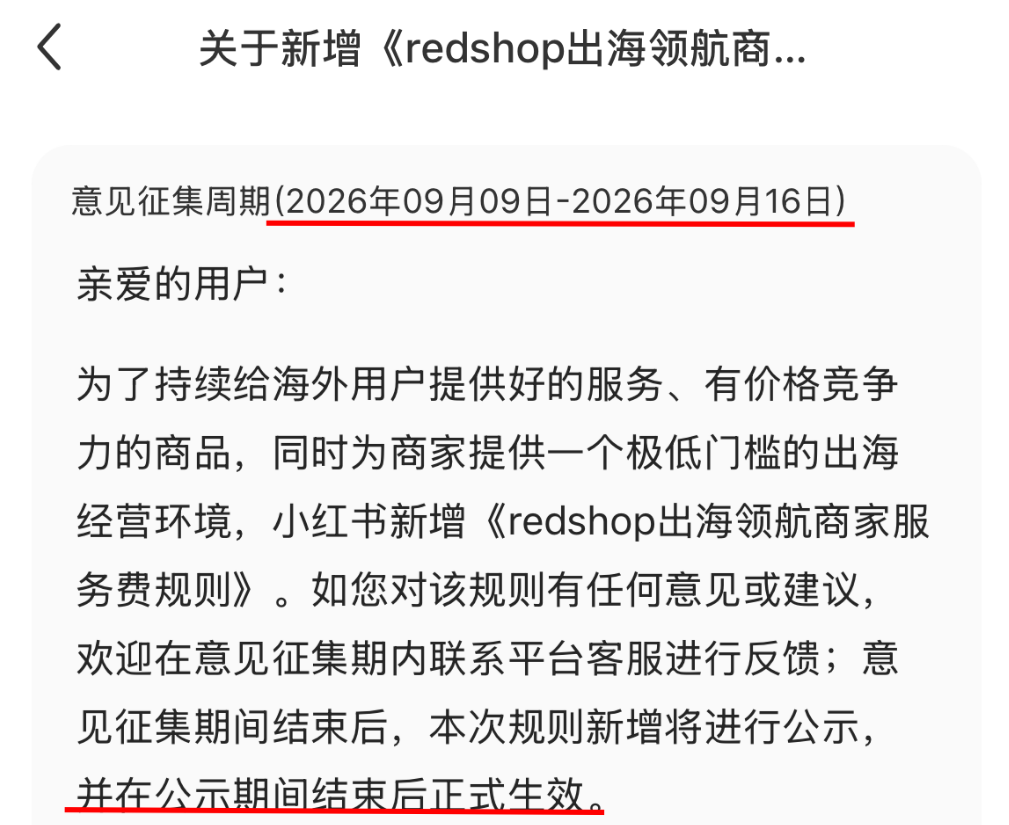
The platform has just started, and before many merchants had a chance to figure out the ropes, a fee notice arrived first. Xiaohongshu is publishing for public notice the 'Redshop Overseas Pilot Merchant Service Fee Rules,' charging merchants who join the 'Overseas Pilot Program' a separate overseas service fee. It officially takes effect on September 16, 2026. The current rate will apply through the end of the year; how much will be charged in 2027, the platform says it will decide when the time comes.

Image source: Xiaohongshu
How exactly is this money charged? Simply put, the platform divides products into several tiers. For mainstream categories such as apparel, beauty, home, 3C electronics, pets, and outdoor sports, the rate is 10%. Handmade DIY and trading cards are lower, at 5%. Anime merchandise, doll clothing, and cotton dolls are 8%.
However, the platform has set a cap: the overseas service fee per order is at most 70 yuan, and the billing base is the actual amount paid for the product plus platform subsidies. At a 10% rate, 700 yuan is the dividing line. Once the order amount exceeds 700 yuan, the service fee no longer increases, and the actual rate will decline as the order value rises. For example, for a 2,000-yuan product, the service fee is still 70 yuan, and the actual rate is only 3.5%.
But note that this 10% is only the overseas service fee and does not include the platform's technical service fee. Product costs, domestic logistics, packing and labeling, return shipping and damage losses, and so on still need to be borne by the merchants themselves.

Image source: Xiaohongshu
So why does Xiaohongshu charge this money?
The reasoning is not complicated. When selling products overseas, the most troublesome part is often not finding buyers, but what happens after buyers place orders. How parcels clear customs, how shipping is calculated, who pays taxes, who handles returns, every step requires manpower and cost. If every merchant had to handle all this themselves, many small and medium-sized sellers would not be able to get off the ground.
Redshop's approach is to package these steps into a set of services. Merchants only need to showcase products through notes, livestreams, and shops, and the content is automatically translated into the local language by the system. After receiving an order, they send the goods to a designated domestic transit warehouse; the subsequent customs clearance and international transportation are completed by the platform's partners, and the payment is ultimately settled in RMB to the merchant's domestic account.
In other words, merchants save the trouble of finding cross-border logistics, translation, and payment collection themselves. This service fee is essentially paying for these conveniences.
Actually, this logic is not new in the cross-border industry. eBay's International Shipping lets sellers send goods to a designated transit center, after which the platform handles subsequent international transportation and customs procedures. Shopify's Managed Markets goes further, extending to tax registration and compliance. What the platform provides is not just an entry point for selling goods, but a full set of services needed to complete cross-border transactions.

Image source: eBay
Coming back to Xiaohongshu, there is another noteworthy signal.
When Redshop first launched, it only sent targeted invitations to about 50 seed merchants in the initial batch, focusing on intangible cultural heritage handicrafts and specialty handmade crafts.
But this rate table already covers more categories, including shoes, clothing, bags, beauty and personal care, home, digital accessories, automotive supplies, books, and more. Although listing these categories in the rate table does not mean they are all already open, the direction is clear: Redshop does not intend to be only an experimental field for niche handmade goods, but to move toward broader categories.

Image source: Google
Xiaohongshu officially has not yet opened public onboarding and still mainly relies on targeted invitations.
For merchants who already have stable operations on the platform, it is reasonable to take advantage of the strong early support and test the waters with some products. But there is no need to go All in right away. First run through a few orders, see the real feedback from overseas users, calculate the cost and profit of each order, and then decide whether to invest long term.
The platform provides opportunities, but whether you can seize them ultimately depends on the product and operations. On the road to going overseas, paying the service fee does not mean easy money.
What this signal means for growth teams
This market signal should be treated as an operating prompt, not a standalone trend. The brand question is whether the team can connect TikTok content, creators, paid media, commerce readiness, and reporting into one measurable growth cycle.
Commercial read
- Market signal: TikTok Marketing Information and Solutions
- Published: September 20, 2026
- Commercial lens: TikTok Ads, creators, TikTok Shop, live commerce, and reporting.
- Source transparency: the original source linked in this article
What brands should do next
- Identify the market, audience, product group, and KPI this signal could affect.
- Turn the insight into a small TikTok creative, creator, Shop, or paid media test before scaling spend.
- Add FAQ, offer clarity, product proof, and contact paths so traffic can convert instead of only reading.
- Review weekly performance across reach, click quality, Shop actions, creator output, and revenue impact.
Tuke Marketing helps brands connect TikTok Ads, creator partnerships, TikTok Shop operations, live commerce, and reporting into one accountable operating system.
What should brands do with this TikTok signal?
Brands should translate the signal into a focused operating test across creative, creators, TikTok Shop readiness, paid media, and reporting before increasing budget.
How does Tuke Marketing evaluate this kind of news?
Tuke Marketing reviews platform news through market timing, category demand, creator supply, commerce readiness, and measurable growth actions.
When should a team contact Tuke about this topic?
A team should contact Tuke when it needs to turn a TikTok market signal into a practical launch, creator, advertising, live commerce, or reporting plan.
Source transparency: Tuke cites the original source linked in this article and adds its own operating analysis for brands evaluating TikTok growth decisions.