
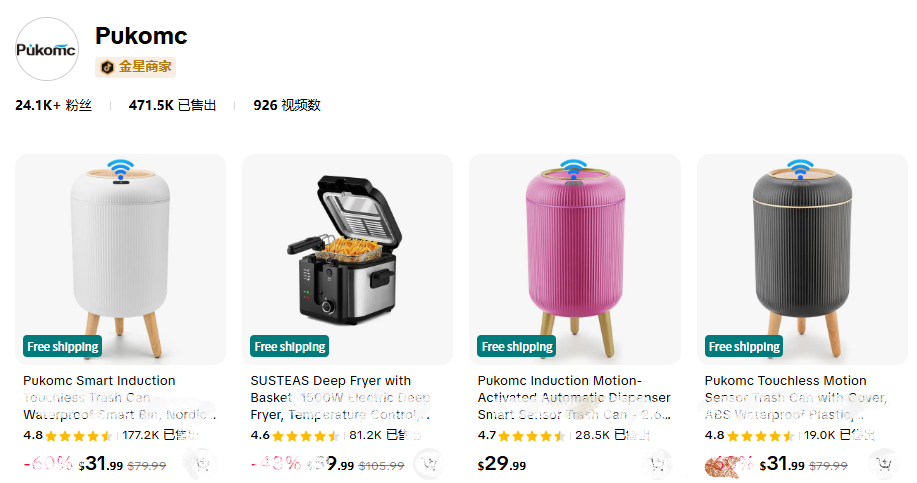
”Why are 'high-tech kitchen appliances' with dozens of patents of their own ignored in the US market, while Pukomc's trash cans and simple electric griddles, which have little technical threshold, can frequently top TikTok sales charts?
The answer to this question is actually very simple, but many people are unwilling to accept it: it's not that your product technology isn't strong enough; it's that you lack the ability to turn the product into content.
According to third-party store data, Pukomc's annual sales on TikTok have already exceeded $3.43 million, and total sales volume has reached 471,500 units.
So, how exactly did this brand become successful?

Image source: TikTok Shop
Turnordinary trash canintoshort video material
The Pukomc brand does not take a 'high-tech' route. Its product line covers household care products, with prices ranging from $1.47 to $371.99, an average order value of about $41.99, positioning it in the mid-to-high-end segment.
What really made it take off on TikTok is the smart sensor trash can category.

Image source: TikTok Shop
A trash can does sound like there's not much to talk about. But Pukomc's approach is: not to talk about it as a trash can, but to turn it into action material suitable for short-video display.
Infrared sensing, no touch required, waterproof design, Nordic modern style—these selling points do not need complicated explanation; a video of a few seconds can explain them clearly.
Creators don't even need to spend time introducing the brand; they only need to shoot a very simple scene: hands are covered with something and it is inconvenient to touch the trash can, the hand approaches, and the trash can opens automatically. Users immediately know what problem this thing solves. This kind of 'before-and-after action comparison' is itself content.
This logic is especially valid in the household small goods category. Because consumers do not need to understand the technical principles; they only need to see 'what this thing is actually useful for.'

Image source: TikTok
Trends are pushing this category forward
From the perspective of the broader market environment, what Pukomc has tapped into is not an isolated demand.
American consumers' demand for household goods is increasingly emphasizing convenience and efficiency. Research on the kitchen appliance market shows that consumers' preference for automation, cost efficiency, and convenience has become an important factor driving the market.
Although the smart trash can is only a niche product within household goods, it fits this consumer logic: it does not require learning a complicated new way of use; it simply makes an action that originally needed to be done manually more convenient.

Image source: grandview research
At the same time, TikTok Shop itself is also continuously expanding the scale of the US market.
Data from Momentum Works shows that TikTok Shop's US market GMV reached $15.1 billion in 2025, a year-on-year increase of 68%, and compared with $9 billion in 2024, it continues to maintain rapid growth.
This means that for products such as home goods and small appliances, TikTok is no longer just a platform for brand exposure, but has gradually become a sales channel capable of directly completing 'content seeding—product display—order conversion'.
Pukomc's growth, in essence, is also the meeting of product demand and the platform's consumption model.

Image source: Momentum Works
Turning creators into 'sales entry points'
Back to Pukomc's TikTok playbook, the phrase 'turning creators into sales entry points' is not rhetoric, but its actual operating structure.
At present, the brand has collaborated with 31,600 creators, with a total of 72,500 sales videos. In the past 30 days alone, 1,868 new creators joined promotions, and 2,690 new sales videos were published. Over the past year, creator-driven sales accounted for 92.5% of the store's total revenue, with sales of about $3.43 million.
In other words, this brand has bet almost all of its sales on creators, and the content of the brand's official account is more like a 'display window' for the entire sales system rather than the main source of transactions.

Image source: kalodata
The reason this model works is directly related to Pukomc's creator screening logic.
Unlike many brands, when selecting creators to collaborate with, Pukomc did not blindly follow top influencers, but is more inclined to work with tail creators.
Tail creators have follower counts ranging from tens of thousands to hundreds of thousands, and the cost of a single collaboration is far lower than that of top influencers, but their content conversion efficiency is not low. The reason is that purchase decisions in the home daily necessities category do not rely on 'celebrity endorsement' but on 'scenario recognition'.

Image source: kalodata
For example, TikTok creator @shopwithzachdavani is a good example. His account bio itself emphasizes 'finding practical and unique products,' and he is a fairly typical content creator in the product discovery and product review category.
In videos related to Pukomc, this content attribute fits the product itself well: there is no need to spend a lot of space introducing brand background; instead, the product is directly placed into the content logic of 'discovering a practical good product,' letting users see the product first and then judge whether they have a need. According to current data, this video reached 3.68 million views and generated about $59,600 in sales.

Image source: TikTok
Livestreaming is also part of Pukomc's creator matrix.
In the past 30 days, the brand's total livestream promotion sessions reached 3,700+, and livestream transaction value accounted for 83% of total transaction value.
The rhythm of livestreaming and short videos complements each other: short videos are responsible for repeatedly reaching potential users in the feed, while livestreaming provides a venue for immediate conversion after users become interested.
The combination of the two keeps Pukomc's products in TikTok's ecosystem in a state where they can be 'seen at any time and bought at any time.'

Image source: kalodata
Take creator @michaels.gifts as an example. Their account has only 6,728 followers, but their content positioning is very direct; the homepage bio is about finding recommended home goods every day. From Pukomc's data over the past 30 days, this creator contributed $75,700 in sales, of which livestream transaction value reached $75,600, almost all from livestreaming, while video transactions were only $23.99.

Image source: TikTok
From the livestream clips, his livestreaming method is not particularly complicated either: the camera stays around the product itself for a long time, repeatedly showing the trash can's appearance, lid-opening method, internal space, and actual usage scenarios, so users can intuitively see what the product is and how to use it.
This type of livestreaming actually fits Pukomc's product characteristics very well. For small home goods, consumers often do not place orders because they understood a complex product introduction; rather, after repeatedly seeing the product in the livestream, confirming its appearance and functions, and then combining that with price and discounts, they make a purchase decision.

Image source: kalodata
Conclusion
Looking beyond the Pukomc case, when domestic companies enter overseas markets, there is actually no need to set the goal from the outset as “building a globally renowned brand”.
For many small and medium-sized enterprises, a more realistic path is to first find a product that overseas consumers truly need and that is also suitable for content dissemination, and then validate the market through different channels.
Especially on content e-commerce platforms like TikTok and TikTok Shop, what consumers see is not necessarily an enterprise with a massive brand history, but may simply be a product that solves a small everyday inconvenience.
Overseas markets are still large, but the opportunity is no longer just “selling products abroad”.
What this signal means for growth teams
This market signal should be treated as an operating prompt, not a standalone trend. The brand question is whether the team can connect TikTok content, creators, paid media, commerce readiness, and reporting into one measurable growth cycle.
Commercial read
- Market signal: TikTok marketing tips - short video marketing methods
- Published: September 18, 2026
- Commercial lens: TikTok Ads, creators, TikTok Shop, live commerce, and reporting.
- Source transparency: the original source linked in this article
What brands should do next
- Identify the market, audience, product group, and KPI this signal could affect.
- Turn the insight into a small TikTok creative, creator, Shop, or paid media test before scaling spend.
- Add FAQ, offer clarity, product proof, and contact paths so traffic can convert instead of only reading.
- Review weekly performance across reach, click quality, Shop actions, creator output, and revenue impact.
Tuke Marketing helps brands connect TikTok Ads, creator partnerships, TikTok Shop operations, live commerce, and reporting into one accountable operating system.
What should brands do with this TikTok signal?
Brands should translate the signal into a focused operating test across creative, creators, TikTok Shop readiness, paid media, and reporting before increasing budget.
How does Tuke Marketing evaluate this kind of news?
Tuke Marketing reviews platform news through market timing, category demand, creator supply, commerce readiness, and measurable growth actions.
When should a team contact Tuke about this topic?
A team should contact Tuke when it needs to turn a TikTok market signal into a practical launch, creator, advertising, live commerce, or reporting plan.
Source transparency: Tuke cites the original source linked in this article and adds its own operating analysis for brands evaluating TikTok growth decisions.