
This year's Black Friday falls on November 27. Looking at the calendar, there are still over two months, but stocking up is not counted backward from Black Friday. Confirming the product pallet, placing production orders, running first-leg ocean freight, and clearing customs into the warehouse — the whole chain typically takes more than 45 days, and in between there is the National Day holiday — factories shut down for seven days, and you can't do anything.
After deducting that time, the true decision-making window left to sellers closes by the end of September.
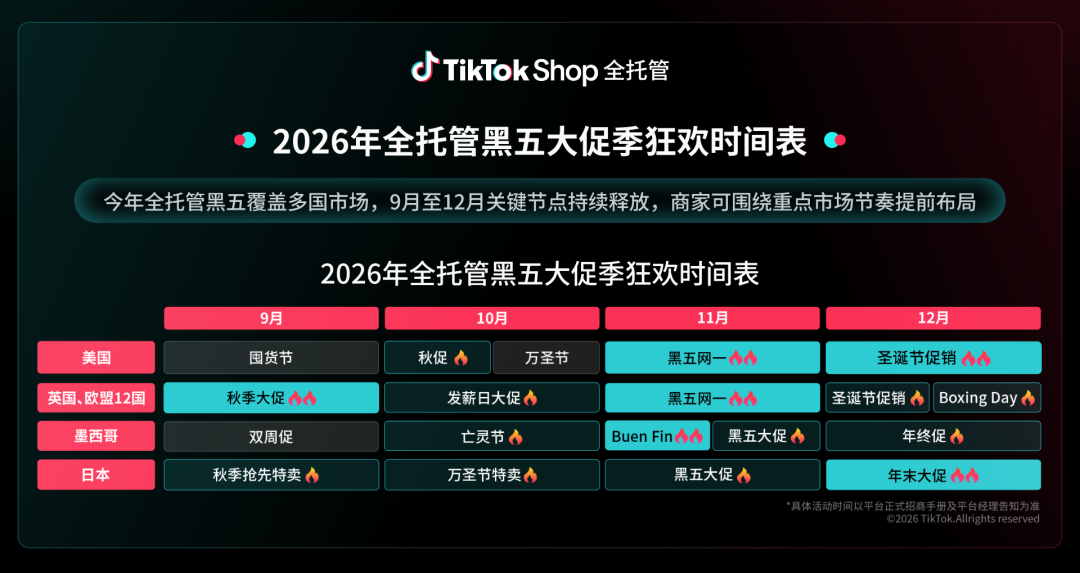
And this year, this window is worth more than it was in previous years.TikTok Shop Full-Managed service has, for the first time, expanded the Black Friday promotional season to 16 countries: the U.S., the U.K., 12 EU countries, Mexico, and Japan.The schedule runs from September all the way to December, with the autumn promotion, Halloween, Black Friday and Cyber Monday, Christmas, and year-end sales events taking turns.That spans more than 90 days in total.。

Image source: TikTok Shop Full-Managed official
Last year's report card gave the platform the confidence to scale. During the 2025 Black Friday and Cyber Monday, Full-Managed global business doubled versus mid-year; the U.S. and U.K. markets hit historic peaks, and new markets in Mexico and Europe grew at multiple-fold rates.
On this foundation, the platform's operating direction for this year's Black Friday is four words: 'superior goods win by quality.' Translated into language sellers can act on, it means exposure and resources are no longer distributed evenly, but are concentrated on products with excellent quality, competitive pricing, and market demand. Stores that follow the broad-listing route will be systematically screened out in this round. The platform's filter has only two categories: quality selection, and novel/unique items.
So the key move for preparing this year is not to stack up more products, but to cut SKUs: converge your promoted SKUs down to a few truly competitive styles, then fully execute stocking, content, and registration around those styles.
Four operational steps form one timeline.
How exactly? The official side gave four steps: product selection and stocking, content accumulation, activity registration, and fulfillment. These four steps are not parallel options; they are a timeline — if the order goes wrong, everything breaks down.
In September, do product selection and lock up production capacity. Apparel uses JIT mode to quickly launch styles, tests high-potential styles, then uses small-batch quick reorders to lock in capacity for core styles in advance. For the comprehensive industry, the product pallet is split into two lines: quality-selected products should focus on autumn/winter replacement, feature upgrades, and festival gifting demand; novel/unique products should seek differentiated styles from sub-segments such as pets, office, sports and outdoor. These products get exposure support and a green channel for item recruitment.
In October, move into content accumulation and activity registration. Arrange influencer sample sending, test selling points with short video, and scale up promotion after the content model is proven; meanwhile, submit for Super Single Item, Black Friday Category Day, and Brand Gala according to backend qualifications.
November to December is the field burst phase. Follow actual sales data for rolling replenishment — don't cram all inventory in at once.

Image source: TikTok Shop Full-Managed official
Five markets: where should the money be placed?
Beyond the product pallet, the second decision is the market. The five markets differ greatly in pace and operating style, which directly determines the stocking structure:
Why is it arranged this way? The U.S. is the only market with last year's data to reference, so it deserves concentrated resources for a small number of core bestsellers. Mexican consumption moves with biweekly payday cycles; Day of the Dead, El Buen Fin, and Black Friday are the three main handles, so spreading bets across the long tail is a waste. The newly opened 8 EU countries have no historical data; the safe approach is to use AIGC to batch-produce multilingual assets and test on a small scale. Japan's key is the price band — this year the platform launched a 1,000-yen shopping zone. Submit traffic-driving products by price band, then use associated products to capture additional purchases.

Image source: TikTok Shop Full-Managed official
Fulfillment also has new changes this year. The U.S. market supports adding overseas warehouse selling on top of the original store and listing, offering faster delivery and lower costs; eligible products also get exclusive labels and exposure positions. The EU has simultaneously opened two models: overseas warehouse and local hosting. Large-size products now, for the first time, have a smooth entry channel. Sellers going to the EU should immediately confirm the VAT and product qualifications of the target markets, choose a model by product type, and start Black Friday stocking and shipping at the same time.
Two new variables — don't bet heavily on them.
Livestream auction is the new feature most worth watching this year. It will roll out in the U.S., U.K., and EU starting from September. It is not for low-price clearance; it relies on limited-time interaction to raise the perception of value, and suits products with strong display appeal and high perceived value — accessories benefit first. But the feature has just launched with no mature precedent, so test it on a small scale first and scale up after data comes out.
Image-text and AIGC are another low-cost line. Image-text is suitable for pre-event style testing; AIGC solves the production capacity problem of multilingual content. Both are supplements to the short-video main battlefield — don't let them steal the limelight.
Finally, let's recalculate the time schedule once more.
Complete order placement and production before the National Day shutdown, and ship by sea before early October. Black Friday is on November 27, and your deadline is the end of September.

Image source: TikTok Shop Full-Managed Official
What this signal means for growth teams
This market signal should be treated as an operating prompt, not a standalone trend. The brand question is whether the team can connect TikTok content, creators, paid media, commerce readiness, and reporting into one measurable growth cycle.
Commercial read
- Market signal: TikTok Marketing Information and Solutions
- Published: September 8, 2026
- Commercial lens: TikTok Ads, creators, TikTok Shop, live commerce, and reporting.
- Source transparency: the original source linked in this article
What brands should do next
- Identify the market, audience, product group, and KPI this signal could affect.
- Turn the insight into a small TikTok creative, creator, Shop, or paid media test before scaling spend.
- Add FAQ, offer clarity, product proof, and contact paths so traffic can convert instead of only reading.
- Review weekly performance across reach, click quality, Shop actions, creator output, and revenue impact.
Tuke Marketing helps brands connect TikTok Ads, creator partnerships, TikTok Shop operations, live commerce, and reporting into one accountable operating system.
What should brands do with this TikTok signal?
Brands should translate the signal into a focused operating test across creative, creators, TikTok Shop readiness, paid media, and reporting before increasing budget.
How does Tuke Marketing evaluate this kind of news?
Tuke Marketing reviews platform news through market timing, category demand, creator supply, commerce readiness, and measurable growth actions.
When should a team contact Tuke about this topic?
A team should contact Tuke when it needs to turn a TikTok market signal into a practical launch, creator, advertising, live commerce, or reporting plan.
Source transparency: Tuke cites the original source linked in this article and adds its own operating analysis for brands evaluating TikTok growth decisions.