
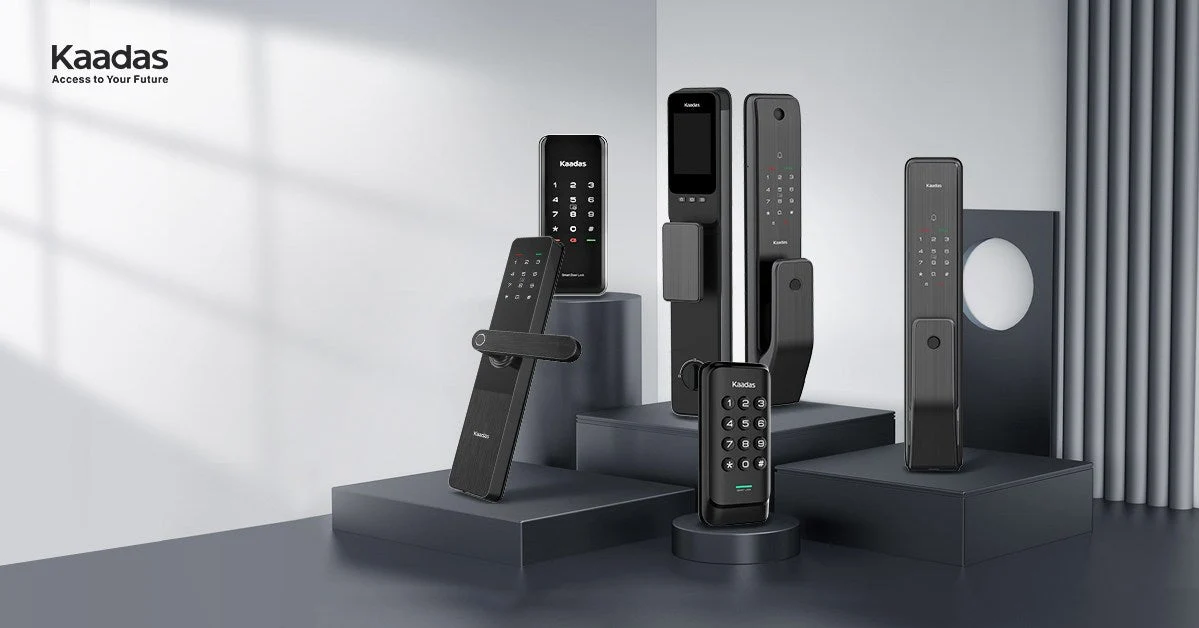
In the landscape of Chinese brands going overseas, Shenzhen is an unavoidable city.
From drones and consumer electronics to smart homes, players keep emerging here to take global market share.
And in the smart door lock track—seemingly traditional but actually fiercely competitive—another Shenzhen brand has quietly risen to the top.
With cumulative sales exceeding 10 million units, it has been certified by internationally authoritative consulting firm Frost & Sullivan as the world's No.1 in both global high-end smart lock sales volume and sales revenue in 2025.
It isKaadas。
This is not a company that suddenly emerged on a trend. Its story is much longer than most people imagine.

Source: Google
A relay between two generations, starting from a mechanical lock
Let's go back to the 1980s.
In 1988, founder Mr. Su entered the traditional lock industry, deeply engaged in the production and sales of mechanical locks. In that era without the concept of smart homes, a lock was just a lock—what mattered was sturdiness, durability, and theft prevention.
Mr. Su's mechanical lock business was not small. At its peak, annual sales reached 20 million sets, and the company's revenue exceeded 100 million yuan. If he had continued on that path, this might have been the trajectory of a typical traditional manufacturing enterprise.
The turning point came in 2005. While on a business trip in Germany, Mr. Su noticed a smart door lock priced quite high in the local market.
Relying on his intuition cultivated over many years in the lock industry, he realized that "not carrying keys" would become a rigid need for many families in the future. Plus, his own experience of forgetting keys amplified that pain point in his mind.
After returning to China, he decided to transform into smart locks, and in 2009 officially founded the Kaadas brand.

Source: Google
But in 2009, smart locks had very few consumers in China; consumers didn't recognize them, and the channels were not mature.
So Mr. Su, then over forty, left his familiar environment and went to Shenzhen to recruit new people and build a team, gradually cultivating the market through engineering channels and offline stores.
In 2013, he even officially moved the headquarters to Shenzhen, staying there for well over a decade.
The next generation takes the stage, and the brand accelerates
The real acceleration came after the next generation joined.
Mr. Su's son, Young Mr. Su, joined the company and led three key strategic moves:
First, in October 2016, they launched the Bluetooth push-pull smart lock K7, which broke Taobao crowdfunding records, became a hit product in the industry, and directly made push-pull smart locks the mainstream form.
Second, they signed Liu Tao, the star of the hit urban drama "Ode to Joy," as the brand ambassador, and heavily advertised on CCTV prime time, high-speed rail, and at airports.
According to the interview content disclosed by Tianxia Wangshang, after the K7 became a viral hit, Kaadas’s first-year revenue exceeded 100 million yuan, seizing the market share that Samsung had previously held in China.

Image source: Google
But no matter how large the domestic market is, it has a ceiling. The third strategic move Mr. Xiao Su got right was taking the brand overseas.
Unlike before, when it only focused on its own small patch of domestic territory, Kaadas shifted its development focus to going global, transforming from a pure lock seller into a smart home security brand.
Multi-platform support: putting locks on shelves worldwide
Many people can’t help wondering: Is there really an opportunity for smart locks to go global?
The answer is yes.
1. For example, smart lock penetration in North America leads the world, and the local DIY installation culture is prevalent, so producing products that users can install themselves has a strong market;
2. Southeast Asia, due to its geographical location, has a hot and humid climate, resulting in a huge rental market and strong demand for lock replacement;
3. The Middle East strongly prefers intelligent high-end security, where safety is the core consideration, so high-quality smart locks have higher market potential than in most regions;
4. The European market attaches particular importance to privacy protection and product compliance; as long as it is a brand-name lock with compliance qualifications, there are huge business opportunities.

Image source: Google
Thus, after identifying the demand in overseas markets, Kaadas launched its overseas expansion in 2018. It did not simply ship goods out; it used a combined strategy of multi-channel support.
Offline, it cooperates with large local home-improvement retail giants such as Home Depot and Lowe’s, while also continuing to open up sales channels through overseas distributors, agents, apartment real estate projects and other engineering channels.

Image source: Google
Online, besides mainstream e-commerce platforms such as Amazon, Shopee, Lazada, Walmart, eBay, and Temu, it also built multiple independent websites tailored to different market segments.
The significance of independent websites is not just having one more sales entrance; more importantly, it is about accumulating private-domain traffic. Through product details, installation tutorials, after-sales support and other content, it keeps customer data in its own hands and gradually reduces its reliance on third-party platform traffic.

Image source: Kaadas
According to the brand introduction published on its official website, Kaadas products have sold well in 36 countries and regions worldwide, with cumulative sales exceeding 10 million units.
It was also certified by international authoritative consulting firm Frost & Sullivan as the world’s No.1 in both sales volume and sales value of high-end smart locks in 2025, making it an undisputed leader among Chinese smart lock brands going overseas.

Image source: Google
How to choose a smart lock?In short videosSelfThere is an answer.
But smart locks are not the same as ordinary consumer products. The biggest concern for consumers before buying is: What exactly is smart about it? Is installation troublesome? Is it convenient for daily use?
These questions cannot be explained clearly with a few product images, but short videos can.
To create localized content that locals love to watch, Kaadas has established dedicated brand accounts in multiple target countries, including Vietnam and Singapore.
Among them, @kaadasSg, the account created for the Singapore market, is especially representative.
Despite having only a few thousand followers, it produced a viral video with more than 2.1 million views.

Source: TikTok
With just 23 seconds of content, it enabled potential buyers to grasp multiple functions of the Kaadas smart door lock, including checking the situation outside the door in real time through the app on their phones and recording visitor information.
When such on-screen demonstrations let users perceive convenience, safety, and ease of use, their sense of immersion naturally grows, and their purchasing desire is subtly and naturally stimulated.

Source: TikTok
Of course, brand accounts are only one approach; Kaadas also has another approach: influencer collaboration.
To put it plainly, many users are naturally wary of brands talking about themselves, but they are more willing to listen to trusted influencers.
Among the many smart-home vertical influencers Kaadas has worked with, @Review Master is a very typical example.
He used 'Smart lock or ordinary lock, which one would you choose?' as the theme and made the most direct functional comparison between a traditional key-operated door lock and a Kaadas smart door lock. During the testing of the two locks' functions, the smart lock's convenience and speed were highlighted—fingerprint, password, and card swiping can all unlock it.
In the comment section, many users directly asked about prices, and the conversion effect was quite obvious.
The logic behind this content strategy is not complicated: it is not that users don't want to buy, but that they need a moment that makes them feel immersed. Short videos and influencer content happen to serve exactly this purpose.

Source: TikTok
Conclusion
It took Kaadas more than 30 years to go from making a mechanical lock to achieving the world's No.1 in both sales volume and sales revenue for high-end smart locks.
But compared with the brand's own story, more attention should be paid to its many correct decisions.
First:When facing transformation, execution matters more than imagination. Many companies are not blind to new opportunities; they are just reluctant to leave the comfort zones they already have. Trends never belong to those who see them first, but to those who act first.
Second:Going overseas is not a hit-and-run game; rather, it is about turning every channel into a brand asset, not becoming a tenant renting platform traffic.
Third:How do you get users overseas who have never heard of your brand to be willing to place an order? It comes down to content. Translate product features into value users can perceive. Whoever tells a better story is more likely to earn a premium.
What this signal means for growth teams
This market signal should be treated as an operating prompt, not a standalone trend. The brand question is whether the team can connect TikTok content, creators, paid media, commerce readiness, and reporting into one measurable growth cycle.
Commercial read
- Market signal: TikTok marketing tips - short video marketing methods
- Published: September 7, 2026
- Commercial lens: TikTok Ads, creators, TikTok Shop, live commerce, and reporting.
- Source transparency: the original source linked in this article
What brands should do next
- Identify the market, audience, product group, and KPI this signal could affect.
- Turn the insight into a small TikTok creative, creator, Shop, or paid media test before scaling spend.
- Add FAQ, offer clarity, product proof, and contact paths so traffic can convert instead of only reading.
- Review weekly performance across reach, click quality, Shop actions, creator output, and revenue impact.
Tuke Marketing helps brands connect TikTok Ads, creator partnerships, TikTok Shop operations, live commerce, and reporting into one accountable operating system.
What should brands do with this TikTok signal?
Brands should translate the signal into a focused operating test across creative, creators, TikTok Shop readiness, paid media, and reporting before increasing budget.
How does Tuke Marketing evaluate this kind of news?
Tuke Marketing reviews platform news through market timing, category demand, creator supply, commerce readiness, and measurable growth actions.
When should a team contact Tuke about this topic?
A team should contact Tuke when it needs to turn a TikTok market signal into a practical launch, creator, advertising, live commerce, or reporting plan.
Source transparency: Tuke cites the original source linked in this article and adds its own operating analysis for brands evaluating TikTok growth decisions.