
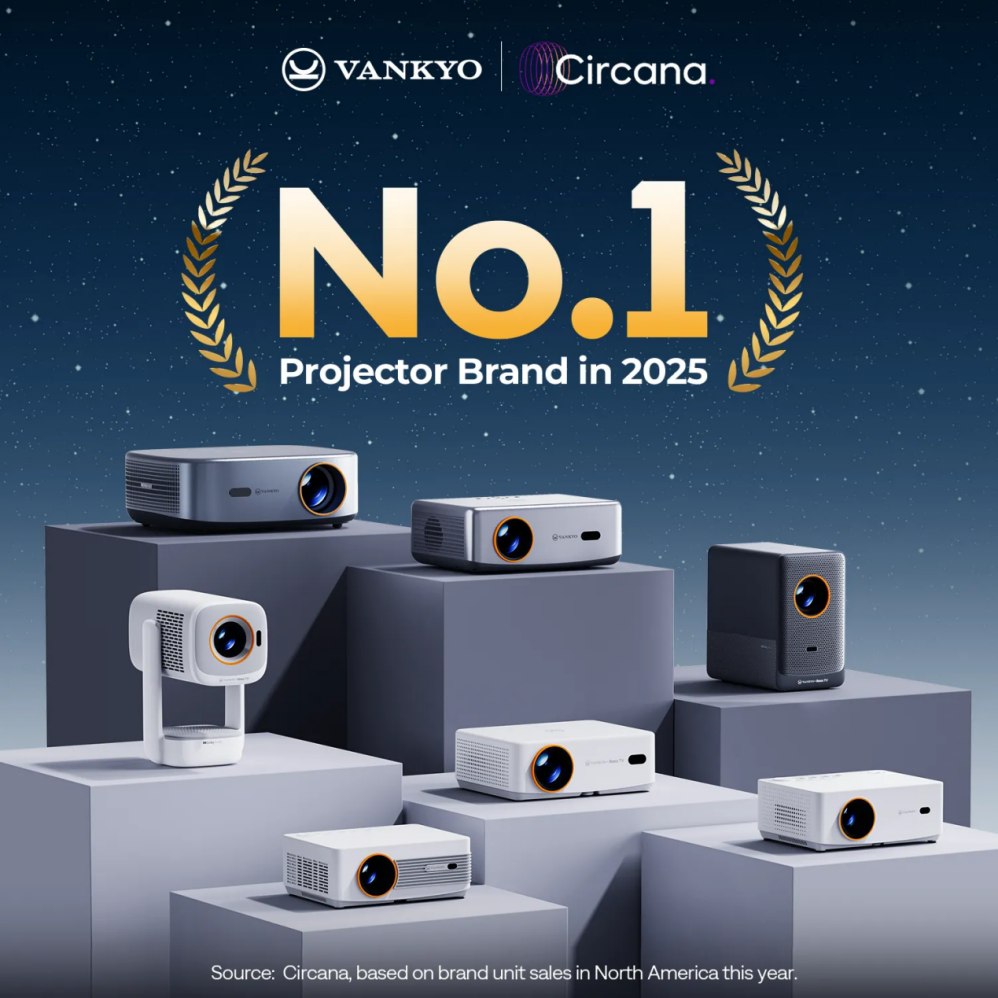
In the cross-border e-commerce circle, while many sellers are still worrying about product selection, a Shenzhen brand has long broken away from the OEM rat race, directly “storming” into North American living rooms with home projectors, even becoming a reason for American young people to abandon TV.
It isVANKYO。
According to data from Circana, a globally authoritative market research firm, this brand has consistently dominated the No.1 spot in North American projector sales. And its initial story is nothing more than a foreign student “setting up a stall” on Amazon to sell digital accessories.

Image source: Google
From reselling goods to building a self-owned brand, an international student's supply chain awakening
More than ten years ago, founder Vincent was studying in the United States. Like many work-study students, he set his sights on Amazon and started cross-border retail. He put Shenzhen Huaqiangbei's 3C products online and sold them to overseas consumers.
Although this OEM model made a price difference, problems followed one after another: suppliers could ship today but might cut off supply tomorrow; product quality was uneven; as customer complaints increased, store ratings dropped sharply.
Vincent realized that without his own brand and supply chain, he would always be working for others' benefit and could be eliminated by the market at any time.
After seeing these industry pain points clearly, he decided to return to China to create his own brand.
In September 2017, Shenzhen Vantop Innovation and Technology was officially established, and the VANKYO brand was incubated simultaneously. The direction was clear: not to focus on complex large home appliances, but to concentrate on the home smart projector track.
At that time, North American young people were tired of the bulky and fixed settings of traditional TVs. The renting crowd and student crowd had no resistance to lightweight entertainment that could project a blockbuster onto a white wall.
What VANKYO wanted to do was to fill this market gap with high-cost-performance portable projectors.

Image source: Google
Winning the Amazon sales title in the first year relied on strong localization strength
In February 2018, VANKYO launched its first product on Amazon US. Surprisingly, this new brand hardly experienced the so-called cold start.
According to Vantop Innovation's official development milestones:
In July of that year, it won the Amazon North America single-item projector sales championship; by December, it directly topped the market share ranking in the Amazon US projector category, pushing Vantop Innovation's overall annual sales beyond the 100 million yuan mark.
Why was it so fast? The key was not low price, but rather that it understood North American users extremely well.
Many Chinese projectors going overseas obsessed over hardware parameters, yet ignored the content ecosystem.
VANKYO's approach was straightforward. It built the Android/Roku system in, preloaded with mainstream streaming apps such as Netflix, Disney+, YouTube, and Prime Video.

Image source: Google
Users can log into their accounts and binge-watch episodes right after turning on the device, without needing an extra TV box, and without facing the awkward notice that the app is not supported in their region.
In addition, VANKYO's pricing strategy is also extremely precise, with its main models priced in the $100-300 range. For an ordinary American family, this price is equivalent to two or three restaurant meals, making the impulse purchase threshold very low.
The product line also fully covers everything from entry-level LCD models to high-end 4K laser models. Whether you want to casually watch in the bedroom or build a professional home theater, you can find a corresponding model.

Image source: Google
Don't put all your eggs in one basket: starting with Amazon, building walls with a standalone website
In terms of online channel layout, VANKYO took a path of first storing grain widely, then building high walls.
After gaining a foothold on Amazon, it quickly entered third-party platforms such as eBay, AliExpress, and Rakuten, forming a traffic moat.
But to be honest, platforms ultimately belong to others. Rule restrictions, risk of account suspension, and the inability to retain user data are all hidden dangers.
To this end, VANKYO set up its own official independent website. Unlike the hodgepodge display on third-party platforms, the independent website categorizes products by scenarios such as home, portable, laser, and flagship, and also has a dedicated bestseller zone.

Image source: VANKYO
New users won't be confused when they enter. Within a few minutes, they can lock onto their target model based on budget and usage, greatly shortening the purchase decision path.
This dual-track model of platform traffic generation + independent website conversion allows the brand to accumulate long-term stable user assets.
TikTok product seeding does not rely on top influencers, but focuses on life-like scenarios
But the most critical step is the next one—making good use of social media.
The VANKYO brand has a strong understanding of overseas young people's preferences, directly treating TikTok as its core seeding platform, using influencers' real-life scenarios to subtly win over users.
It did not blindly chase after top influencers, but instead chose to collaborate with mid-tier influencers in vertical fields, winning through authentic content and high conversion rates.
Among them, the most classic case is the collaboration with blogger @lucymassad.
Her follower count is not particularly large, only 292,300, but her content is extremely relatable and down-to-earth, with a strong sense of immersion. Her followers are also mostly home-oriented consumers.

Image source: TikTok
In the collaboration video with VANKYO, she genuinely shared her daily life in a small apartment. Without a traditional TV at home, she uses just a projector and a white wall to easily enjoy big-screen drama watching in the bedroom.
This lazy, comfortable home atmosphere perfectly hits the aesthetic of young people on TikTok. Currently, the video has received 2.2 million views and 174,100 likes, and the comments are all from users saying they've been influenced to buy.

Image source: TikTok
Of course, that's not all. In addition to the home drama-watching scenario, VANKYO is very good at comprehensive layout, targeting young people across different segments with two major popular scenarios: outdoor camping viewing and big-screen immersive gaming, penetrating user minds in an all-round way.
For example, camping influencer @Ryan Twomey filmed real outdoor camping footage—a simple white cloth and a projector allow easy open-air viewing in the wild at night, precisely hitting the needs of camping enthusiasts. Meanwhile, gaming influencer @Tussalty focuses on big-screen gaming, successfully entering the game player circle.
Through multi-scenario penetration, VANKYO has reached different interest groups, and user mindshare has been repeatedly reinforced.

Image source: TikTok
Three insights for cross-border going global
If your overseas brand truly wants to do well, grow bigger, and become stronger, then the following 3 tips are really worth boldly trying—what if one of the paths works out?
InsightOne:Understanding the target market's usage habits, content platform rules, and consumption aesthetics in advance is more important than simply competing on parameters.
InsightTwo:Using the right e-commerce channels and independent sites, walking on two legs, can both borrow strength to hit hard and leave yourself a fallback and a long road.
InsightThree:You need to penetrate from multiple scenarios; the finer the scenario, the stronger the user's sense of substitution, and the truer the purchase intention.
What this signal means for growth teams
This market signal should be treated as an operating prompt, not a standalone trend. The brand question is whether the team can connect TikTok content, creators, paid media, commerce readiness, and reporting into one measurable growth cycle.
Commercial read
- Market signal: TikTok marketing tips - short video marketing methods
- Published: August 28, 2026
- Commercial lens: TikTok Ads, creators, TikTok Shop, live commerce, and reporting.
- Source transparency: the original source linked in this article
What brands should do next
- Identify the market, audience, product group, and KPI this signal could affect.
- Turn the insight into a small TikTok creative, creator, Shop, or paid media test before scaling spend.
- Add FAQ, offer clarity, product proof, and contact paths so traffic can convert instead of only reading.
- Review weekly performance across reach, click quality, Shop actions, creator output, and revenue impact.
Tuke Marketing helps brands connect TikTok Ads, creator partnerships, TikTok Shop operations, live commerce, and reporting into one accountable operating system.
What should brands do with this TikTok signal?
Brands should translate the signal into a focused operating test across creative, creators, TikTok Shop readiness, paid media, and reporting before increasing budget.
How does Tuke Marketing evaluate this kind of news?
Tuke Marketing reviews platform news through market timing, category demand, creator supply, commerce readiness, and measurable growth actions.
When should a team contact Tuke about this topic?
A team should contact Tuke when it needs to turn a TikTok market signal into a practical launch, creator, advertising, live commerce, or reporting plan.
Source transparency: Tuke cites the original source linked in this article and adds its own operating analysis for brands evaluating TikTok growth decisions.