
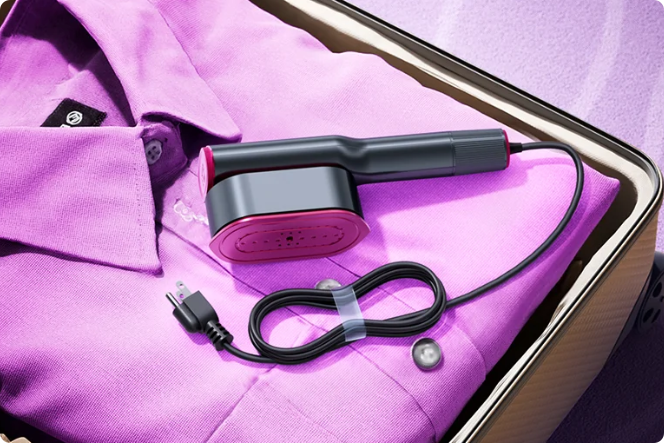
If you are a small home appliance brand just going overseas, with insufficient budget and no top livestreamer resources, facing increasingly fierce traffic competition on TikTok, where should you start?
Two years ago, many people's first reaction to this question might have been 'find big livestreamers to promote' or 'throw money at paid traffic'.
But a brand from Shenzhen gave the answer with a completely different approach—no head influencers, no livestream wars, no paid traffic—relying only on short videos from thousands of ordinary influencers, selling over 540,000 handheld garment steamers in the US TikTok market, with total store sales exceeding $19,643,600.
The brand is calledDr.Flash。

Source: Dr.Flash
Cheap, but 'cheap' with a strategy
Dr.Flash's most direct competitiveness is reflected in its pricing. The final retail price is $34.98, compared to the original listed price of $84.99, a direct discount of nearly 60%. Coupled with the store-wide free shipping policy, the entry threshold for consumers has been lowered to an extremely low level.
But behind the low price is not selling at a loss for attention. Looking solely at profit margins, according to public information, domestic source factories are concentrated in the Pearl River Delta industrial belt, with a purchasing cost of approximately 50 RMB.
And with a TikTok US market price of $34.98, equivalent to about 235 RMB, the premium space is considerable. Coupled with a high 10% commission on single items, it has continuously driven a large number of influencers to promote and sell spontaneously.
In other words, Dr.Flash opened up the market with a highly attractive final price, while using sufficient profit margins and commission incentives to keep the entire distribution chain running.

Source: TikTok Shop
Industry trend: The 'timing' for small home appliances going overseas
The fact that Dr.Flash found opportunities in overseas markets is also related to the growth of the garment care industry itself.
According to Grand View Research data, the global garment steamer market was approximately $3 billion in 2023, and is expected to reach approximately $4.5 billion by 2030, with a compound annual growth rate of 5.8% from 2024 to 2030.
Among them, apparel care holds the largest application market share, with revenue accounting for 54.8% in 2023; at the same time, online channels already account for 84.9% of the market share.

Source: Grand View Research
This means that garment care is not a short-term viral product track entirely 'created' by TikTok, but already has relatively clear consumer demand.
More importantly, consumer demand for such products is gradually shifting from 'can it iron out wrinkles' to 'can it iron out wrinkles more conveniently'.
Grand View Research points out that consumer demand for efficient, portable, and easy-to-operate garment care products is increasing, especially handheld products, which better meet the requirements of urban consumers and travelers for saving time and reducing storage space.
This gives a product like Dr.Flash an entry point: no need to educate consumers on why they should organize clothes, only need to tell consumers that there is a lighter and faster way to solve the original problem.

Source: TikTok
Instead of competing for top livestreamers, hand traffic over to 'small influencers'
If you look closely at Dr.Flash's TikTok strategy, you will find that the most noteworthy aspect is not 'how many big influencers they found', but quite the opposite—it relies more on a large number of micro and small creators.
According to its TikTok marketing data, in the past 30 days, Dr.Flash's cumulative transaction amount reached $1.2674 million, of which affiliate creators contributed $1.1249 million, accounting for 88.76%; the brand's own account transaction amount was $141,200, accounting for 11.14%, and the mall's natural transactions accounted for a relatively low proportion.
At the same time, during this period, a total of 1,915 affiliate creators participated in content promotion and published 2,200 related videos or livestream contents.


Image source: kalodata
The core logic of this approach is actually very easy to understand.
A top creator's single post may bring a lot of traffic, but the cost is also higher; while a large number of small creators, although each account has few followers, can continuously produce content, making the product appear repeatedly across different user segments.
For example, TikTok creator @simplysteamed_ has only 3,543 followers, but through more than 70 videos brought about $272,800 GMV for the product; another creator @elena_homehacks with only 4,459 followers also contributed about $114,400 GMV.

Image source: kalodata
These cases show that in TikTok Shop's content e-commerce system, the number of followers does not necessarily equal final transaction capability.
For small home appliance brands, instead of betting limited budgets on a single top creator, it is better to let more creators participate in testing, and then screen out accounts that can truly drive sales from a large amount of content.
Turning complex product selling points into videos that anyone can shoot.
Of course, having a large number of creators does not necessarily mean scale can be achieved.
One more thing Dr.Flash did was to make content production simple enough.
From the materials, its creator content basically revolves around a very clear three-part structure: first showing pain points such as clothing wrinkles and the inconvenience of traditional ironing; then directly comparing the effect before and after ironing; finally emphasizing features like quick wrinkle removal, portability, and simple operation.

Image source: TikTok
Such content has a huge advantage: low replication cost.
Creators do not need to set up complex scenes specifically, nor do they need to spend a lot of time researching the product.
For example, a promotional video posted by creator account @simplysteamed_, which recently contributed a relatively high transaction amount, perfectly reflects this content logic.
The video does not directly introduce the product at the beginning, but starts from the life scenario of 'improving wardrobe experience', attracting users' attention by showing clothing wrinkle problems. The entire video has no complicated product explanations, but uses a simple 'before use - during use - after use' process to let consumers quickly understand what problems this product can solve.

Image source: TikTok
From the data performance, this video accumulated 18.6481 million views on TikTok, and brought $162,600 in transaction amount, while advertising spend was about $35,400, and advertising ROAS reached 3.66.
For a small home appliance that needs to demonstrate usage effects, this type of content centered on real experience can not only increase exposure, but also directly drive conversions.

Image source: kalodata
From a hit product to a larger sales channel.
At present, Dr.Flash does not regard TikTok as the only sales channel.
The brand has already expanded into channels such as Walmart, Amazon, and domestic e-commerce platforms.
At the same time, the TikTok store continues to expand its product range.
In addition to the original portable garment steamer, Dr.Flash is now selling larger-capacity steam ironing products on TikTok Shop. For example, a 270ml, 1400W suction garment steamer from its Dr.Flash Home store has already achieved sales of over 8,000 units.
This shows that for a brand going global, what is truly valuable is not a single hit product itself, but whether, after the hit product succeeds, the brand can further consolidate its brand, channels, and product matrix.

Image source: TikTok Shop
Final Thoughts
For domestic enterprises, there are still many opportunities worth exploring in overseas markets.
Especially in mature categories such as small home appliances, household goods, and consumer electronics, domestic supply chains have accumulated fairly strong product development and manufacturing capabilities. What really needs to be solved is often not 'whether there are products,' but whether one can find usage scenarios suitable for local consumers and express the value in a way that local consumers can understand.
In the past, when doing business overseas, companies often had to first solve issues of channels, advertising, and brand awareness; now, content platforms are lowering part of the entry barrier. As long as a product is distinctive enough, it has the opportunity to gain its first batch of consumers through creator content.
What this signal means for growth teams
This market signal should be treated as an operating prompt, not a standalone trend. The brand question is whether the team can connect TikTok content, creators, paid media, commerce readiness, and reporting into one measurable growth cycle.
Commercial read
- Market signal: TikTok marketing tips - short video marketing methods
- Published: August 21, 2026
- Commercial lens: TikTok Ads, creators, TikTok Shop, live commerce, and reporting.
- Source transparency: the original source linked in this article
What brands should do next
- Identify the market, audience, product group, and KPI this signal could affect.
- Turn the insight into a small TikTok creative, creator, Shop, or paid media test before scaling spend.
- Add FAQ, offer clarity, product proof, and contact paths so traffic can convert instead of only reading.
- Review weekly performance across reach, click quality, Shop actions, creator output, and revenue impact.
Tuke Marketing helps brands connect TikTok Ads, creator partnerships, TikTok Shop operations, live commerce, and reporting into one accountable operating system.
What should brands do with this TikTok signal?
Brands should translate the signal into a focused operating test across creative, creators, TikTok Shop readiness, paid media, and reporting before increasing budget.
How does Tuke Marketing evaluate this kind of news?
Tuke Marketing reviews platform news through market timing, category demand, creator supply, commerce readiness, and measurable growth actions.
When should a team contact Tuke about this topic?
A team should contact Tuke when it needs to turn a TikTok market signal into a practical launch, creator, advertising, live commerce, or reporting plan.
Source transparency: Tuke cites the original source linked in this article and adds its own operating analysis for brands evaluating TikTok growth decisions.